

Exchange students (non-Erasmus) & Free Movers
Short-term mobilities for study, training or research, hosted at Alexandru Ioan Cuza University of Iasi (UAIC) within the framework of its inter-institutional bilateral agreements (exchange students) or those of free movers are undertaken in accordance with the priorities set into place for the development of the institution’s international cooperation scheme.
Exchange students and free movers are non-degree seeking students and, upon finalizing their mobilities, they shall return to their home university, for the completion of their studies.
Reception of inbound exchange students and free movers shall be organized in accordance with the applicable national legislation and the UAIC operational internal regulations in force, concerning the financial conditions for the reception of international students.
REGULATIONS
EXCHANGE STUDENTS
An exchange student within the framework of an academic partnership is a student enrolled in an accredited higher education institution from abroad with which UAIC has an operational bilateral agreement or from a member institution in a multiple partnership (Coimbra Group, Utrecht Network, CUMRU) and who is interested in carrying out a study, training or research mobility at UAIC.
Exchange students are exempted from paying tuition fees at UAIC, unless otherwise decided within a specific cooperation agreement.
APPLICATION FORM AND REQUIRED DOCUMENTS
In order to obtain the approval of the mobility:
- letter of nomination issued by the home university;
- Application form;
- partial Transcript of Records for the degree programme where the student is currently enrolled;
- copies of the diplomas/certificates for the completed academic studies (MA and PhD students);
- letter of recommendation from the academic advisor at the home university (PhD students only).
Before the start of the mobility, accepted candidates will submit:
- signed Learning Agreement (mobility for studies or training);
- signed Academic Mobility Protocol EN/FR (mobility for research);
- pre-acceptance from an academic coordinator in UAIC (PhD students only);
- certificate of language proficiency.
In view of being issued the letter of acceptance to studies by the Romanian Ministry of Education and Research (MER), students who are citizens of non-EU/EFTA countries are required to send the following documents:
- MEC’s application form for the issuance of the acceptance to studies, duly filled in, including photos;
- certificates of studies – High School Graduation Diploma (Baccalaureate), Graduation Diploma (University Degree) for BA and/or MA studies, as the case may be;
- academic transcripts / diploma supplements for the diplomas/certificates for the completed studies;
- birth certificate;
- passport – copy of the personal details page, photo included; passport’s validity must exceed a minimum of 6 months since the registered date of MER’s letter of acceptance;
- medical certificate (issued in an internationally spoken language), stating that the student is not suffering from infectious diseases or other illnesses incompatible with the future profession;
- marriage certificate, or any other document certifying a change of name, if applicable.
- copy of the document certifying the permanent residence in the home country;
(copies of documents in English/French, respectively authorized translations in English of documents in other languages along with a copy of the original).
FREE MOVER STUDENTS
A free mover (fee-paying student) is a student enrolled in an accredited higher education institution from abroad with which UAC has no academic partnership and who is interested in carrying out a study, training or research mobility at UAIC.
Tuition fees – Free Movers
APPLICATION FORM AND REQUIRED DOCUMENTS
In order to obtain the approval of the mobility:
- Application form;
- partial Transcript of Records for the degree programme where the student is currently enrolled;
- copies of the diplomas/certificates for the completed academic studies (MA and PhD students);
- letter of recommendation from the academic advisor at the home university (PhD students only).
Before the start of the mobility, accepted candidates will submit:
- signed Learning Agreement (mobility for studies or training);
- signed Academic Mobility Protocol EN/FR (mobility for research);
- pre-acceptance from an academic coordinator in UAIC (PhD students only);
- certificate of language proficiency.
In view of being issued the letter of acceptance to studies by the Romanian Ministry of Education (ME), students who are citizens of non-EU/EFTA countries are required to send the following documents:
- MEC’s application form for the issuance of the acceptance to studies, duly filled in, including photos;
- certificates of studies – High School Graduation Diploma (Baccalaureate), Graduation Diploma (University Degree) for BA and/or MA studies, as the case may be;
- academic transcripts / diploma supplements for the diplomas/certificates for the completed studies;
- birth certificate;
- passport – copy of the personal details page, photo included; passport’s validity must exceed a minimum of 6 months since the registered date of MER’s letter of acceptance;
- medical certificate (issued in an internationally spoken language), stating that the student is not suffering from infectious diseases or other illnesses incompatible with the future profession;
- marriage certificate, or any other document certifying a change of name, if applicable.
- copy of the document certifying the permanent residence in the home country;
(copies of documents in English/French, respectively authorized translations in English of documents in other languages along with a copy of the original).
ELIGIBILITY
General eligibility criteria: In order for an applicant to be eligible for a mobility as an exchange student or as a free mover at UAIC, (s)he must be enrolled as a full-time degree-seeking student in an accredited higher education institution from abroad.
APPLICATION DEADLINES
For a mobility during the 1st Semester: August 1st (April 1st for non-EU citizens)
For a mobility during the 2nd Semester: December 1st (September 1st for non-EU citizens)
Nominations are to be sent by the home university by email to: relint@uaic.ro at least 2 weeks prior the application deadline.
DURATION
The duration of a study mobility covers the period of the module / semester / academic year (examination session included), during which the student is temporarily enrolled at UAIC. The duration of a study mobility shall not exceed one academic year.
The duration of a training or a research mobility is established upon prior consultation with the student’s home university, as well as host faculty/department, and shall not exceed one academic year. This type of mobility can be undertaken throughout the duration of an academic year, as approved by UAIC’s faculty hosting the inbound student.
ACADEMIC CALENDAR
1st semester (Fall): beginning of October – end of January
2nd semester (Spring): mid-February – mid-June
STUDYING AT UAIC
Required documents:
- copy of the signed Learning Agreement // Academic mobility protocol
- copy of the passport/national ID and of the visa (applicable only for non-EU students)
- updated copy of the Transcript of Records from the home university.
- two passport-sized photos
The Romanian grading scale runs from 1 to 10 and the marks have the following meanings: 1-4 fail, 5-6 sufficient, 7 satisfactory, 8 good, 9 very good, 10 excellent.
Recommended ECTS grades:
- 1-4 = F
- 5-6 = E
- 7 = D
- 8 = C
- 9 = B
- 10 = A
The total number of ECTS credits for one semester is 30 (thirty) and for one academic year is 60 (sixty).
What is the Bologna Process?
The Bologna Process is an intergovernmental higher education reform process that includes 48 European countries aimed at enhancing the quality and recognition of European higher education systems and improving the conditions for exchange and collaboration within Europe, as well as internationally.
The three priorities of the Bologna process are:
- introduction of the three cycle system (bachelor/master/doctorate)
- quality assurance
- recognition of qualifications and periods of study
Promotion of student mobility and diploma recognition in Europe are possible mainly due to the use of European Credit Transfer and Accumulation System (ECTS).
ECTS credits are allocated to all educational components / disciplines of a study programme (including course units, modules, placements, dissertation work, etc.) based on the allocation of 60 credits per full-time academic year, according to the estimated workload required to achieve the defined learning outcomes for each component.
In our university, disciplines taught within an undergraduate study programme are awarded between 4 and 6 ECTS credits, while disciplines of a Master study programme are awarded between 5 and 10 ECTS credits. One ECTS credit is equal to 25 hours of student work (including contact hours, independent or guided study, practical/specialised training).
More general information on ECTS available at: http://ec.europa.eu/education/lifelong-learning-policy/doc48_en.htm.
Beginning with the 2005-2006 academic year, academic education in Romania is structured on 3 study levels:
Bachelor Studies lasting 3 years (except for the specializations Law, Technological Physics Geological Engineering, Pastoral Orthodox Theology and Pastoral Catholic Theology)
Master Studies lasting 2 years
Doctoral Studies lasting 3 years
More info on the Bologna Process at European level available at: http://ec.europa.eu/education/higher-education/doc1290_en.htm
All students registered at Alexandru Ioan Cuza University can have access to the University libraries and to other libraries in Iasi.
The Central University Library (Biblioteca Centrală Universitară „Mihai Eminescu”)
4 Pacurari Street, http://www.bcu-iasi.ro, tel. 0040-232-264245, e-mail: bcuis@bcu-iasi.ro
Access to the library services is possible based on the entrance permit (which is also valid for the library branches). Permits can be obtained from the Permits Office, the Central Library building, ground floor. Necessary documents:
- student card or certificate
- ID card
- a small-size photo.
Central University Library branches
- Biology: 20A Bd. Carol I, Building B 1st floor, room B-459; e-mail: bib.bio@uaic.ro, tel.: 201473
- Physics and Chemistry: 11 Bd. Carol I, Building A ground floor; e-mail: bib.fiz@uaic.ro, tel.: 201151
- Geography and Geology: 20A Bd. Carol I, Building B 3rd floor; e-mail: * Computer Science: 16 General Berthelot Str., Building C ground floor; e-mail: bib.inf@uaic.ro
- Mathematics: 20A Bd. Carol I, Building B ground floor; e-mail: bibmath@uaic.ro, tel.: 201561
- “Al. Myller” Mathematical Seminary: 11 Bd. Carol I, Building A; e-mail: semmath@uaic.ro
- Law: 11 Bd. Carol I, Building A 2nd floor; e-mail: bib.law@uaic.ro, tel.: 201159
- History: 11 Bd. Carol I, Building A 2nd floor; e-mail: bib.ist@uaic.ro, tel.: 201157
- Letters: 14 Codrescu Str. (Codrescu Campus); tel. 116600
- Economical Sciences: 16 General Berthelot Str., Building C 3rd floor; e-mail: eco@uaic.ro, tel.: 201452
- The on-line library of the Faculty of Economics and Business Administration: 20A Bd. Carol I, Building B 1st floor, room 401
- Philosophy: 11 Lapusneanu Str. (near Casa Studentilor); tel.: 201155
- Pedagogy, Psychology and Physical Education and Sport: 3 Toma Cozma Str., Building D ground floor; tel.: 201127
- Orthodox Theology: 9 Closca Str., Building T ground floor
Other libraries in Iasi
- Romanian Academy Library: 8 Bd. Carol I, tel.: 267584
- Gheorghe Asachi Public Library of Iasi: 4 Palat Str., tel./fax: 212773
- French Cultural Centre: 26 Bd. Carol I, tel.: 267637, fax: 211026
- British Council: 4 Pacurari Str., tel./fax: 316159
- German Cultural Centre: 21 Bd. Carol I, tel.: 214051
ACCESS TO INTERNET in the C5 student residence
Alexandru Ioan Cuza University of Iasi is an EDUROAM enabled location (a roaming service used in most of the universities from EU countries, but also outside the EU). International students from universities who already have access to EDUROAM should connect to the EDUROAM guest network available in the C5 residence and use the password they have previously set in order to connect. This way, they will get easy access to WiFi (EDUROAM authentication is automatic).
International students who DO NOT use EDUROAM should follow the steps described in our university’s internal registration procedure.
Please click here to see the connection steps.
Given that being granted access may take around 24 hours, you may want to start the registration process before your arrival in Iasi. The network configuration step is to be done only after your actual arrival in the C5 residence.
Please note that, throughout their visit at UAIC, all our guests (students, researchers and staff alike) are compelled to use the university’s logistics and infrastructure for educational purposes exclusively, in accordance with our applicable internal procedures.
In Gaudeamus Centre for International Exchanges, free-of-charge internet connection can be provided in each room.
Almost all faculties have computer rooms, where students can have free-of-charge access to Internet. It is possible to use these computers only based on the student card, which proves that the student is registered at the respective faculty.
LIFE AT UAIC
Total cost estimated per month in Euro: 600 Euro, so as to cover:
- On-campus accommodation: from ≈120 euros/month (C5 Residence, Titu Maiorescu Campus) to ≈175 euros /month (Gaudeamus Residence, Codrescu Campus)
- Meals: ≈350 euros/month (for lunch and dinner at the student cafeteria where the student can benefit from a 50% discount based on the UAIC student ID card).
- Local transportation: ≈30 euros/month
- Books and stationery: ≈50 euros/month
On-Campus Medical Services
International students who chose UAIC as their study destination can benefit from free medical assistance provided at our on-campus medical office for students.
The medical office provides primary medical care and can assist with common or acute health concerns.
Services offered may include:
- general medical consultations and treatment for minor or acute conditions
- preventive care and basic health monitoring
- medical advice related to student wellbeing and general health
- validation of medical documents issued by other healthcare providers
The office may also provide follow-up support for students with ongoing health conditions and help ensure that appropriate medical documentation is available when required for academic procedures.
Location: Titu Maiorescu Campus – C8 Residence, Room 1 (entrance on the left side of the building)
Phone: +40 232 20 1324
Consultation hours: Monday – Friday, 8:00 a.m. – 6:00 p.m.
Off-Campus Medical Services
Iași offers reliable healthcare services, including hospitals, emergency care facilities, and private clinics.
Several private medical networks provide consultations with English-speaking staff, including:
When visiting a clinic or hospital, please remember to bring:
- your passport or ID
- your health insurance details
- information on any known allergies and prescriptions for medication you take regularly (optional)
If you require urgent medical assistance, you must call 112, the national emergency number in Romania.
For less urgent health concerns, your UAIC host or faculty coordinator may assist you in identifying appropriate medical services.
Pharmacies
Pharmacies (RO: farmacii) are easy to find throughout the city.
Several pharmacies in central areas and near the university remain open late or operate 24/7, including Ropharma and Rosmarin Pharmacy.
Basic over-the-counter medication for common conditions (such as allergies, colds, or pain relief) is widely available.
Emergency Contacts
In case of an emergency, please dial 112, the national emergency number in Romania. The operator will connect you to the appropriate service (ambulance, police, or fire brigade).
For non-emergency situations, you may also contact your UAIC host or faculty coordinator, who can help you identify appropriate local services.
Personal Safety
Iași is generally a safe and welcoming city. As in any urban environment, we recommend a few simple precautions:
- Keep personal belongings secure in crowded areas.
- Use licensed taxis or ridesharing apps such as Bolt or Uber.
- Stick to well-lit streets when walking at night.
- Keep your passport, ID, and insurance documents safely stored.
- Follow local instructions in case of emergencies.
- If you ever feel unsafe, call 112.
Water, Food & Hygiene
Tap water in Iași is safe to drink, although bottled water is widely available in shops and supermarkets.
Food safety standards are high, and restaurants and cafés follow European Union hygiene regulations.
Information about food allergens is usually provided on menus. If you have dietary restrictions or allergies, please ask the restaurant staff for assistance.
Whether you enjoy staying active or simply spending time outdoors, Iași offers a variety of opportunities for sports, recreation, and relaxation during your stay.
Fitness & Wellness
Iași offers many fitness centers and sports clubs where visitors can maintain their workout routines. Many gyms provide short-term passes or daily access.
Activities available in the city include:
- gym and fitness training
- yoga and pilates classes
- swimming pools and wellness facilities
Parks & Outdoor Recreation
Iași is known for its many green spaces, which are ideal for walking, jogging, cycling, or relaxing outdoors.
Popular outdoor locations include:
- Copou park – a historic park located near the university, perfect for walks, reading, or jogging
- Palas gardens – a landscaped urban garden surrounding the Palace of Culture, with walking paths, fountains, lawns, and many cafés and terraces nearby
- Ciric park & lakes – a recreational area on the edge of the city where visitors can enjoy walking trails, lakeside relaxation, and paddle boat rentals during the warm season
What to do in Iasi?
Find out here!
“…Forever the traveller and the wanderer, I always found Iaşi to be a restful place to stop by (…). I remember its cheerfulness as being entirely intellectual, presided over by the icon of my literary friends, gathered in debates and readings (…). A day spent in Iaşi was for me a discreet and finely nuanced celebration. In Iaşi I felt closer than elsewhere to the ideal place where everyone would like to spend their life. There was, in this royal city, enveloped in the melancholy of unbearably grand memories, more wit and more worship of all things intellectual than in any other Romanian centre…”
Gala Galaction – “Iaşii-precum erau”
For more information about the city you are invited to visit the official website of the Touristic Information Center of Iaşi.
- “Journées de la Francophonie”: end of March
- The National Book Fare: 21–25 April
- Romanian-French Music Festival (“Fête de la musique”): May
- “Cucuteni 5000” – Ceramics Fair: end of May/beginning of June and 12-15 October
- The Beer Festival: 12-15 June
- The Romanian Folk Music Festival for Children “Catalina”: July or August
- The Fashion Week: October
- The City of Iasi Festival (St. Parascheva Days, the patron saint of Iasi) – Religious and Cultural Festivities: 8 – 15 October
- “Dies Academicus” of Alexandru Ioan Cuza University: 26 October (conferences, symposia, etc.)
- “Unifest”, Students’ Festival: 8-14 November
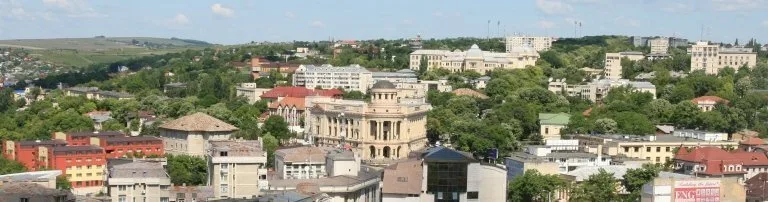
You may want visit the most important monuments of art in Iasi, as well as the most important religious sites. Iasi is extremely rich in religious monuments of all ages, from the Middle Ages (the ‘embroidered’ Church of the Three Hierarchs) to the modern times (the Metropolitan Church).
You may also want to visit the beautiful sites around the city (Ciric lake and forest; Birnova, Bucium and Poieni Forests).
But most of all, make sure to take a trip to the famous chain of monasteries in Northern Moldavia. Most of them are painted monasteries dating back to the 15th – 16th centuries. To give just a few examples:
- the Monastery of Voronet is unique in the world due to the mysterious origin of its deep-blue colour and to the painting of the “Last Judgement” on its western exterior wall;
- the Monastery of Putna has a powerful symbolical meaning for the Romanian people because it was built by the most famous Moldavian ruler, Stefan cel Mare (Stephen the Great), whose grave is also at Putna;
- the Monasteries of Sucevita, Moldovita, Dragomirna, Arbore, Bistrita, Agapia, Varatec and many othersare all beautifully-painted unique monuments of art and religion.
| AIESEC
International Association of Students in Economics and Management |  |
| ANSSA
National Association of Students in Administrative Sciences |  |
| ASAFFI
Association of Students and Graduates of the Faculty of Phylosophy in Iaşi |  |
| AEGEE
Association des Etats Généraux des Etudiants de l’Europe |  |
| ASFI
Association des Etudiants Francophones de Iaşi |  |
| ASII
Association of Students in Computer Science in Iaşi |  |
| ASJ
Association of Students in Journalism in Iaşi |  |
| ASALT
Association of Students and Graduates in Social Work, Iaşi |  |
| ELSA
The European Law Students’ Association, Iași |  |
| LSGG
League of Students in Geography and Geology |  |
| OSSEI
Organization of Students in European Studies, Iaşi |  |
| PRIME
European Association of Students in Public Relations and Communication, Iaşi Branch |  |
| TERIS
Association of Young Romanian Echologists, Iaşi |  |
| SPP
Student Association ”Society for Psychology” |  |
| Gipsy Eye
Gipsy Eye Association of Rroma Students |  |
| ISACA Student Group
Information Systems Audit and Control Association Student Group – ISG |
INSURANCE REQUIREMENTS
All international visitors should have valid travel and health insurance for the entire duration of their stay.
Citizens of EU/EEA countries may use the European Health Insurance Card (EHIC) to access public healthcare services in Romania. However, additional travel insurance is strongly recommended, as it may cover services not included in the EHIC system.
Non-EU citizens should have a valid private travel health insurance policy which covers the entire duration of their stay in Iasi, including travel days.
ACCOMMODATION
Accommodation for international students is available upon request on campus in:
Photo gallery
Location: Titu Maiorescu campus, 7-9, Titu Maiorescu street, 700461, Iași
Accommodation cost: approx. 120 euros/month
Places are available in triple rooms, which are fully furnished and equipped with a refrigerator. Each room has a private bathroom and access to Internet. On each floor there is a kitchen equipped with gas-stoves and ovens. Laundry service is available on campus.
Virtual tour
Location: Codrescu campus, 1, Codrescu street, Iași 700479
Accommodation cost: approx. 175 euros/month
Places are available in double rooms (fully furnished, including a TVset and a refrigerator); each room has a private bathroom and a little balcony. On each floor there is a kitchen equipped with gas-stoves and ovens. International guests can also have breakfast and lunch at the Gaudeamus Restaurant.
Access to the Internet is made available (using an internet cable from the socket to the laptop).
Laundry can be done at request and free-of-charge.
Important!
- An Accommodation Agreement is to be signed shortly upon arrival (for this, a copy of the passport and a passport-sized photo are required).The accommodation fee is to be paid after arrival (no down payment is necessary).
- The student residences provide: pillow, duvet, bed sheets; they do not provide: towels, hair dryer, electric kettle, cutlery, plates, pans and pots.
- The International Relations Office cannot provide support in finding a private accommodation in the city or recommend international students a real estate agency.
VISA AND RESIDENCE PERMIT
Non-EU citizens need to apply for a long-stay visa (D/SD) for studies, the only type of visa allowing students to apply for the residence permit.
IMPORTANT! The long-stay visa for studies covers a total of 90 days of legal stay in Romania. The process of getting the visa lasts for about a month, on condition that the application file is complete.
In order for Non-EU students to extend the temporary residence right, within 30 to 60 days upon their arrival in Iasi, they have to apply for the residence permit.
Information available at: http://igi.mai.gov.ro/en/content/studies
IMPORTANT! The application for the residence permit requires a proof of the students’ means of subsistence for the entire period of their mobility in Iasi (the student is required to provide a bank statement certifying (s)he has an account open at a Romanian bank and (s)he has around 4850 Euros).
Fees to be paid for the residence permit are around 175 euros.
EU citizens whose mobilities at UAIC are longer than 6 months, need to register their stay at the General Inspectorate for Immigrations, Iaşi.
Information available at: https://igi.mai.gov.ro/en/citizens-of-eu-eea/
The General Inspectorate for Immigrations online platform can be accessed here.


 Serviciul Relaţii Internaţionale, Universitatea Alexandru Ioan Cuza din Iași, Bulevardul Carol I, Nr. 11, Corp A, Iaşi, România, Telefon: 0040. 232. 20 1111, Fax: 0232. 20 1802, Email: relint@uaic.ro