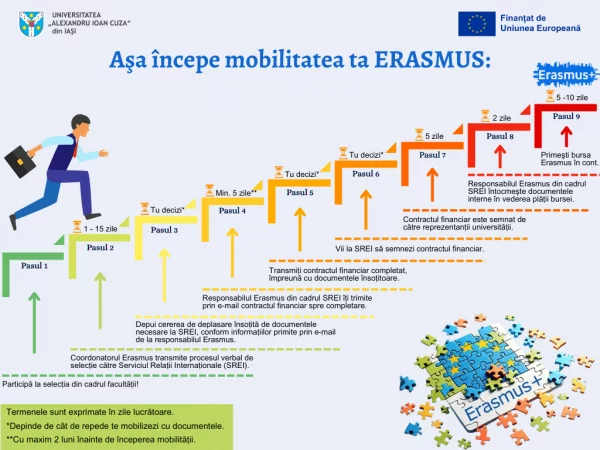
Erasmus Programme with Programme Countries – traineeship mobilities

Erasmus+ Traineeship mobilities 2025 – 2026 (applicable to selections organized starting with 1 May 2025)
Call for applications: long-term traineeship mobilities + international dimension

UAIC Regulations on the selection and organization of mobilities within the ERASMUS+ KA131 – HED Program

An ERASMUS+ traineeship mobility represents a placement period abroad (practical training activities, not courses attended at a university) carried out by students, PhD students, and future recent graduates of “Alexandru Ioan Cuza” University of Iași (UAIC) at[1]:
  • any public or private organization active in the labor market or in the fields of education, training, youth, research, and innovation. For example, such an organization can be:
  • a small, medium, or large enterprise, public or private (including social enterprises);
  • a public body at local, regional, or national level;
  • embassies or consular offices of Romania;
  • a social partner or other representative of working life, including chambers of commerce, craft/professional associations, and trade unions;
  • a research institute;
  • a foundation;
  • a non-governmental organization (foundation, association);
  • a school/institute/educational center (at any level, from pre-school to upper secondary education, including vocational training and adult education);
  • a non-profit organization, association, or NGO;
  • a body providing career guidance, professional counseling, and information services;
  • a higher education institution from an EU Member State or a third country associated with the program holding an ECHE, or a higher education institution from a third country not associated with the program recognized by the competent authorities, which has signed inter-institutional agreements with its partners from an EU Member State or a third country associated with the program before the mobility takes place.
Erasmus+ traineeship mobilities also include:
  • Teaching assistantships – for future teachers;
  • Research assistantships carried out in any relevant research institution;
  • Digital Opportunity Traineeships[2] – carried out to acquire digital skills.
The duration of traineeship mobilities can be between 2 and 12 [3] months of physical activity.

Erasmus+ traineeship mobilities can take place throughout the entire academic year or may include part of the following academic year. However, it is recommended that traineeships take place primarily during holidays or during periods dedicated to specialized practical training. [1] The following types of organizations are not eligible as host organizations for student traineeship mobilities: EU institutions and other EU bodies, including specialized agencies (the exhaustive list is available on the website – https://europa.eu/european-union/abouteu/institutions-bodies_en); organizations managing EU programs, such as Erasmus+ National Agencies (to avoid possible conflict of interest and/or double funding).

[2] When the student or recent graduate performs one or more of the following activities during the mobility: digital marketing; digital graphic, mechanical, or architectural design; development of applications, software, scripts, or websites; installation, maintenance, and management of IT systems and networks; cybersecurity; data analysis, mining, and visualization; programming and training of robots and artificial intelligence applications. Generic customer support, order fulfillment, data entry, or office tasks are not part of this category.

[3] The mobility period is calculated according to the Erasmus+ Program rules established by the European Commission, which state that an Erasmus+ mobility month has 30 days, regardless of the number of
Call for applications: long-term SMT (valid for the 2024 – 2025 academic year)

Presentation of ERASMUS+ KA131 – HED student mobilities

Selection regulations for Erasmus+ KA131 long-term traineeship mobilities

An ERASMUS+ traineeship mobility represents a placement period abroad (practical training activities, not courses attended at a university) carried out by students, PhD students, and future recent graduates of “Alexandru Ioan Cuza” University of Iași (UAIC) at[1]:

a) any public or private organization active in the labor market or in the fields of education, training, youth, research, and innovation. For example, such an organization can be:
  • a small, medium, or large enterprise, public or private (including social enterprises);
  • a public body at local, regional, or national level;
  • embassies or consular offices of Romania;
  • a social partner or other representative of working life, including chambers of commerce, craft/professional associations, and trade unions;
  • a research institute;
  • a foundation;
  • a school/institute/educational center (at any level, from pre-school to upper secondary education, including vocational training and adult education);
b) a non-profit organization, association, or NGO;

c) a body providing career guidance, professional counseling, and information services;

d) a higher education institution from an EU Member State or a third country associated with the program holding an ECHE, or a higher education institution from a third country not associated with the program recognized by the competent authorities, which has signed inter-institutional agreements with its partners from an EU Member State or a third country associated with the program before the mobility takes place.

Erasmus+ traineeship mobilities also include:
  • Teaching assistantships – for future teachers;
  • Research assistantships carried out in any relevant research institution;
  • Digital Opportunity Traineeships[2] – carried out to acquire digital skills.
The duration of traineeship mobilities can be between 2 and 12[3] months of physical activity.

Erasmus+ traineeship mobilities can take place throughout the entire academic year or may include part of the following academic year. However, it is recommended that traineeships take place primarily during holidays or during periods dedicated to specialized practical training.

[1] The following types of organizations are not eligible as host organizations for student traineeship mobilities: EU institutions and other EU bodies, including specialized agencies (the exhaustive list is available on the website – https://europa.eu/european-union/abouteu/institutions-bodies_en); organizations managing EU programs, such as Erasmus+ National Agencies (to avoid possible conflict of interest and/or double funding).

[2] When the student or recent graduate performs one or more of the following activities during the mobility: digital marketing; digital graphic, mechanical, or architectural design; development of applications, software, scripts, or websites; installation, maintenance, and management of IT systems and networks; cybersecurity; data analysis, mining, and visualization; programming and training of robots and artificial intelligence applications. Generic customer support, order fulfillment, data entry, or office tasks are not part of this category.

[3] The mobility period is calculated according to the Erasmus+ Program rules established by the European Commission, which state that an Erasmus+ mobility month has 30 days, regardless of the number of calendar days (28, 29, 30, or 31 days) of that specific month.
Presentation of long-term Erasmus+ traineeship mobilities

Call for applications: long-term traineeship mobilities

Selection regulations for Erasmus+ KA131 long-term traineeship mobilities
  • An ERASMUS+ traineeship mobility represents a placement period abroad (not courses attended at a university) carried out by students, PhD students, and future recent graduates at:
    • a public or private institution active in the labor market, or in the fields of education, training, youth, research, and innovation;
    • a non-profit organization, association, or NGO;
    • a body providing career guidance, professional counseling, and information services;
This also includes:
  • Teaching assistantships – for future teachers;
  • Research assistantships carried out in any relevant research institution;
  • Digital Opportunity Traineeships – carried out to acquire digital skills (digital marketing; digital graphic, mechanical, or architectural design; development of applications, software, scripts, or websites; installation, maintenance, and management of IT systems and networks; cybersecurity; data analysis, mining, and visualization; programming and training of robots and artificial intelligence applications).
* The following types of organizations are not eligible as host organizations for student traineeship mobilities:
    • EU institutions and other EU bodies, including specialized agencies (the exhaustive list is available on the website – https://europa.eu/european-union/abouteu/institutions-bodies_en);


    • organizations managing EU programs, such as Erasmus+ National Agencies (to avoid possible conflict of interest and/or double funding).
  • The duration of traineeship mobilities can be between 2 and 12 months of physical activity. The mobility period is calculated according to the Erasmus+ Program rules established by the European Commission, which state that an Erasmus+ mobility month has 30 days, regardless of the number of calendar days (28, 29, 30, or 31 days) of that specific month.
  • The monthly grant amount for long-term traineeship mobilities was established at national level by the National Agency for Community Programs in the Field of Education and Vocational Training (ANPCDEFP), in accordance with the Erasmus+ Guide, and is awarded based on the destination country, as follows:
    • 824 Euro/ month: Austria, Belgium, Cyprus, Denmark, Finland, France, Germany, Greece, Iceland, Ireland, Italy, Liechtenstein, Luxembourg, Malta, Norway, Portugal, Spain, Sweden, Netherlands.
    • 756 Euro/ month: Bulgaria, Croatia, Czech Republic, Estonia, Latvia, Lithuania, North Macedonia, Poland, Serbia, Slovakia, Slovenia, Hungary, Turkey.
  • Erasmus grant top-ups:
    • with 250 Euro/month for candidates who receive social grants or qualify to receive one according to MEN Order 3392/2017 (Art. 6, paragraph 2), those of Roma ethnicity or those with refugee status;
    • with 50 Euro for GREEN TRAVEL = using a means of transport with lower emissions for the main part of the journey to and from the host country (e.g., bus, train, or car-pooling).
    • with the amount corresponding to a maximum of 4 days (outside the mobility period), if applicable, for travel days, using a means of transport that falls under the “green travel” category.
    • with amounts awarded based on the principle of real costs, for participants with fewer opportunities (special needs), whose physical, mental, or health-related condition is such that participation in the mobility is not possible without extra financial support, requiring a preparatory visit, or requiring an accompanying person during the mobility.
! Social grant files are submitted and evaluated at the Secretariat of the faculty where the student is enrolled at the time of selection.
Presentation of long-term Erasmus+ mobilities

Selection regulations for Erasmus+ KA131 long-term traineeship mobilities (valid starting with the 2021-2022 academic year)
  • An ERASMUS+ traineeship mobility represents a placement period abroad (not courses attended at a university) carried out by students, PhD students, and future recent graduates at:
    • a public or private institution active in the labor market, or in the fields of education, training, youth, research, and innovation;
    • a non-profit organization, association, or NGO;
    • a body providing career guidance, professional counseling, and information services;
This also includes:
  • Teaching assistantships – for future teachers;
  • Research assistantships carried out in any relevant research institution;
  • Digital Opportunity Traineeships – carried out to acquire digital skills (digital marketing; digital graphic, mechanical, or architectural design; development of applications, software, scripts, or websites; installation, maintenance, and management of IT systems and networks; cybersecurity; data analysis, mining, and visualization; programming and training of robots and artificial intelligence applications).
* The following types of organizations are not eligible as host organizations for student traineeship mobilities:
    • EU institutions and other EU bodies, including specialized agencies (the exhaustive list is available on the website – https://europa.eu/european-union/abouteu/institutions-bodies_en);
    • organizations managing EU programs, such as Erasmus+ National Agencies (to avoid possible conflict of interest and/or double funding).
  • The duration of traineeship mobilities can be between 2 and 12 months of physical activity. The mobility period is calculated according to the Erasmus+ Program rules established by the European Commission, which state that an Erasmus+ mobility month has 30 days, regardless of the number of calendar days (28, 29, 30, or 31 days) of that specific month.
  • The monthly grant amount for long-term traineeship mobilities was established at national level by the National Agency for Community Programs in the Field of Education and Vocational Training (ANPCDEFP), in accordance with the Erasmus+ Guide, and is awarded based on the destination country, as follows:
    • 750 Euro/ month: Austria, Belgium, Cyprus, Denmark, Finland, France, Germany, Greece, Iceland, Ireland, Italy, Liechtenstein, Luxembourg, Malta, Norway, Portugal, Spain, Sweden, Netherlands.
    • 690 Euro/ month: Bulgaria, Croatia, Czech Republic, Estonia, Latvia, Lithuania, North Macedonia, Poland, Serbia, Slovakia, Slovenia, Hungary, Turkey.
  • Erasmus grant top-ups:
    • with 250 Euro/month for candidates who receive social grants or qualify to receive one according to MEN Order 3392/2017 (Art. 6, paragraph 2), those of Roma ethnicity or those with refugee status;
    • with 50 Euro for GREEN TRAVEL = using a means of transport with lower emissions for the main part of the journey to and from the host country (e.g., bus, train, or car-pooling).
    • with the amount corresponding to a maximum of 4 days (outside the mobility period), if applicable, for travel days, using a means of transport that falls under the “green travel” category.
    • with amounts awarded based on the principle of real costs, for participants with fewer opportunities (special needs), whose physical, mental, or health-related condition is such that participation in the mobility is not possible without extra financial support, requiring a preparatory visit, or requiring an accompanying person during the mobility.
! Social grant files are submitted and evaluated at the Secretariat of the faculty where the student is enrolled at the time of selection.

General Rules:

  • Funding:
    • 720 Euro/month for: Austria, Belgium, Cyprus, Denmark, Greece, Germany, Finland, France, Ireland, Italy, Iceland, Liechtenstein, Luxembourg, Norway, Malta, United Kingdom, Netherlands, Portugal, Spain, Sweden;
    • 670 Euro/month for: Bulgaria, Croatia, Czech Republic, Estonia, Latvia, Lithuania, North Macedonia, Poland, Serbia, Slovakia, Slovenia, Hungary, Turkey.
  • Eligible Institutions:
    • universities holding an Erasmus Charter for Higher Education (ECHE)
    • any public or private organization active in the labor market or in the fields of education, training, and youth. For example, such an organization could be:
      • a small, medium or large public or private enterprise (including social enterprises),
      • a public body at local, regional or national level,
      • a social partner or other representative of working life, including chambers of commerce, craft/professional associations and trade unions,
      • a research institute,
      • a foundation,
      • a school, institute or educational center (at any level – from pre-school to upper secondary education, including vocational training and adult education),
      • a non-profit organization, association, or NGO,
      • a body providing career guidance, professional counseling and information services.
  • Ineligible Institutions:
  • Eligible Candidates:
    • students enrolled in full-time / part-time / distance learning at UAIC in years I-II-III (IV) Bachelor’s, I-II Master’s, I-II-III and PhD extension years;
  • The minimum duration of an Erasmus+ traineeship mobility is 2 months (60 days), calculated according to the Erasmus+ Program rules established by the European Commission, which state that an Erasmus+ mobility month has 30 days, regardless of the number of calendar days (28, 29, 30 or 31 days) of that specific month.
  • The funded duration of an Erasmus+ traineeship mobility for UAIC students is maximum 12 months.
In case Erasmus+ traineeship beneficiaries wish to extend their mobility, they must submit a request to the Erasmus+ Office at least 30 days before the end of the traineeship. This request must be accompanied by the host institution’s request to extend the traineeship period and a copy of the Learning Agreement for Traineeships (Section: During the mobility) for the extension period. Within the limit of available funds, extension requests and the funding for the extension period are analyzed and proposed for approval to the University’s Executive Board (BECA). A student can benefit from Erasmus+ study and traineeship mobilities at each level of study (Bachelor, Master, PhD), totaling a maximum of 12 months of mobility (study + traineeship) per level.
  • Selection sessions take place on dates established by the Dean of each faculty, upon the proposal of the Erasmus+ Coordinator. Traineeships will take place after the selection results are posted at the faculty, within a timeframe that allows for the completion of internal procedures regarding Erasmus+ travel (minimum recommended timeframe – 14 days).
Observations! Erasmus+ traineeships must be carried out in the students’ field of study. If there are requests to perform a traineeship in a field different from the one studied, it can only take place with the approval of the Dean of the student’s faculty.
    • Traineeship in digital skills:
      • traineeships intended for students and recent graduates who wish to acquire digital skills, regardless of the student’s field of study.
      • Any traineeship will be considered a “traineeship for digital skills” when the trainee participates in one or more of the following activities: digital marketing (e.g. social media management, web analytics); digital graphic, mechanical or architectural design; development of applications, software, scripts or websites; installation, maintenance and management of IT systems and networks; cybersecurity; data analysis, mining and visualization; programming and training of robots and artificial intelligence applications. Generic customer support, order fulfillment, data entry or office tasks are not part of this category.
      • Assistantships: “academic assistantships for future teachers” primarily intended for recent graduates who intend to pursue an academic career.

General Rules:

  • Funding:
    • 720 Euro/month for: Austria, Belgium, Cyprus, Denmark, Greece, Germany, Finland, France, Ireland, Italy, Iceland, Liechtenstein, Luxembourg, Norway, Malta, United Kingdom, Netherlands, Portugal, Spain, Sweden;
    • 670 Euro/month for: Bulgaria, Croatia, Czech Republic, Estonia, Latvia, Lithuania, North Macedonia, Poland, Serbia, Slovakia, Slovenia, Hungary, Turkey.
  • Eligible Institutions:
    • universities holding an Erasmus Charter for Higher Education (ECHE)
    • any public or private organization active in the labor market or in the fields of education, training, and youth. For example, such an organization could be:
      • a small, medium or large public or private enterprise (including social enterprises),
      • a public body at local, regional or national level,
      • a social partner or other representative of working life, including chambers of commerce, craft/professional associations and trade unions,
      • a research institute,
      • a foundation,
      • a school, institute or educational center (at any level – from pre-school to upper secondary education, including vocational training and adult education),
      • a non-profit organization, association, or NGO,
      • a body providing career guidance, professional counseling and information services.
  • Ineligible Institutions:
  • Eligible Candidates:
    • students enrolled in full-time / part-time / distance learning at UAIC in years I-II-III (IV) Bachelor’s, I-II Master’s, I-II-III and PhD extension years;
  • The minimum duration of an Erasmus+ traineeship mobility is 2 months (60 days), calculated according to the Erasmus+ Program rules established by the European Commission, which state that an Erasmus+ mobility month has 30 days, regardless of the number of calendar days (28, 29, 30 or 31 days) of that specific month.
  • The funded duration of an Erasmus+ traineeship mobility for UAIC students is maximum 12 months.
In case Erasmus+ traineeship beneficiaries wish to extend their mobility, they must submit a request to the Erasmus+ Office at least 30 days before the end of the traineeship. This request must be accompanied by the host institution’s request to extend the traineeship period and a copy of the Learning Agreement for Traineeships (Section: During the mobility) for the extension period. Within the limit of available funds, extension requests and the funding for the extension period are analyzed and proposed for approval to the University’s Executive Board (BECA). A student can benefit from Erasmus+ study and traineeship mobilities at each level of study (Bachelor, Master, PhD), totaling a maximum of 12 months of mobility (study + traineeship) per level.
  • Selection sessions take place on dates established by the Dean of each faculty, upon the proposal of the Erasmus+ Coordinator. Traineeships will take place after the selection results are posted at the faculty, within a timeframe that allows for the completion of internal procedures regarding Erasmus+ travel (minimum recommended timeframe – 14 days).
Observations! Erasmus+ traineeships must be carried out in the students’ field of study. If there are requests to perform a traineeship in a field different from the one studied, it can only take place with the approval of the Dean of the student’s faculty.
    • Traineeship in digital skills:
      • traineeships intended for students and recent graduates who wish to acquire digital skills, regardless of the student’s field of study.
      • Any traineeship will be considered a “traineeship for digital skills” when the trainee participates in one or more of the following activities: digital marketing (e.g. social media management, web analytics); digital graphic, mechanical or architectural design; development of applications, software, scripts or websites; installation, maintenance and management of IT systems and networks; cybersecurity; data analysis, mining and visualization; programming and training of robots and artificial intelligence applications. Generic customer support, order fulfillment, data entry or office tasks are not part of this category.
      • Assistantships: “academic assistantships for future teachers” primarily intended for recent graduates who intend to pursue an academic career.

Click here for a better resolution!

ELIGIBILITY CRITERIA:

The following may apply for selection:
  • Students enrolled in full-time / distance learning / part-time education at “Alexandru Ioan Cuza” University of Iași, Romanian citizens, citizens of other states participating in the Erasmus+ Programme, or citizens of countries other than those participating in the Erasmus+ Programme;
  • Students in years I-II-III (IV) of Bachelor’s, I-II of Master’s, I-II-III and PhD extension years;
  • Former beneficiaries of a traineeship or study mobility within the Socrates, LLP-Erasmus and/or Erasmus+ programmes, only if they meet the aforementioned criteria and provided that the total duration of mobilities (Socrates / LLP-Erasmus + and Erasmus+) does not exceed 12 months per study cycle;
  • Students and PhD students in their final years selected before the end of the evaluation/examination session of the second semester of the final year, or before the date of the public PhD thesis defense, for mobilities taking place in the first year after graduation, have the status of “conditionally selected”; they become “titulars” (full beneficiaries) once they can prove their graduate status by presenting a certificate issued by the faculty, a certificate issued by the Secretariat of the Doctoral School where they were enrolled, or by the Office for Doctoral Studies. These mobilities can be carried out and completed within one year of graduation.
  • A student may benefit from Erasmus+ study and traineeship mobilities at each study level (Bachelor, Master, PhD), totaling a maximum of 12 months of mobility (study + traineeship) per level.
  • Consecutive mobilities at the same host institution are not eligible.
Academic eligibility criteria

To be eligible for an Erasmus+ traineeship mobility, students must:
  1. have an ECTS score at the time of selection of at least 50% of the maximum possible score at the time of application, with the exception of first-year, first-semester students, for whom the admission average of the study cycle in which they are enrolled will be considered;
  2. prove knowledge of the working language at the institution they are applying for by presenting at least one of the following documents:
    • language certificate[1];
    • high school transcript (for students who studied a foreign language in high school);
    • language proficiency certificate obtained at the Baccalaureate exam;
    • academic record related to university studies for the foreign language studied or for the study programme, for those studying in a foreign language, according to the candidate’s option and depending on the foreign languages studied.
The arithmetic mean of high school grades / the grade or score of the Baccalaureate language certificate / the average related to university studies or the minimum accepted score (for at least B1 level) must be equal to 80% of the maximum grade or score (e.g.: min. grade 8/10, 16/20 or “good” in the case of qualifiers).

Internationally recognized certificates (such as DELF, DALF, Cambridge, TOEFL, IELTS, DELE, Goethe), obtained for a minimum B1 level, are an exception, for which any score is accepted.

3. obtain at least grade 7 in the interview held during the selection process at the faculty.

Calculation method for the ECTS score:

To calculate the ECTS score, the results obtained by the candidate in the completed semesters of the study cycle in which they are enrolled at the time of selection are taken into account, and the calculation is made as follows: the ratio of the sum of ECTS scores for the completed semesters up to the time of selection (A) to the maximum ECTS score for that period (B): Ax100/ B.

[1] If you do not already have a language certificate, some possibilities for taking a test in Iași are:
  • French Cultural Institute of Iași, 26 Carol I Blvd. (French);
  • German Cultural Center of Iași, 38 Lascăr Catargi St. (German);
  • Foreign Language Center of the Faculty of Letters;
  • EuroEd Iași, 1C Florilor St. (English, French, Italian, Spanish).
Required documents for the application file:

a) Application Form (will remain in the student’s selection file); – which will include:
    • Motivation (reasons for participating in the selection for a traineeship in a specific organization, in a specific (economic) sector/department; readiness to achieve the traineeship goals; understanding the needs and expectations of the host organization; personal career goals)
    • Proposed mobility period
    • Declaration regarding the maximum number of Erasmus+ mobility months a student can benefit from during the study cycle in which they are enrolled at the time of application;
    • Information note regarding the processing of personal data.
b) Curriculum Vitae (will remain in the student’s selection file);

c) Language certificate/ high school transcript/ language proficiency certificate obtained at the Baccalaureate exam/ transcript of records/ academic situation related to university studies for the foreign language studied (a copy will remain in the student’s selection file);

d) Transcript of records for the level of study at which the candidate is enrolled at the time of selection, issued by the faculty secretariat (only with the faculty’s signature); this will not be requested by the candidate, but by the Erasmus coordinator;

e) Recommendation from the PhD coordinator, in the case of doctoral students;

f) Confirmation of receipt/acceptance from the host institution for students who have identified an ERASMUS+ traineeship placement on their own (a scanned copy of the original or a confirmation email is accepted).

Additional documents for students who do not hold citizenship of an EU member state:
  • a copy of the residence permit – an exception to this requirement is made for students of Moldovan citizenship enrolled at UAIC – Bălți and Chișinău Extensions;
The documents will be written in Romanian, with the exception of those under points (a) – motivation and (b) – CV, which will be presented in the working language of the institution the candidate opted for.

Scoring method for the application file:
  1. a) academic results – 50% of the score;
  2. b) language proficiency – 30% of the score;
  3. c) the interview – 20% of the score;
Incomplete files will be declared rejected.
Within the Erasmus+ KA131-HED Programme, long-term traineeship mobilities can take place in EU Member States, EEA countries – Norway, Iceland and Liechtenstein, as well as Turkey, North Macedonia, and Serbia.

Note!

Mobilities to countries not associated with the Erasmus+ KA131-HED Programme (non-EU countries) may also be funded, within the limit of available funds and in accordance with the eligibility and selection conditions available at the following link: Erasmus+ Programme with Partner Countries (non-EU) – Alexandru Ioan Cuza University of Iași (uaic.ro)
The Erasmus+ grant can only be awarded under the following conditions:
  • The selection minutes (Proces-verbal) must be sent to the International Relations Office immediately after the selection process has concluded;
  • The travel request approved by the faculty must be submitted to the Registry Office at least 10 working days before the start of the mobility;
  • The completed and signed financial agreement, along with the supporting documents, must be sent to the Erasmus+ financial officer at the International Relations Office at least 5 working days before the start of the mobility.
Important! UAIC students can benefit from multiple Erasmus+ mobilities; however, it is recommended to allow a sufficient time interval between two mobilities to fulfill the contractual obligations for the previous Erasmus+ mobility and to complete the administrative procedures required for the next one. the travel request for a new Erasmus+ mobility can only be approved after the beneficiary has fulfilled all contractual obligations for their previous Erasmus+ mobility. Selected students will receive the Erasmus grant as a contribution towards the costs of health insurance, civil liability and workplace accident insurance, stay, and travel for the duration of the mobility period abroad. The monthly grant amount for long-term traineeship mobilities was established at national level by the National Agency for Community Programmes in the Field of Education and Vocational Training (ANPCDEFP), in accordance with the Erasmus+ Guide, and is awarded based on the destination country as follows:
  • 824 Euro/ month: Austria, Belgium, Cyprus, Czech Republic, Denmark, Estonia, Finland, France, Germany, Greece, Iceland, Ireland, Italy, Latvia, Liechtenstein, Luxembourg, Malta, Netherlands, Norway, Portugal, Slovakia, Slovenia, Spain, Sweden.
  • 756 Euro/ month: Bulgaria, Croatia, Hungary, Lithuania, North Macedonia, Poland, Serbia, Turkey.
  • a maximum of 2 days of additional individual support (depending on the destination country) for round-trip travel (one travel day before the activity and one travel day after the activity);
  • Travel grant, calculated according to the European Commission’s distance calculator (accessible at this link). The “travel distance” represents the distance between the place of origin and the venue of the activity, while the “amount” represents the grant for travel both to and from the venue:
Travel distance “Green travel” category – Amount per participant (EUR) “Non-green travel” category – Amount per participant (EUR)
10 – 99 KM 56 28
100 – 499 KM 285 211
500 – 1,999 KM 417 309
2,000 – 2,999 KM 535 395
3,000 – 3,999 KM 785 580
4,000 – 7,999 KM 1,188 1,188
8,000 KM or more 1,735 1,735
The Erasmus grant will be disbursed as follows: – a 90% advance of the Erasmus financial support before departure, only after the Travel Order (Rector’s Order) has been issued and the Financial Agreement has been signed by UAIC representatives. – the 10% balance will be received after returning from the mobility and fulfilling all obligations specified in the financial agreement.
Erasmus+ grant top-ups:
  • for students with fewer opportunities, the Erasmus+ grant is supplemented by 250 Euro/month; in accordance with the Programme Guide and the 2024 National Call, a participant with fewer opportunities is one who falls into one or more of the following categories:
a) [1] a student who receives a social grant or who qualifies/meets the conditions to benefit from a social grant awarded by the higher education institution where they are enrolled, according to ME Order 4957/2025 (amending Order 6463/2023);

b) [2] a student who is an orphan of one or both parents;

c) a student coming from a single-parent family (due to death, disappearance, incarceration of the other parent, or non-recognition on the birth certificate);

d) a student who falls into the category of “first-generation student” (meaning they do not already hold a bachelor’s degree and their parents have not obtained a university degree, but they may have siblings who are already students / have already graduated from a university);

e) a person with a disability (including physical, mental, intellectual, or sensory impairments) or health problems (including serious illnesses, chronic diseases, or any other situation related to physical or mental health that prevents a person’s participation in the programme);

f) a person whose family has not achieved an average monthly net income per family member higher than the national minimum net salary in the 12 months prior to the submission of supporting documents;

g) a person of Roma ethnicity;

h) a person with refugee status.

!!! The Erasmus+ grant top-up also applies to students of nationalities other than Romanian, students enrolled in tuition-paying positions, and students attending distance/part-time learning, who are selected to participate in the mobility and who fall into one of the categories described above.

!!! Application files submitted in the 2024-2025 academic year based on criteria b, c, d, e, g, and h, and deemed eligible, remain valid for the entire duration of the study cycle in which the student is enrolled and do not need to be resubmitted within that cycle. Files submitted based on financial criteria (point f) must be submitted annually during the study year in which the Erasmus+ mobility takes place.
  • for students using sustainable means of transport – “green travel” (bicycle, bus, car-pooling, or train), if these were used for the majority of the round trip (more than 50% of the distance calculated according to the European Commission’s distance calculator), the Erasmus+ grant is supplemented as follows:
    • the travel grant corresponding to the “green travel” category is awarded (according to the table above);
    • the amount corresponding to a maximum of 4 days (outside the mobility period) is awarded, if applicable, for the duration of the round trip.
  • for participants with special needs, whose physical, mental, or health-related condition is such that participation in the mobility is not possible without additional support, requiring a preparatory visit or an accompanying person during the mobility, the Erasmus grant is supplemented with amounts awarded based on real costs, according to their needs.
[1] The evaluation of social grant files for ERASMUS+ students is carried out throughout the academic year at the faculty level where the student is enrolled. [2] The file is submitted for one category only. A student can only benefit from a single Erasmus+ grant top-up per mobility.

The file is submitted physically at the Grants and Social Issues Department (Address: 7 Gheorghe Asachi St., Codrescu Campus, Residence Hall C12, room 4, Public hours: 8:00 – 16:00, lunch break: 12:30 – 13:00), ideally before bringing the documents to the Erasmus+ Department.

!!!! Incomplete files are not valid and will not be considered. !!!!!

List of required documents for each category of students with fewer opportunities and the corresponding annexes:
  • Erasmus+ Documents (click here)
  • Annex 1 (click here)
  • Annex 2 (click here)
  • Annex 3 (click here)
  • Annex 4 (click here)
  • Annex 5 (click here)
  • Annex 6 (click here)
All documents must be presented in Romanian (documents in other languages must be accompanied by an official translation).
Students may participate in selections for long-term traineeship mobilities throughout the academic year, either for placements from the faculty’s offer or provided they have an acceptance letter from an eligible host institution, as follows:
  • the selection may take place at least 30 days before the start date of the mobility (the mobility dates are specified in the selection minutes);
  • application files are submitted to the faculty secretariat or sent via email to the faculty Erasmus+ coordinator;
  • the Erasmus+ coordinator confirms the receipt of the application by email and, following the evaluation of the files, posts the results on the faculty’s website;
  • potential appeals can be sent within 24 hours after the results are posted to the Erasmus+ coordinator via email; these are analyzed and resolved within 48 hours by the Faculty Appeals Committee, and the Erasmus+ coordinator then posts the final results;
  • the Erasmus+ coordinator sends the selection minutes to the International Relations Office immediately after the selection process is concluded and informs the selected students about the need to contact the Erasmus+ mobility officer within the International Relations Office.

Erasmus Faculty Coordinators (click here)

For traineeship mobility offers, please consult:
RECOGNITION AND EQUIVALENCE OF ERASMUS+ TRAINEESHIP MOBILITY

All Erasmus+ mobilities are carried out, from an academic perspective, based on a traineeship contract (Learning Agreement Student Mobility for Traineeships – Annex 5), which is signed by the student, the Erasmus+ coordinator of the faculty where the student is enrolled, and the supervisor/mentor from the partner institution.

From an academic point of view, the Learning Agreement serves as a contract. This agreement describes the traineeship programme (work plan and activities) mutually agreed upon by the student, the home faculty, and the host institution, and includes the list of courses or the number of ECTS credits that will be recognized and credited upon return.

Upon returning from the placement, the activities carried out at the host institution will be automatically recognized for the student, according to the traineeship agreement signed before the start of the mobility; the certification of result recognition, as well as the equivalence of grades obtained, will be performed by the committee designated at the faculty level and approved by the Executive Board of the University’s Administration Council. The recognition and equivalence committee consists of 1 to 3 members, depending on the number of departments in the faculty, and must include the faculty Erasmus+ coordinator and the ECTS coordinator who signs the Erasmus traineeship agreements (if this is a different person than the Erasmus coordinator).

The equivalence of grades will be carried out according to the following principles:
  • all subjects specified in the traineeship agreement signed before the start of the mobility at the host institution will be recognized upon return;
  • equivalence will be granted based on a request for equivalence completed and signed by the beneficiary student (form here), together with a copy of the Certificate of Stay and the Traineeship Certificate, which will subsequently be submitted for approval to the faculty-level recognition and equivalence committee;
  • the principle for grade recognition is that for a UAIC course, the grade corresponding to the mark obtained at the host university is awarded, which can range from 1 to 5, where: 1 = poor/unsatisfactory, 2 = satisfactory, 3 = good, 4 = very good, 5 = excellent.
  • grades are determined by the faculty recognition committee and not by each individual course instructor.
At the end of each semester, the Erasmus+ coordinator from each faculty will submit the equivalence certificates for all students who benefited from Erasmus traineeships in that semester to the Erasmus+ Department.

Students who, as a result of participating in an Erasmus+ traineeship, cannot attend the exam session at UAIC, and whose traineeship agreement does not provide for the equivalence of all subjects for that semester, may request the course instructors/faculty dean for an early examination before departure, upon completion of the traineeship, or during the special exam and graduation session in September (this special session is organized with the approval of the UAIC Executive Board and Senate).

Regulations regarding the recognition and equivalence of studies and traineeships carried out within the Erasmus+ programme
The new Online Language Support (OLS) is waiting for you!

It offers a range of interactive and engaging language learning activities to help you learn a new language or master one you have already studied. The best part is that it is specifically designed to meet the unique needs of every learner.

This means you will enjoy a unique language learning experience at your own pace.

So, what are you waiting for? Whether it’s learning the basics of French or mastering German at a native level, click here to get started.

It only takes a few seconds to set up your profile and begin your language learning journey today! Our introductory module quickly guides you through the account creation process, which you can use to access OLS and many other short courses on the EU Academy.

See you in the new OLS!

CONTACT DETAILS

International Relations Office

Erasmus+ Office

Grigoriţa Elena COCEANU

E-mail: grigorita.coceanu(at)uaic.ro
Phone: 0232 20 1812

Office hours:

Monday – Thursday, 10:00 – 12:30

To help Erasmus students looking for accommodation during their mobility, we suggest using the Erasmus Play platform.

Erasmus Play started as a response from a former Erasmus+ group of students who encountered difficulties in finding accommodation in different host cities. It allows you to compare all available housing options with ease. Moreover, you will be able to book in total safety since all accommodations are provided by verified platforms. Book your student accommodation in 3 steps:

– Choose your host University, campus or city and your required dates. – Easily compare accommodation from multiple sites. – Click on view and book it on the website of our trustworthy partners.
Erasmus Survival Guide 2026-2027

Testimonials
Ungureanu Andra, Traineeship mobility: Suleyman Demirel University, Turkey
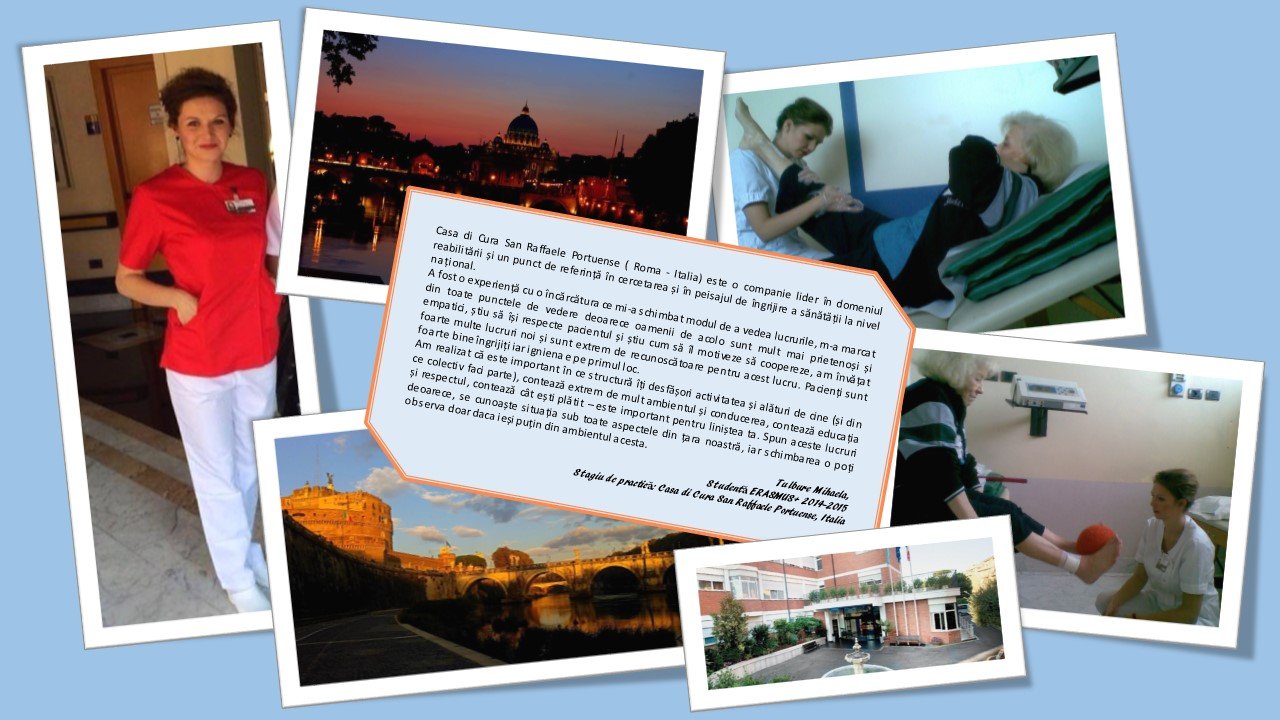
Tulbure Mihaela, Traineeship mobility: Casa di Cura San Raffaele Portuense, Italy
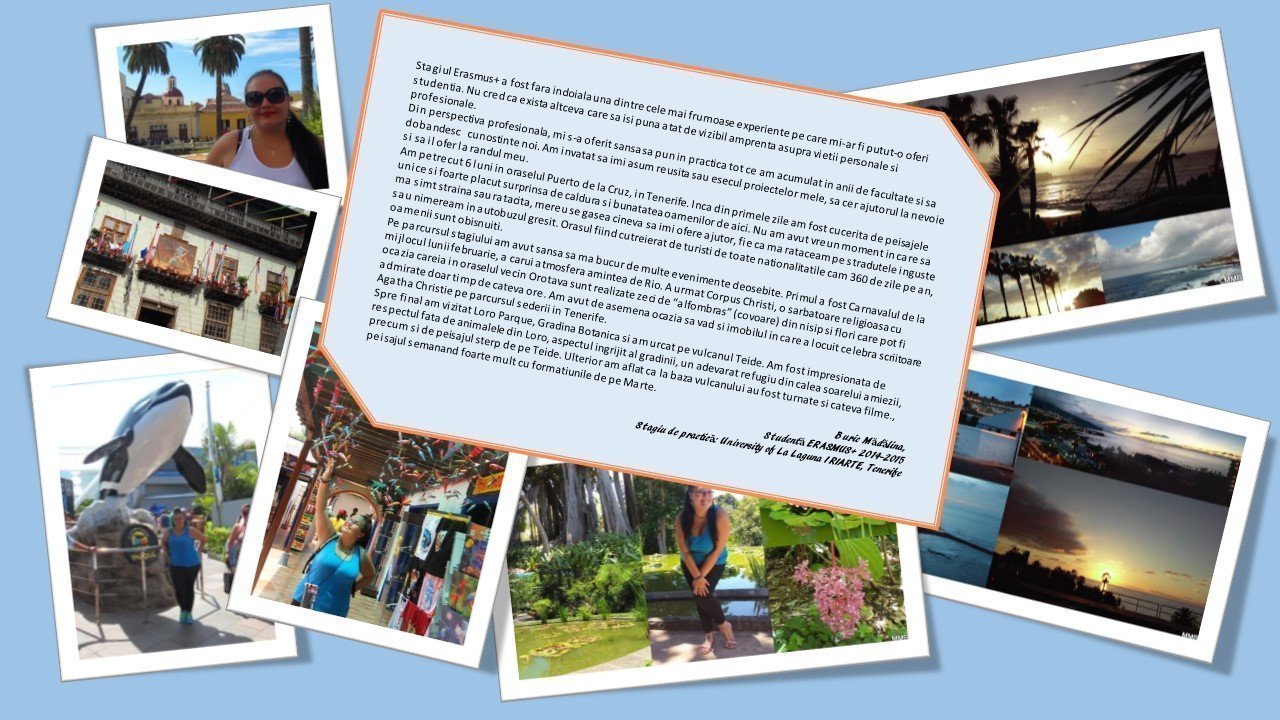
Buric Mădălina, Traineeship mobility: University of La Laguna IRIARTE, Tenerife
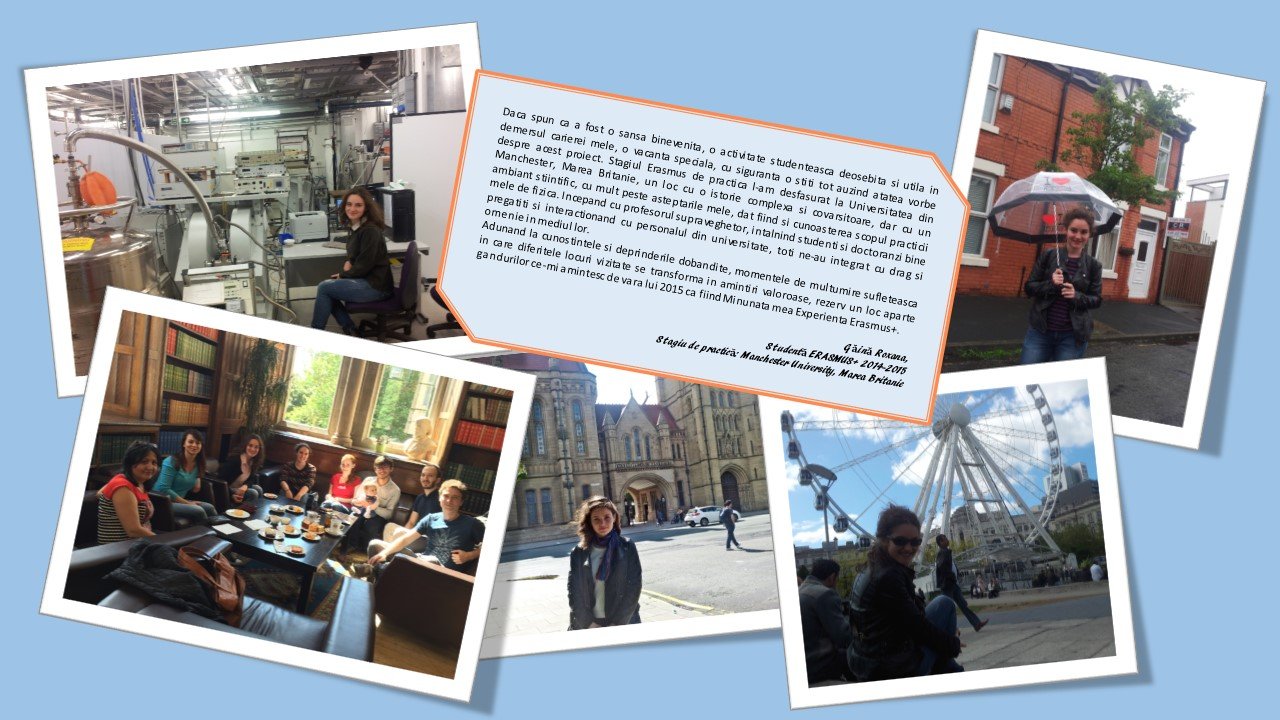
Găină Roxana, Traineeship mobility: Manchester University, United Kingdom
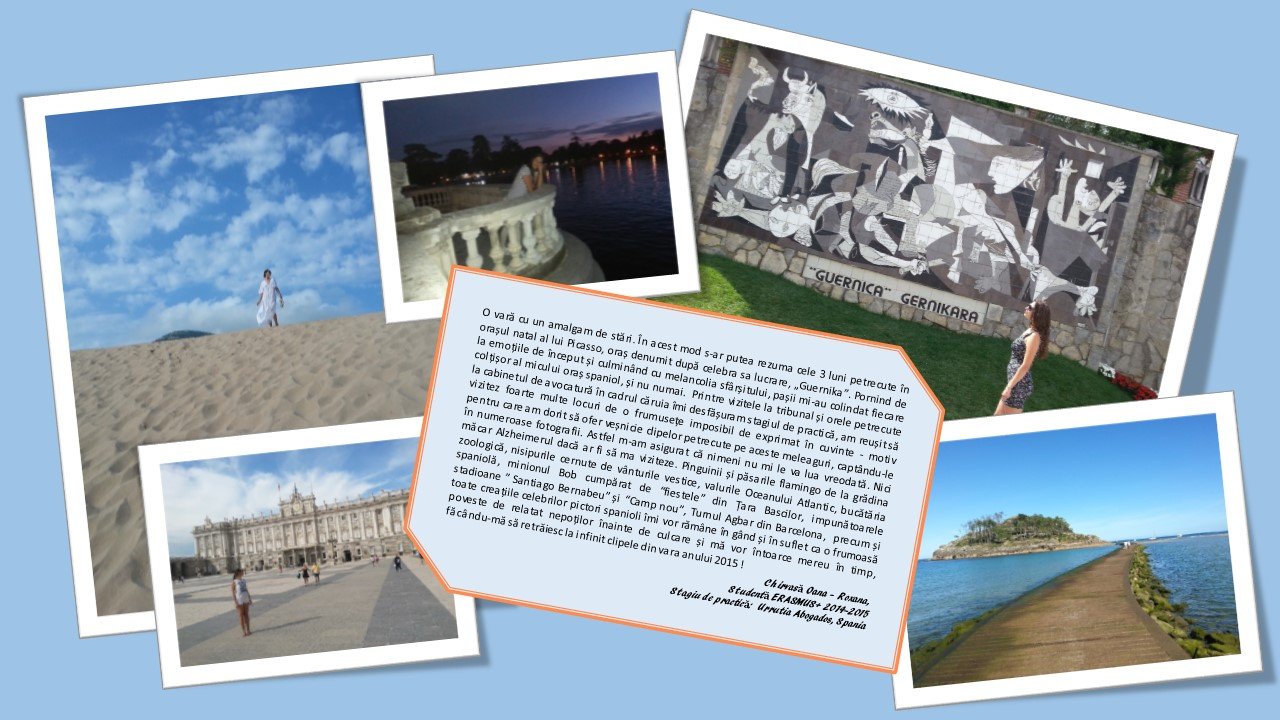
Chirvasă Oana – Roxana, Traineeship mobility:  Urrutia Abogados, Spain
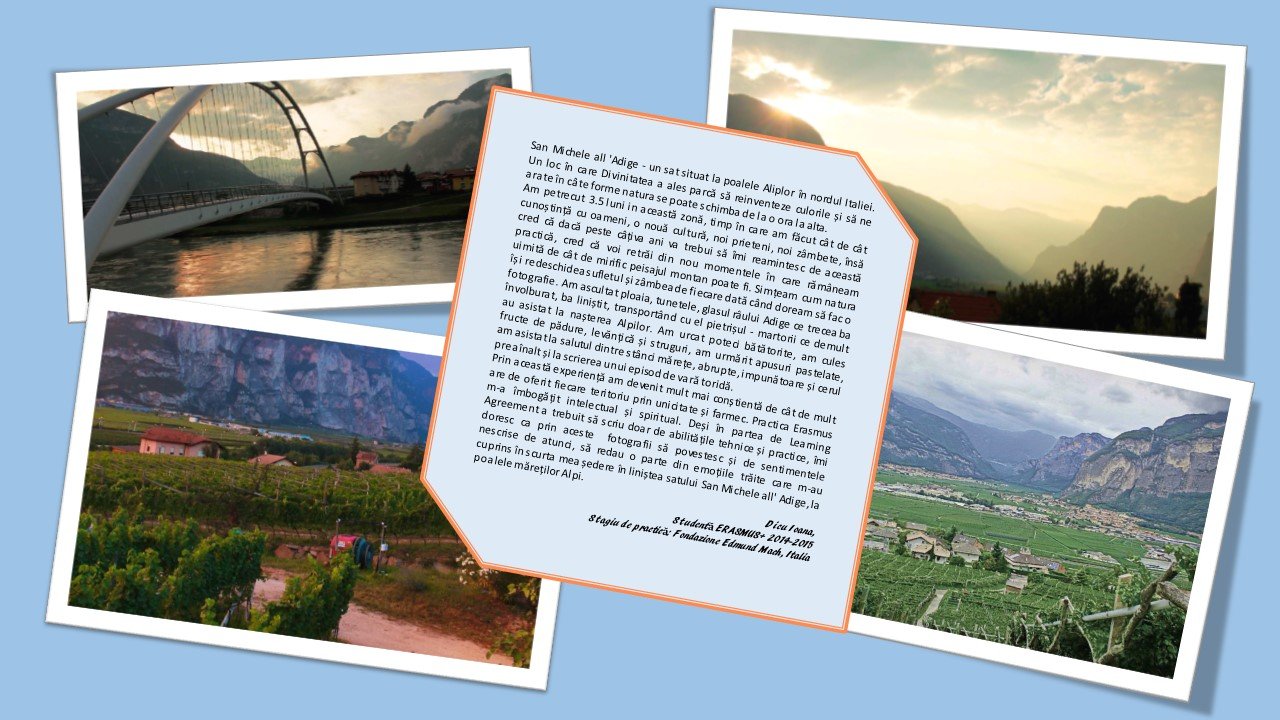
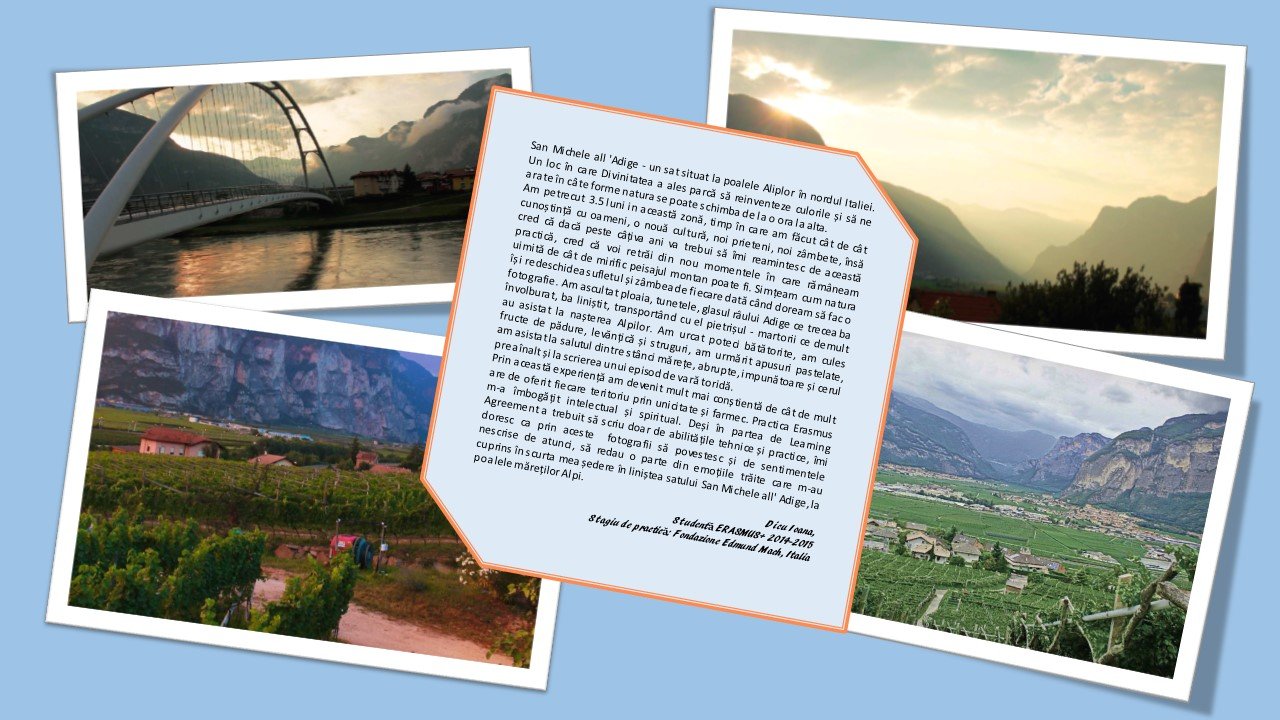
Dicu Ioana, Traineeship mobility: Fondazione Edmund Mach, Italy
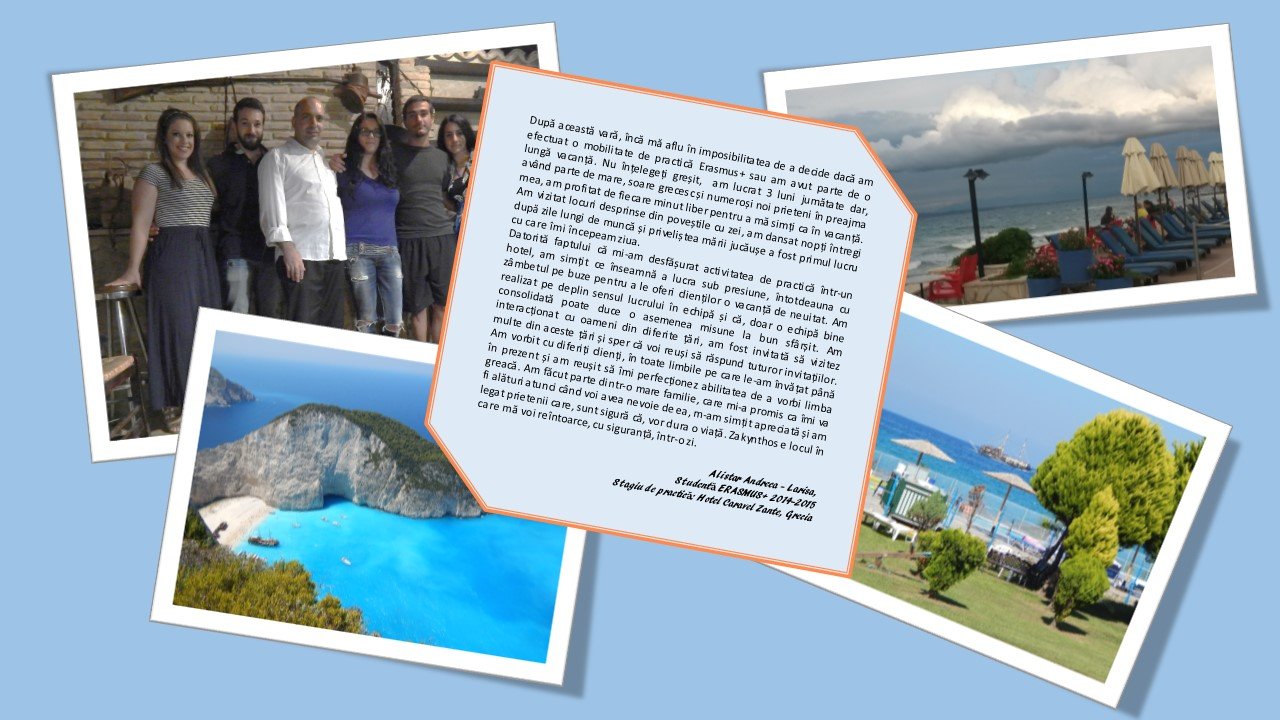
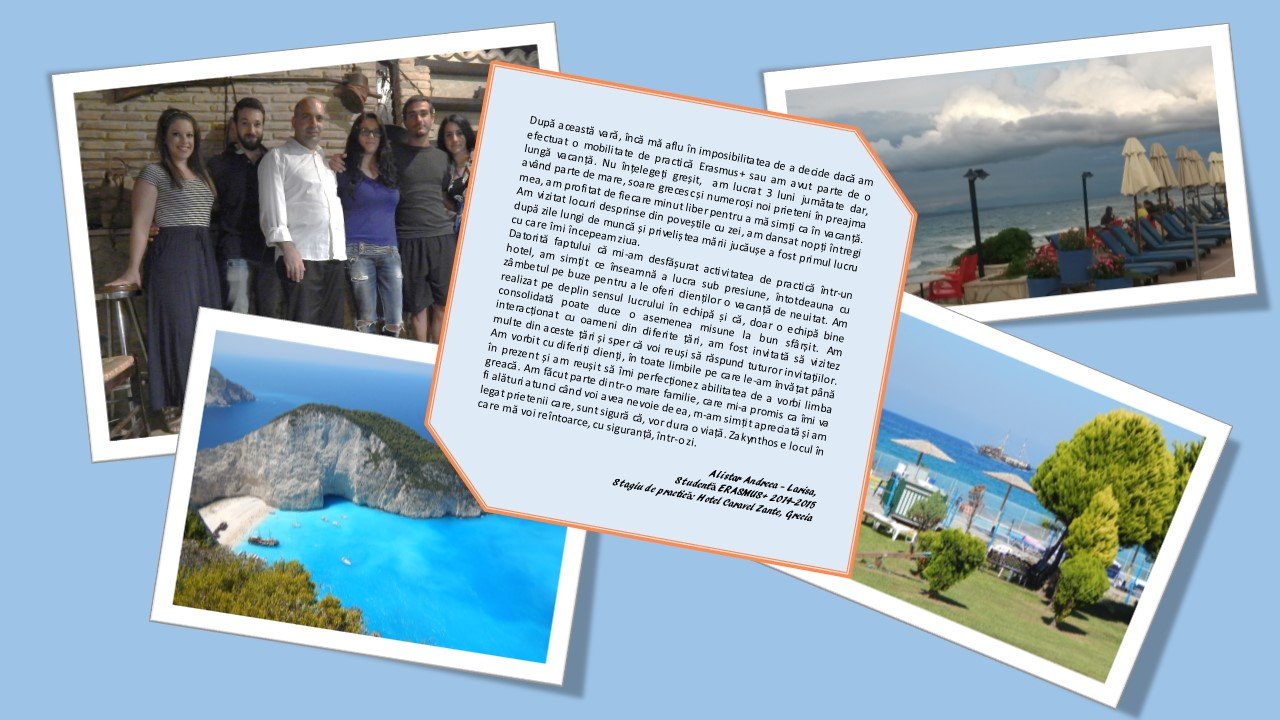
Alistar Andreea – Larisa, Traineeship mobility: Hotel Caravel Zante, Greece
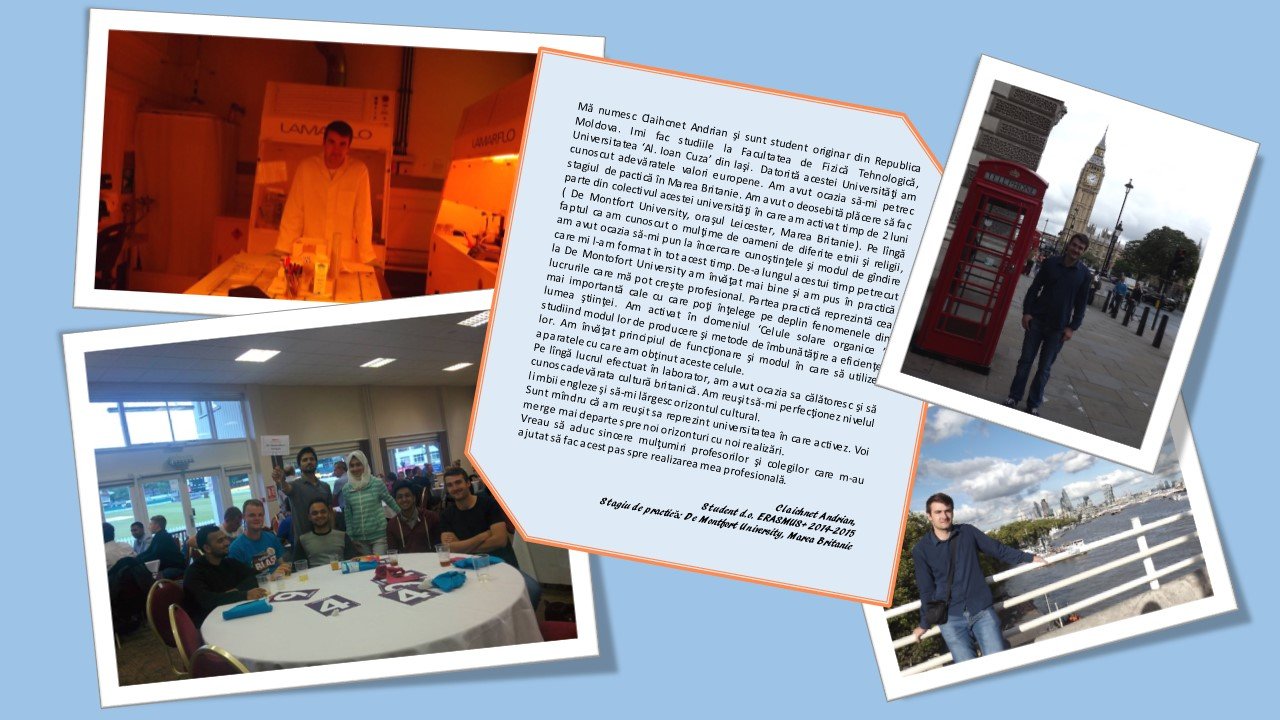
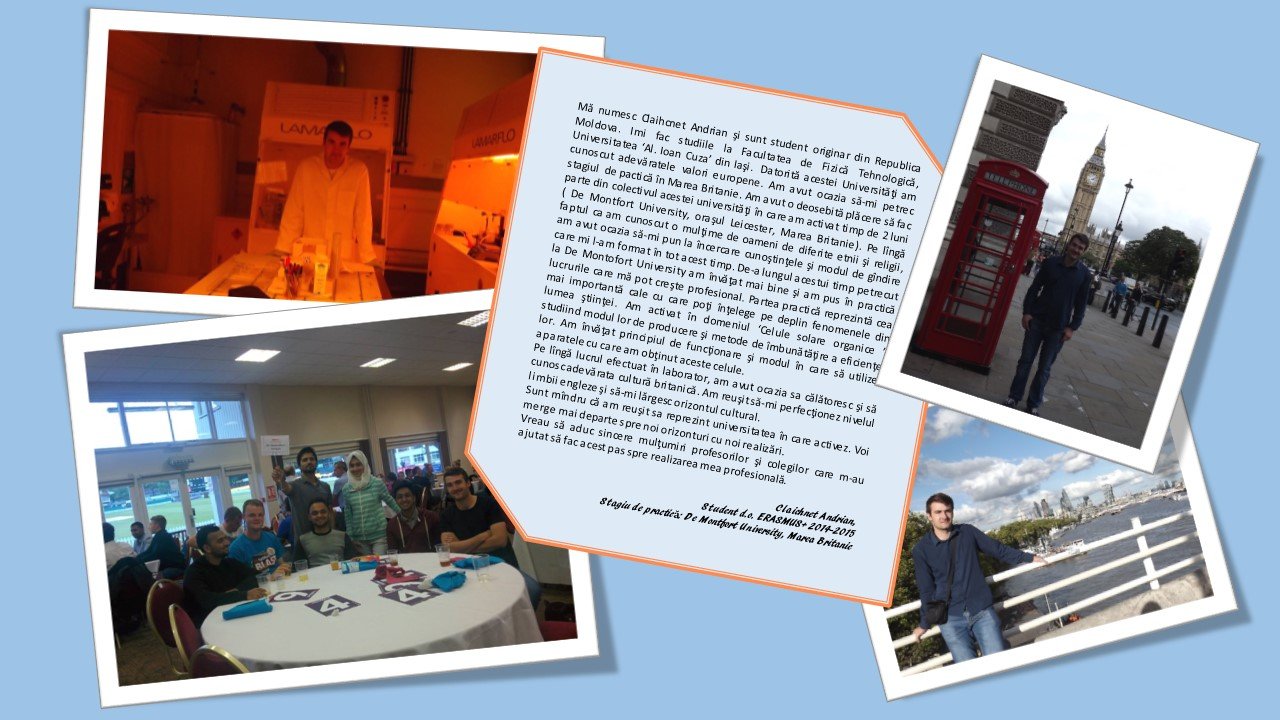
Claichnet Andrian, Traineeship mobility: De Montfort University, United Kingdom
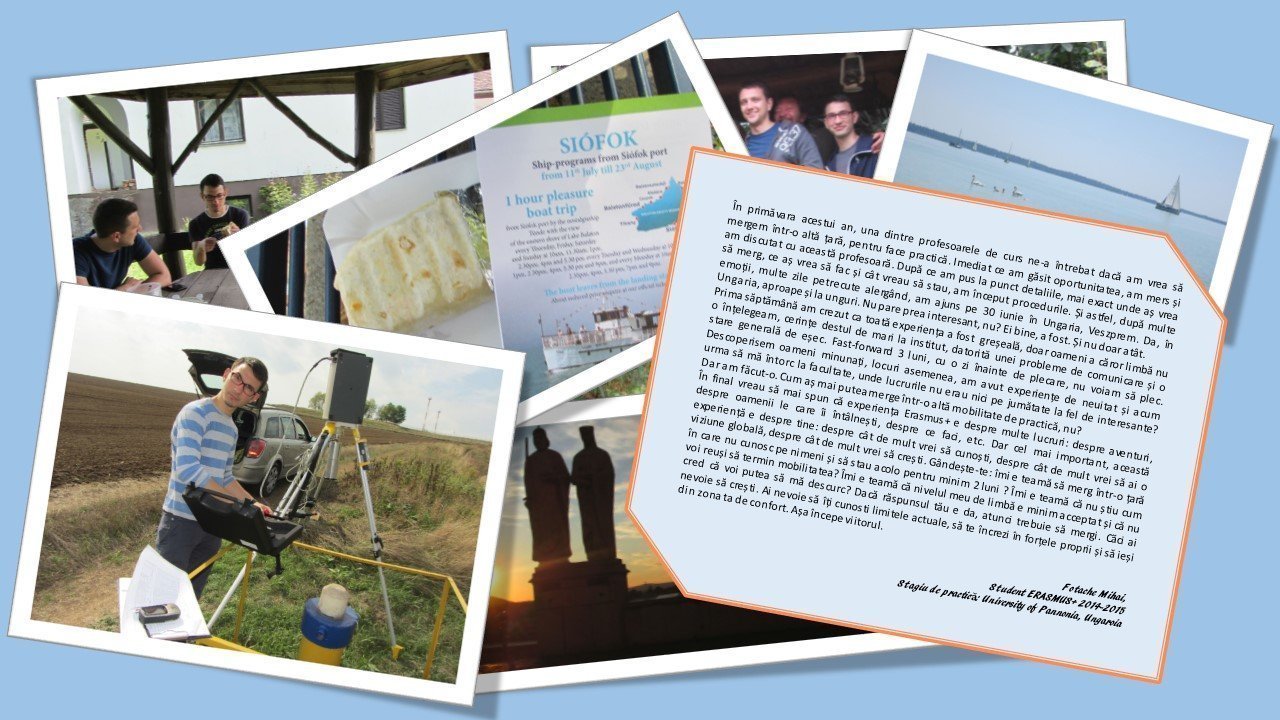
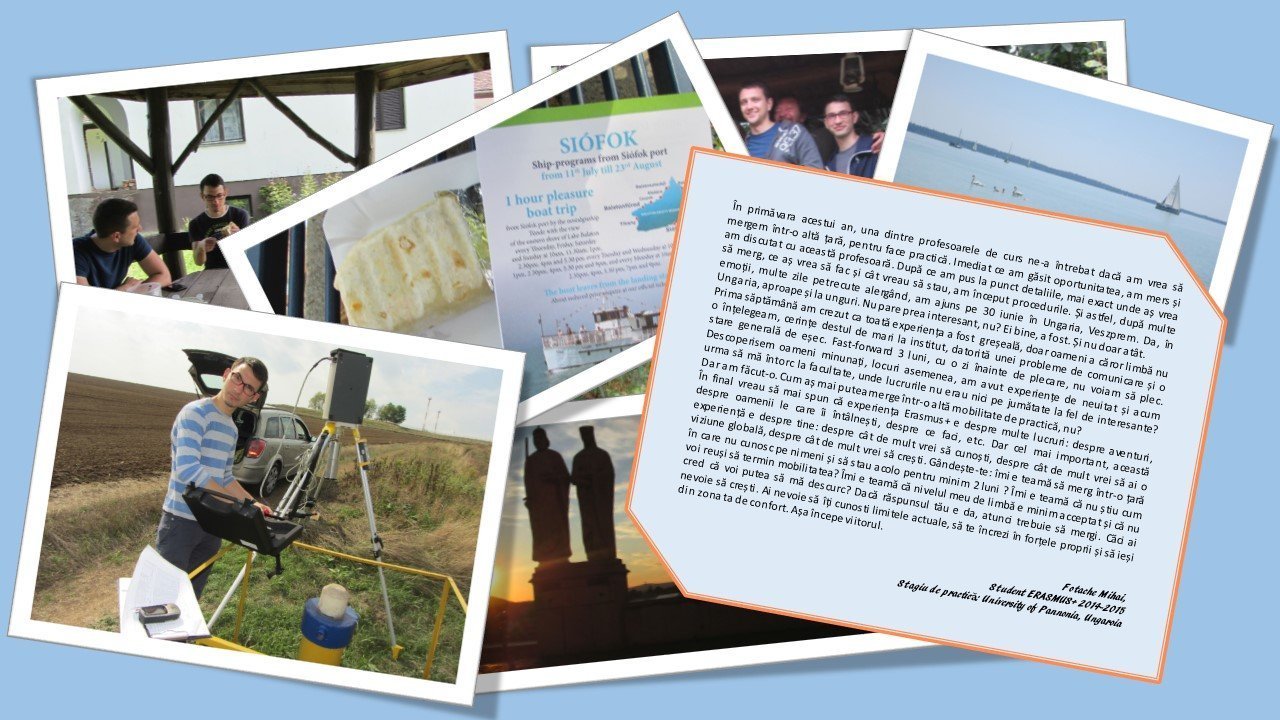
Fotache Mihai, Traineeship mobility: University of Pannonia, Hungary
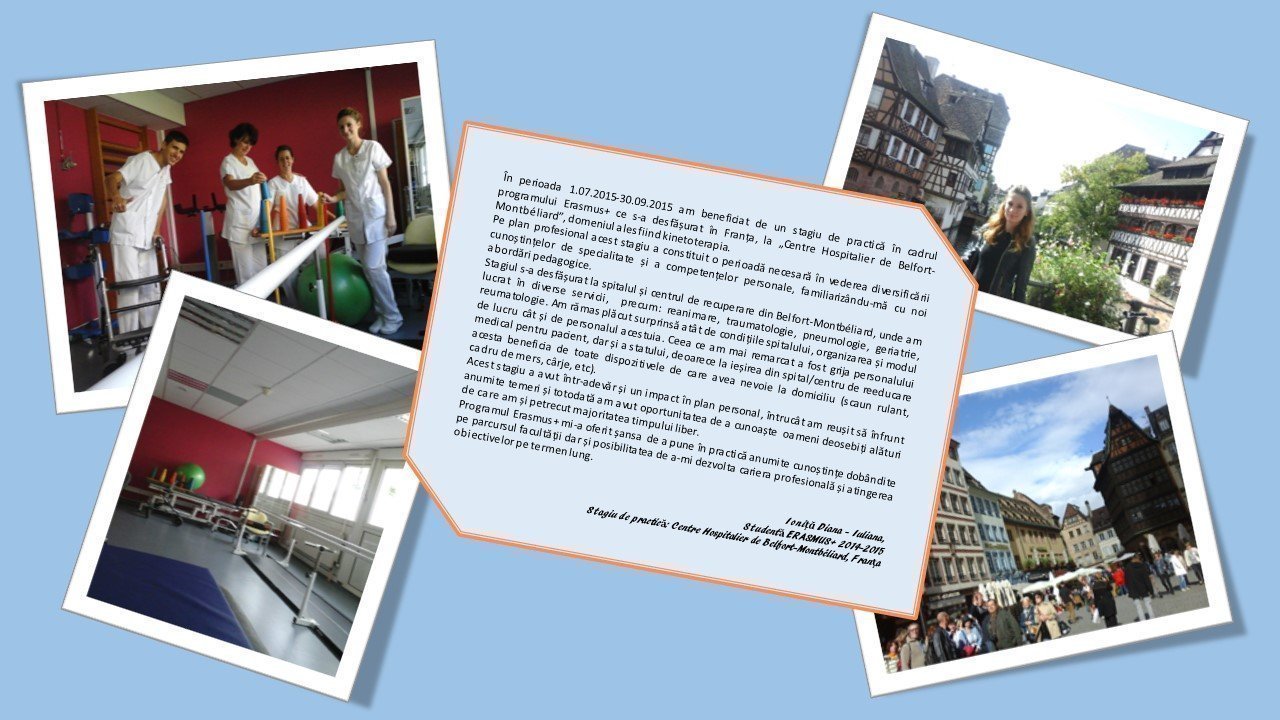
Ioniță Diana – Iuliana, Traineeship mobility: Centre Hospitalier de Belfort-Montbéliard, France
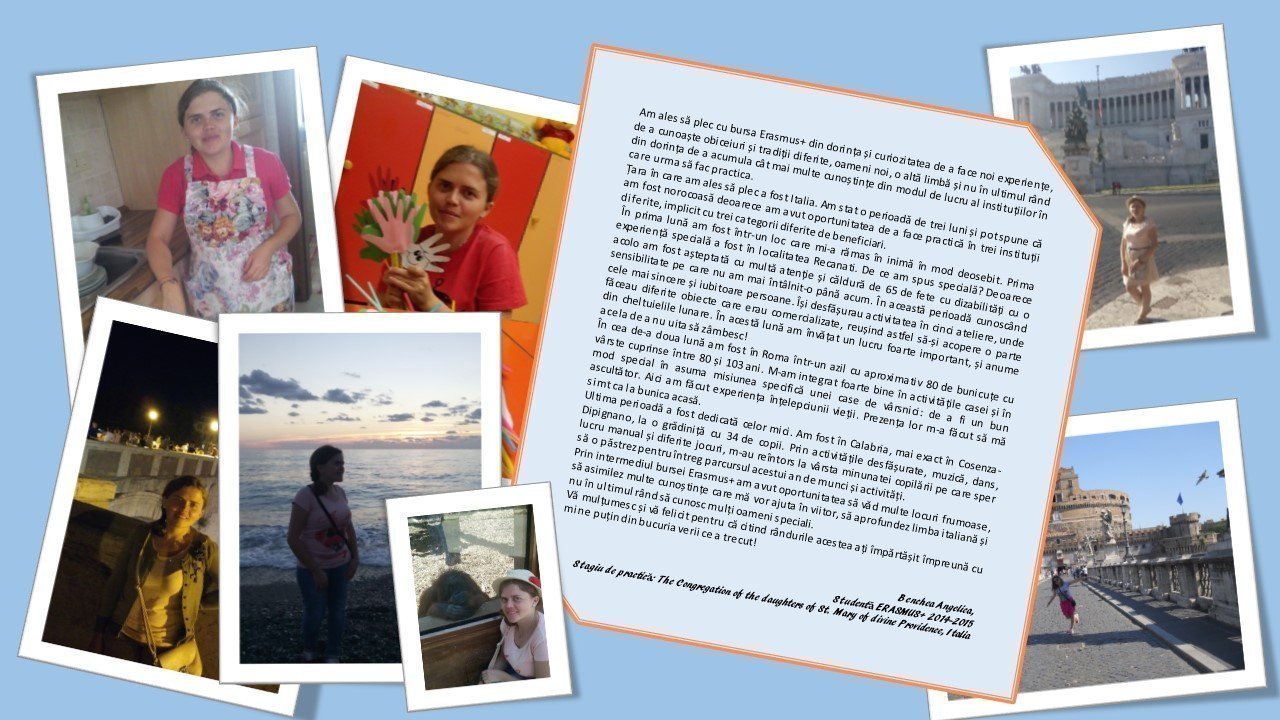
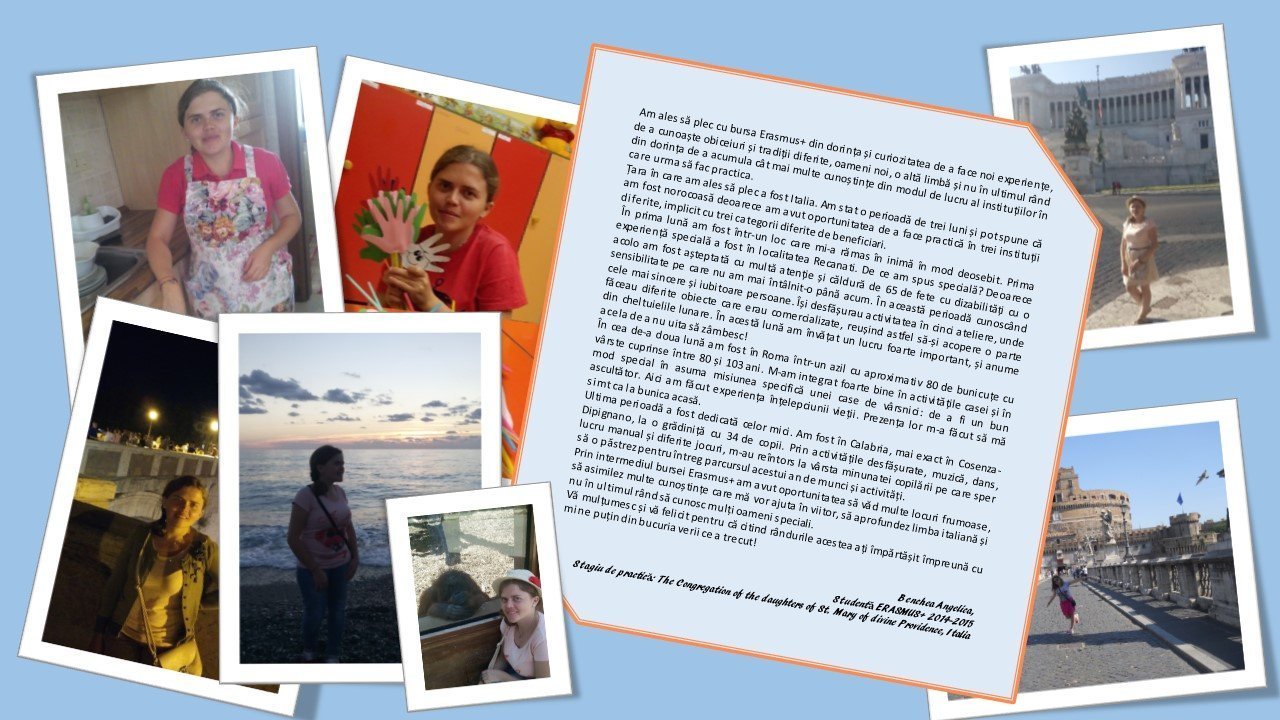
Benchea Angelica, Traineeship mobility: The Congregation of the daughters of St. Mary of divine Providence, Italy
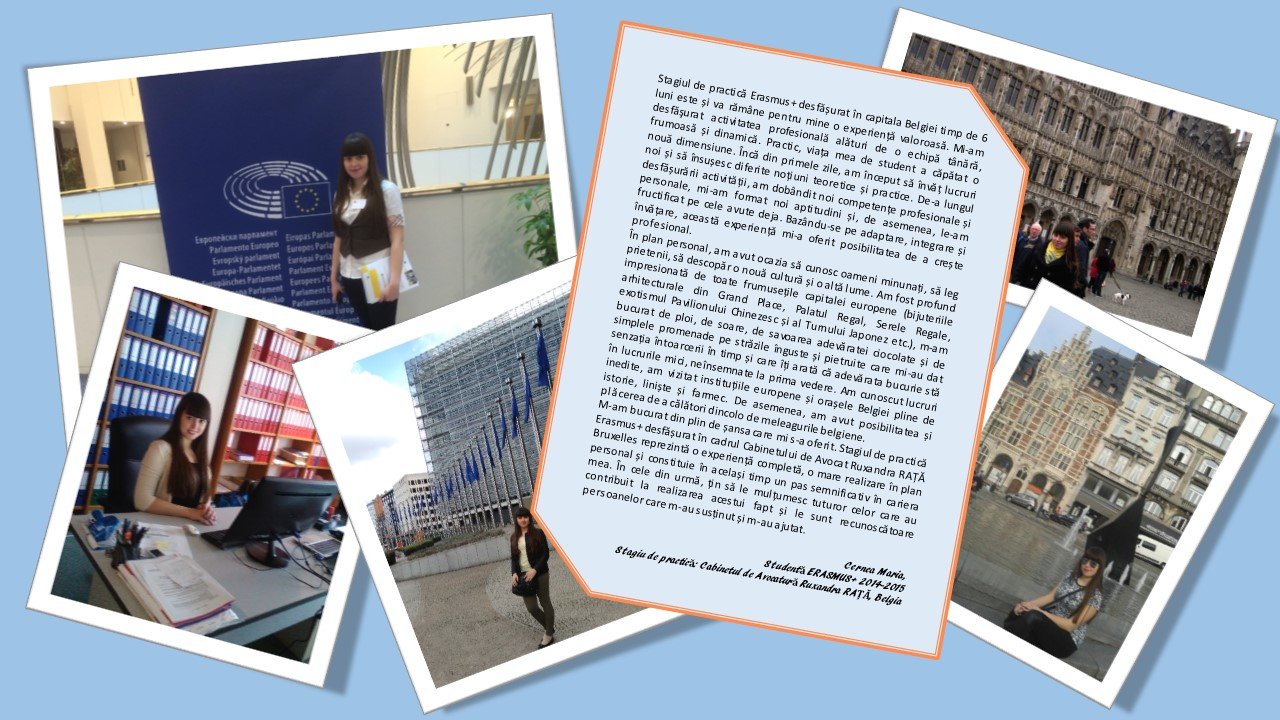
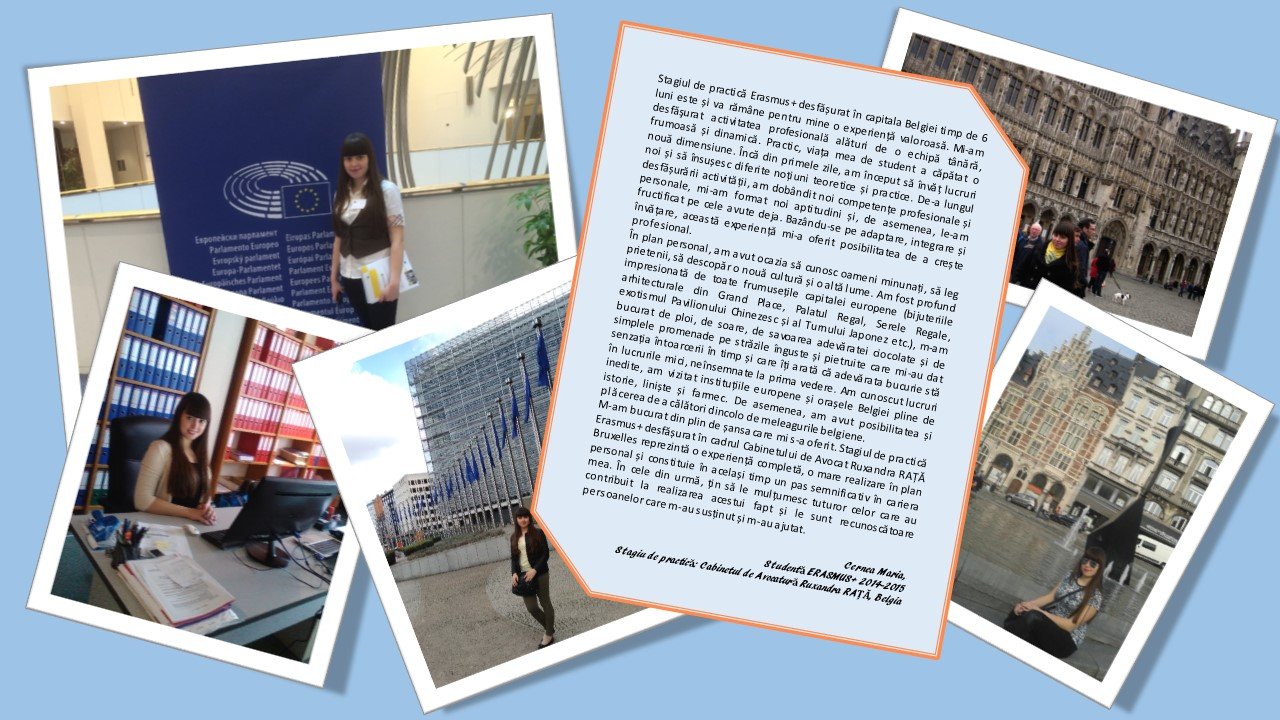
Cernea Maria, Traineeship mobility: Cabinetul de Avocatură Ruxandra RAȚĂ, Belgium
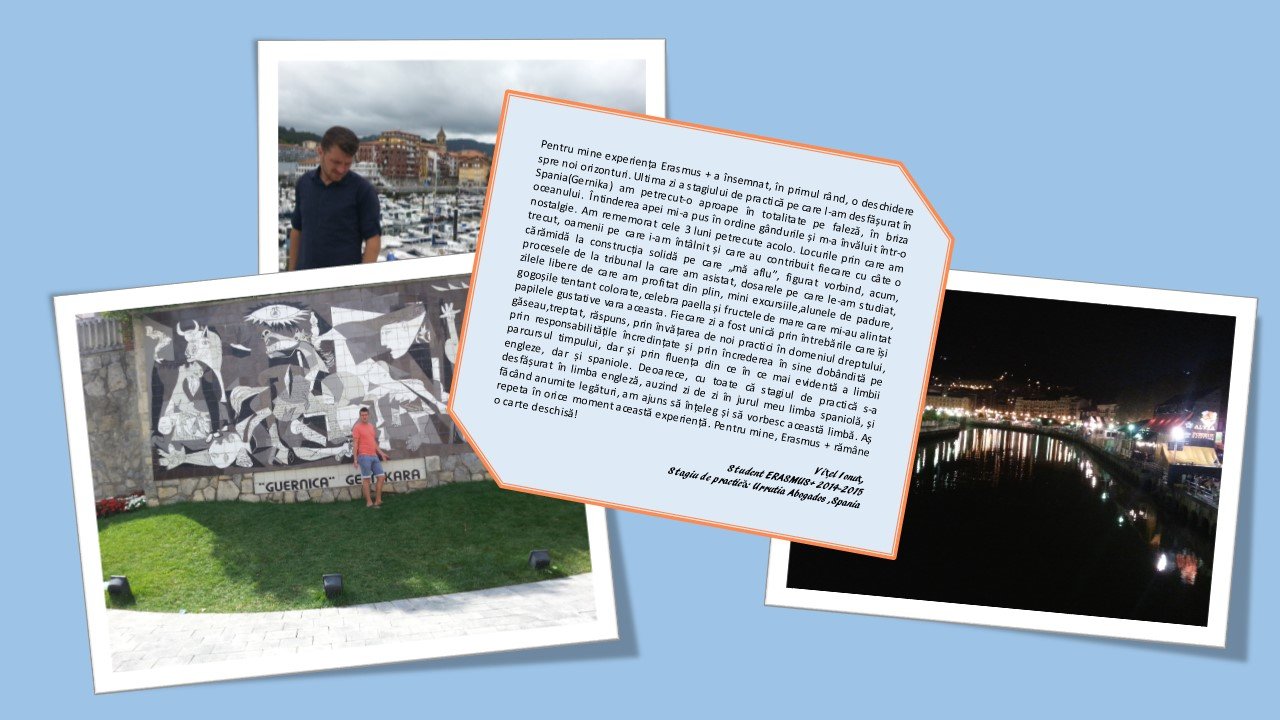
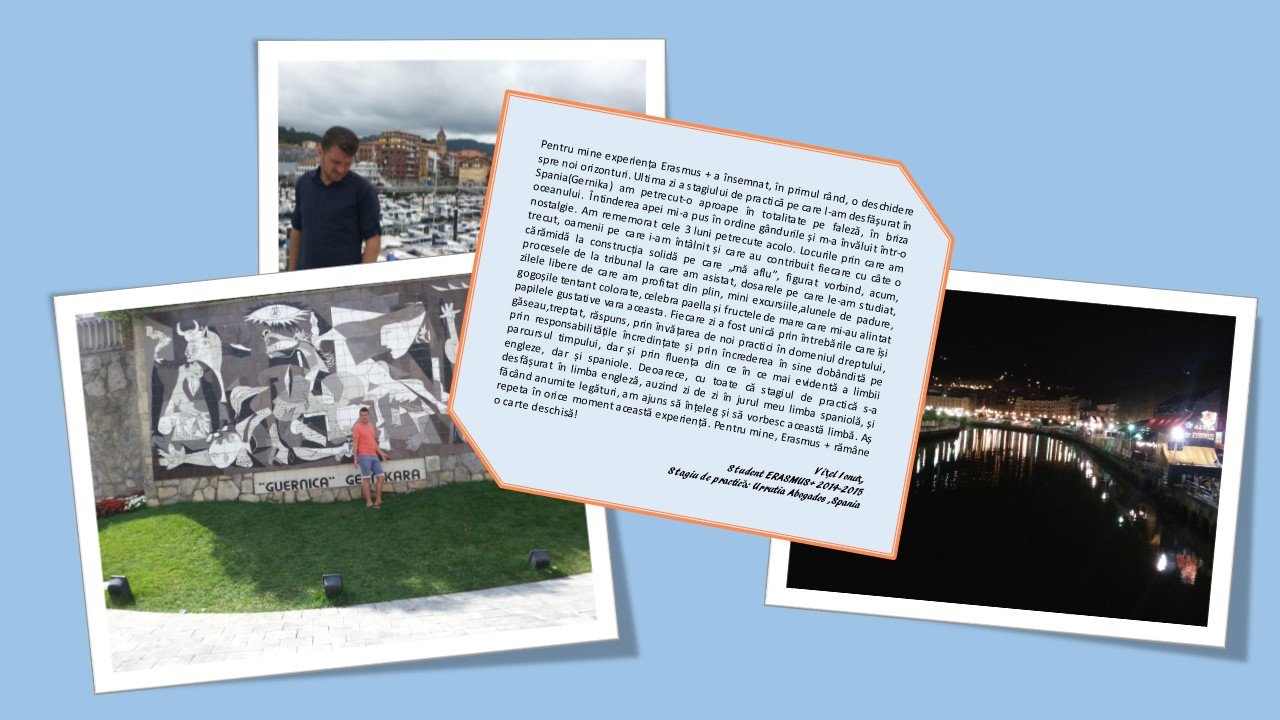
Vițel Ionuț, Traineeship mobility: Urrutia Abogados, Spain
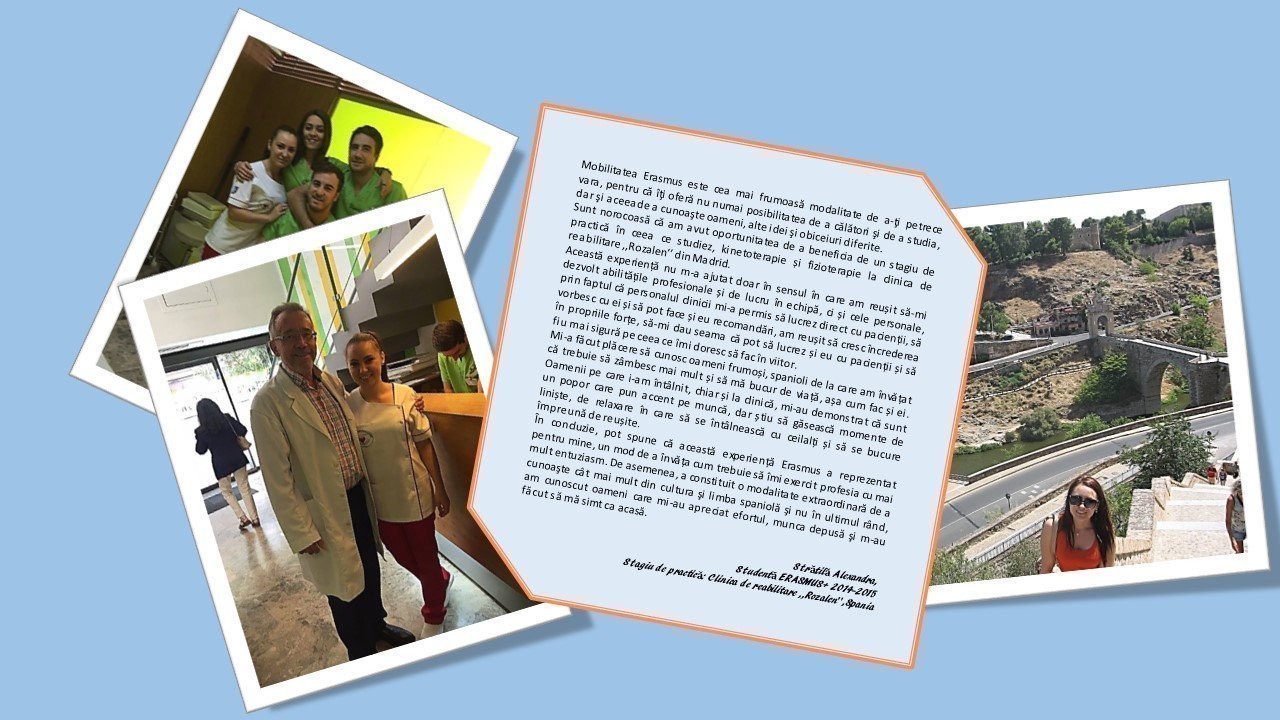
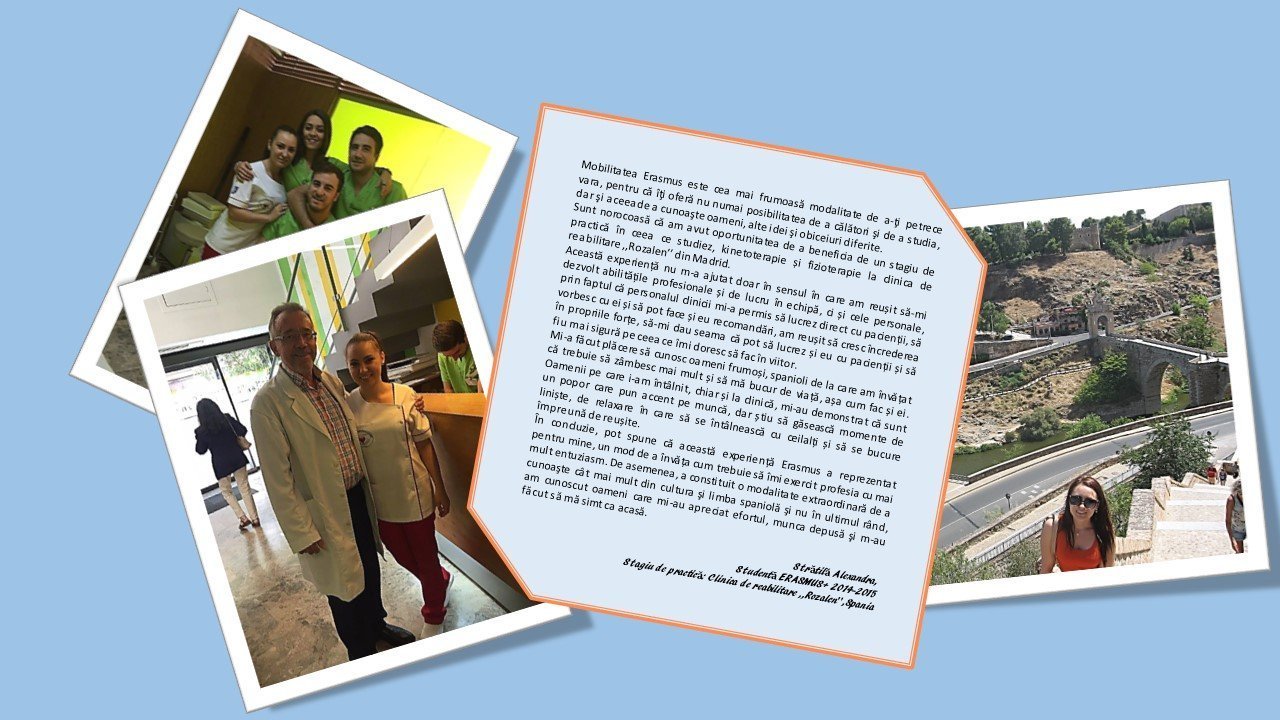
Strătilă Alexandra, Traineeship mobility: Rozalen Rehabilitation Clinic, Spain
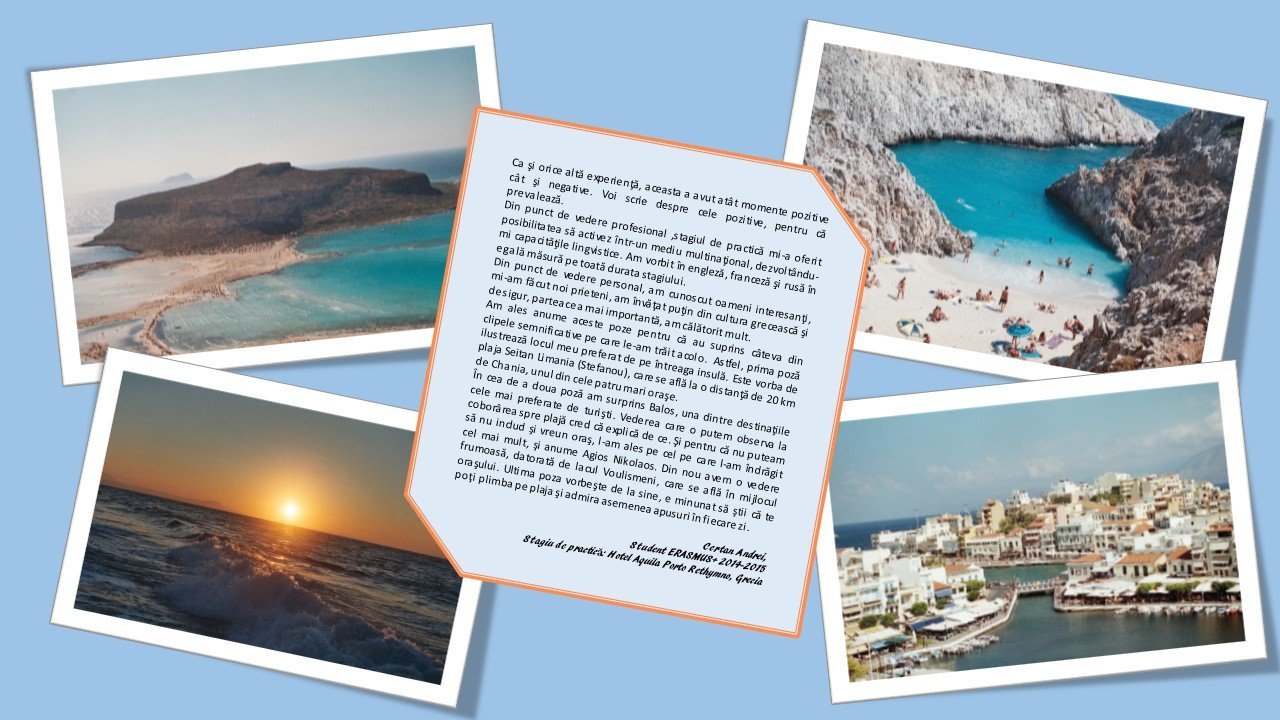
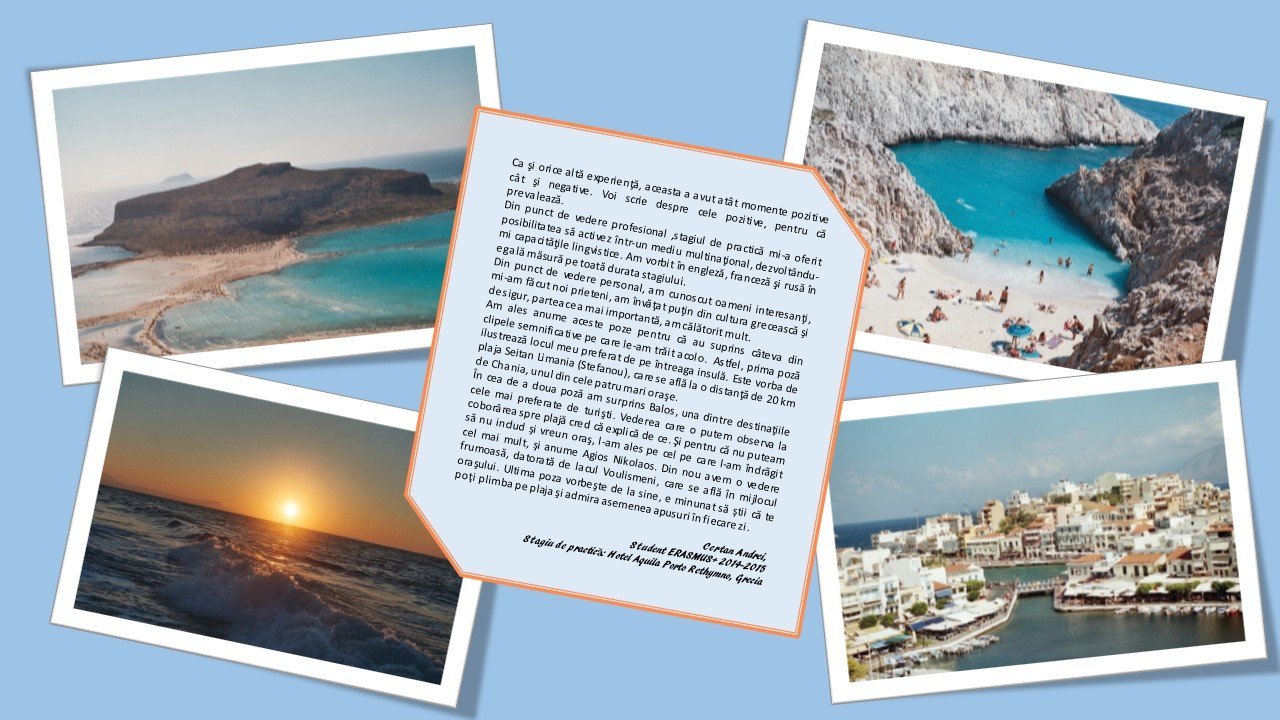
Certan Andrei, Traineeship mobility: Hotel Aquila Porto Rethymno, Greece
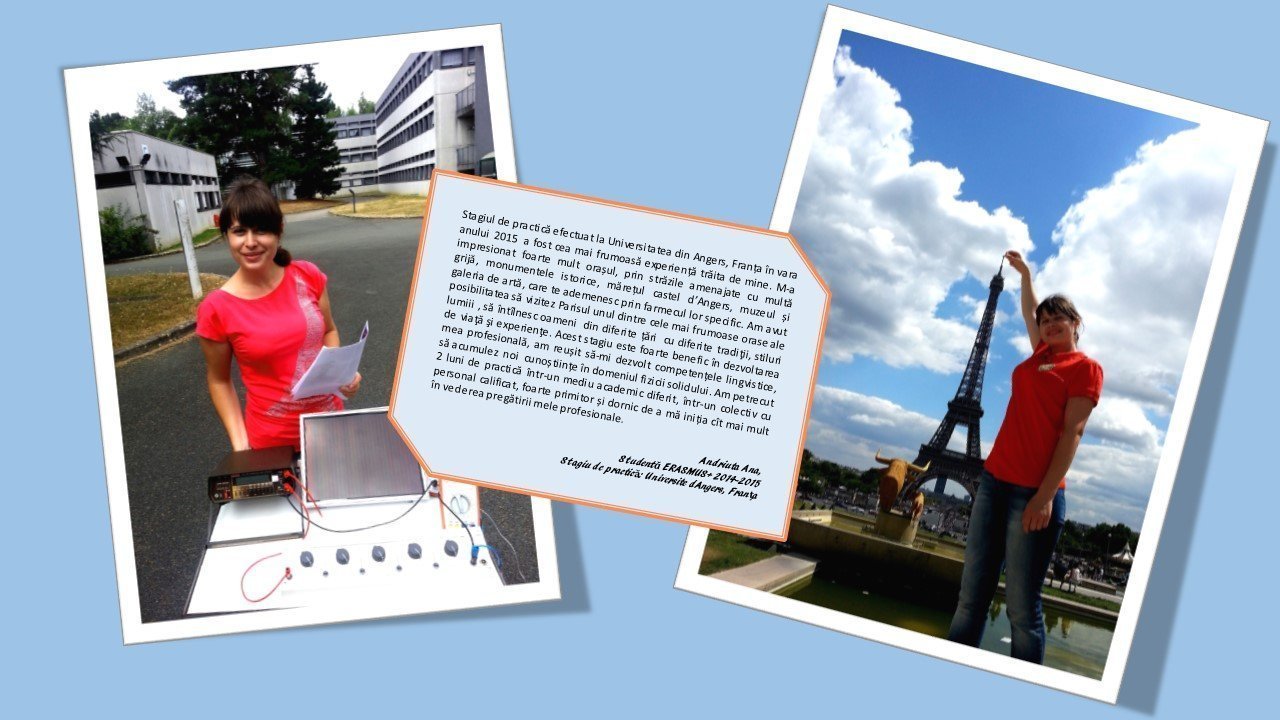
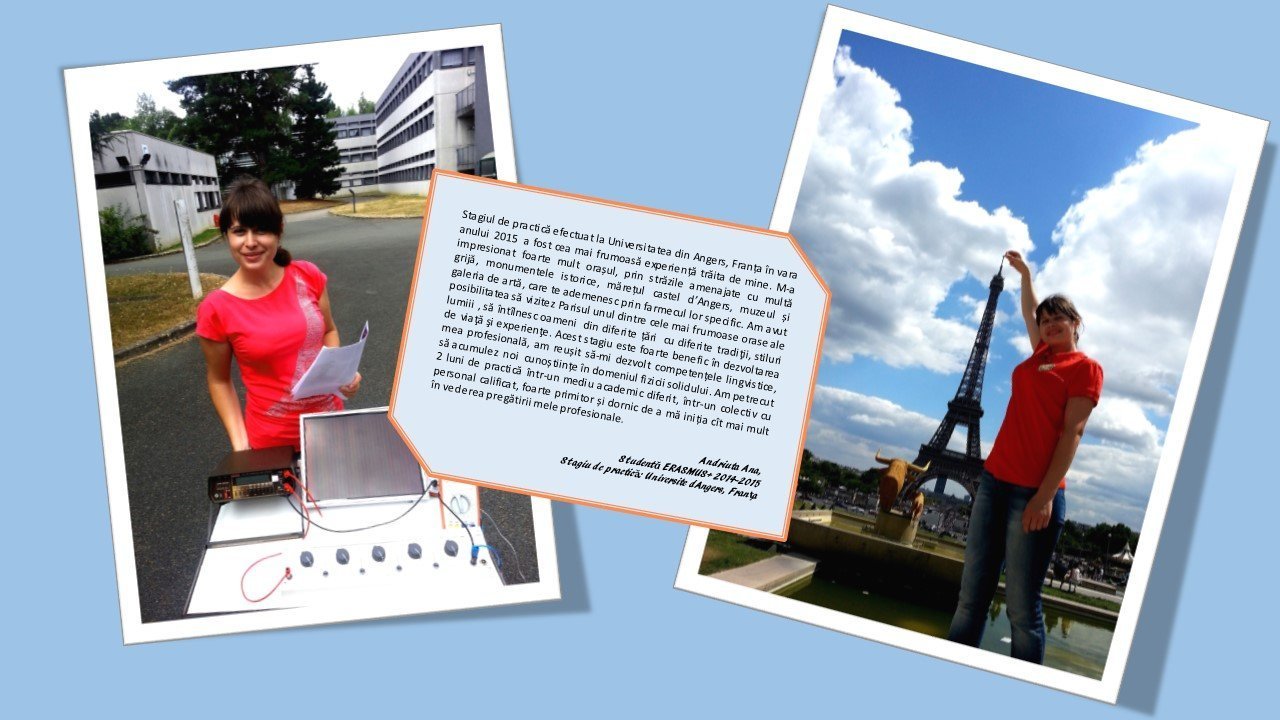
Andriuță Ana, Traineeship mobility: Universite d’Angers, France
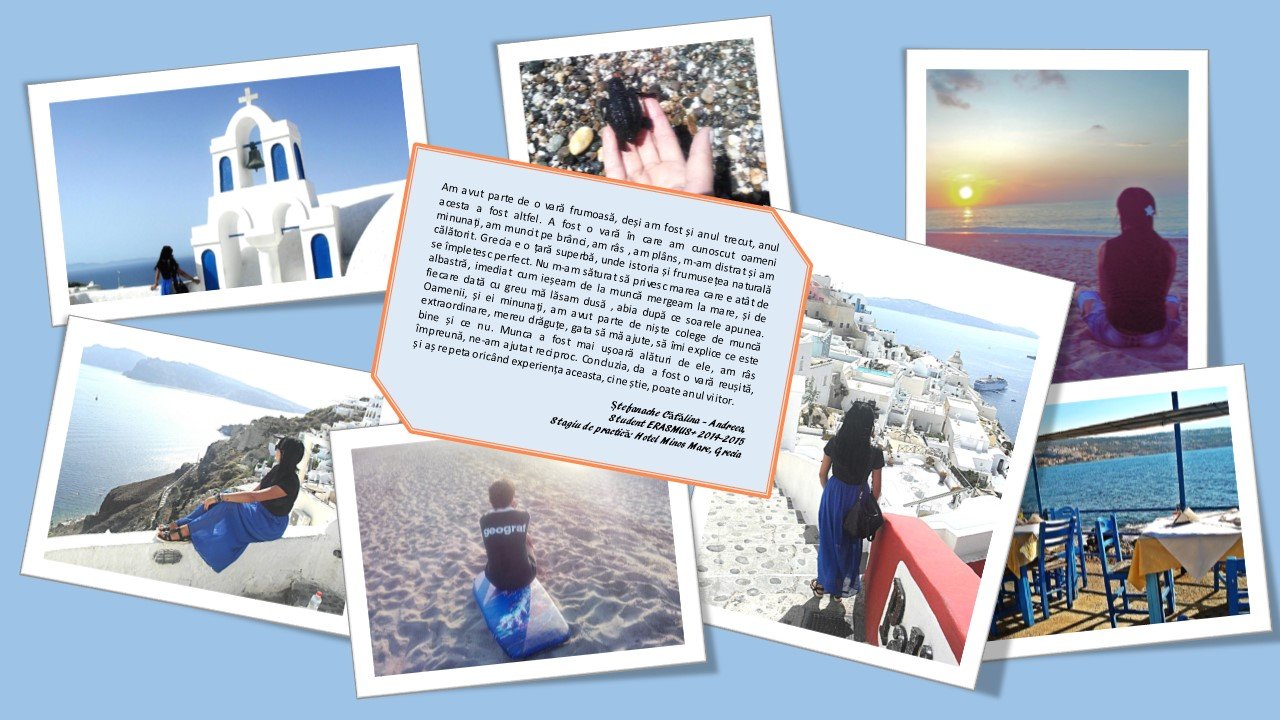
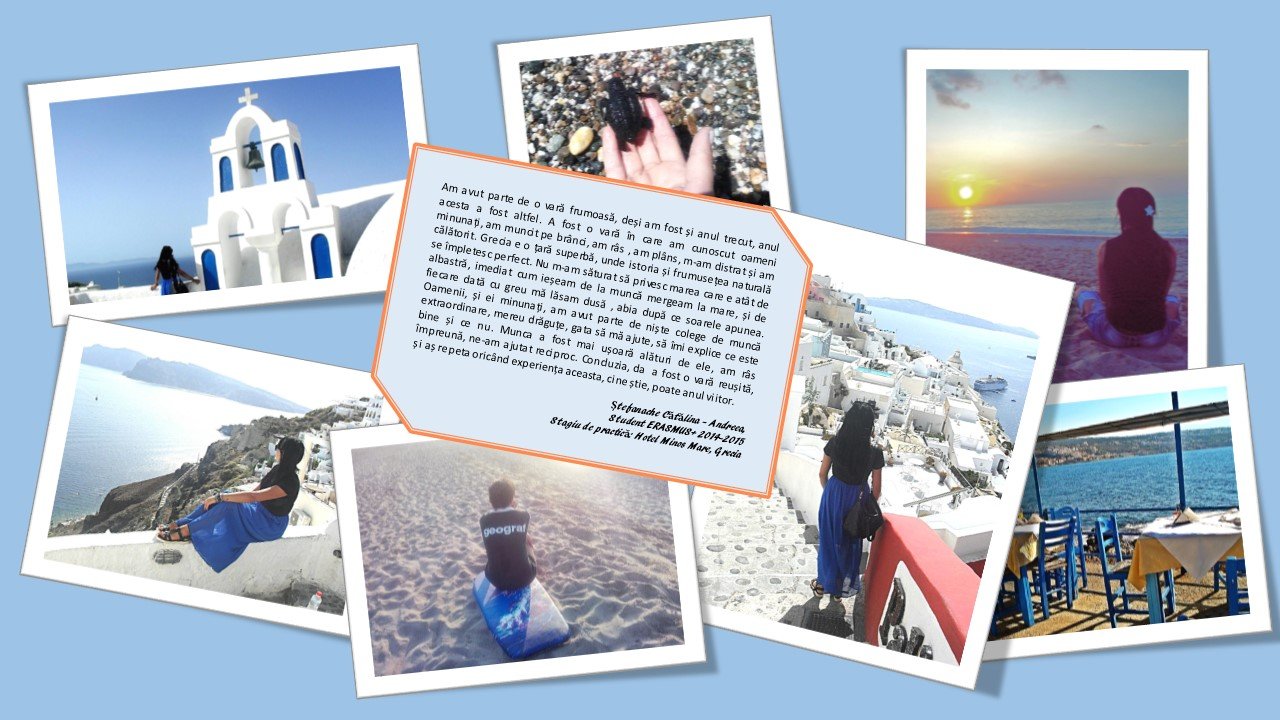
Ștefanache Cătălina – Andreea, Traineeship mobility: Hotel Minos Mare, Greece
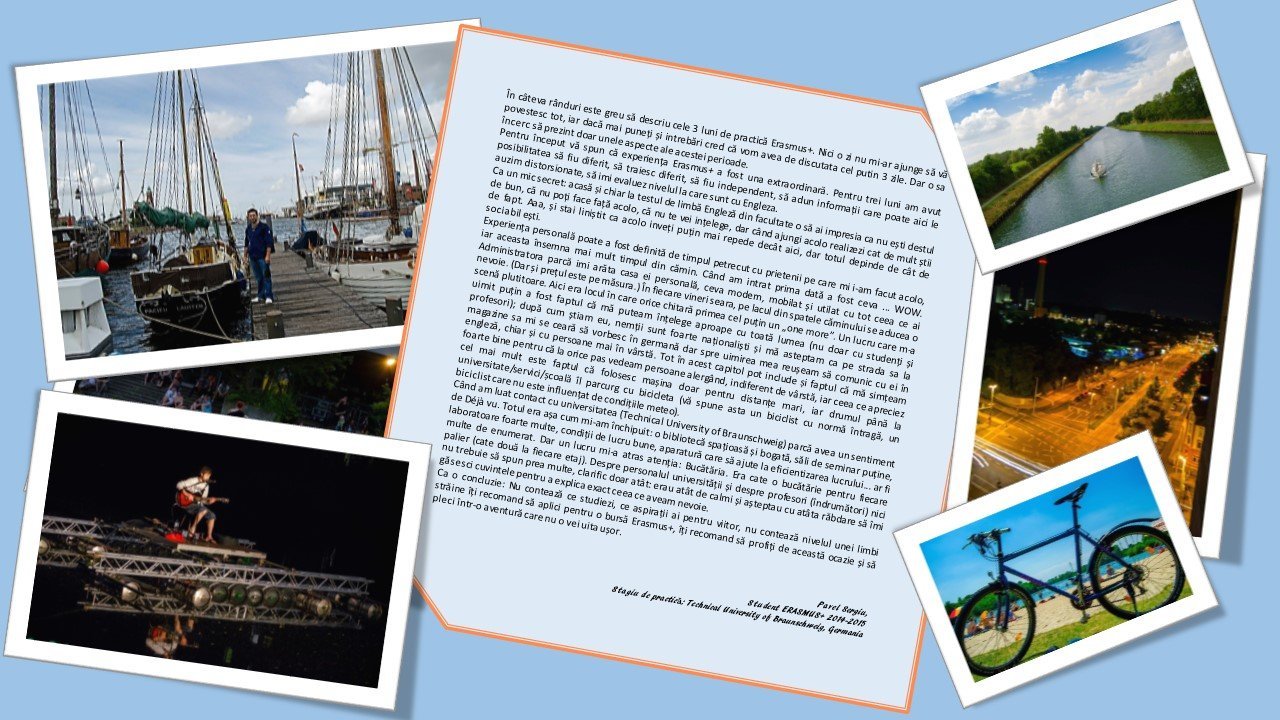
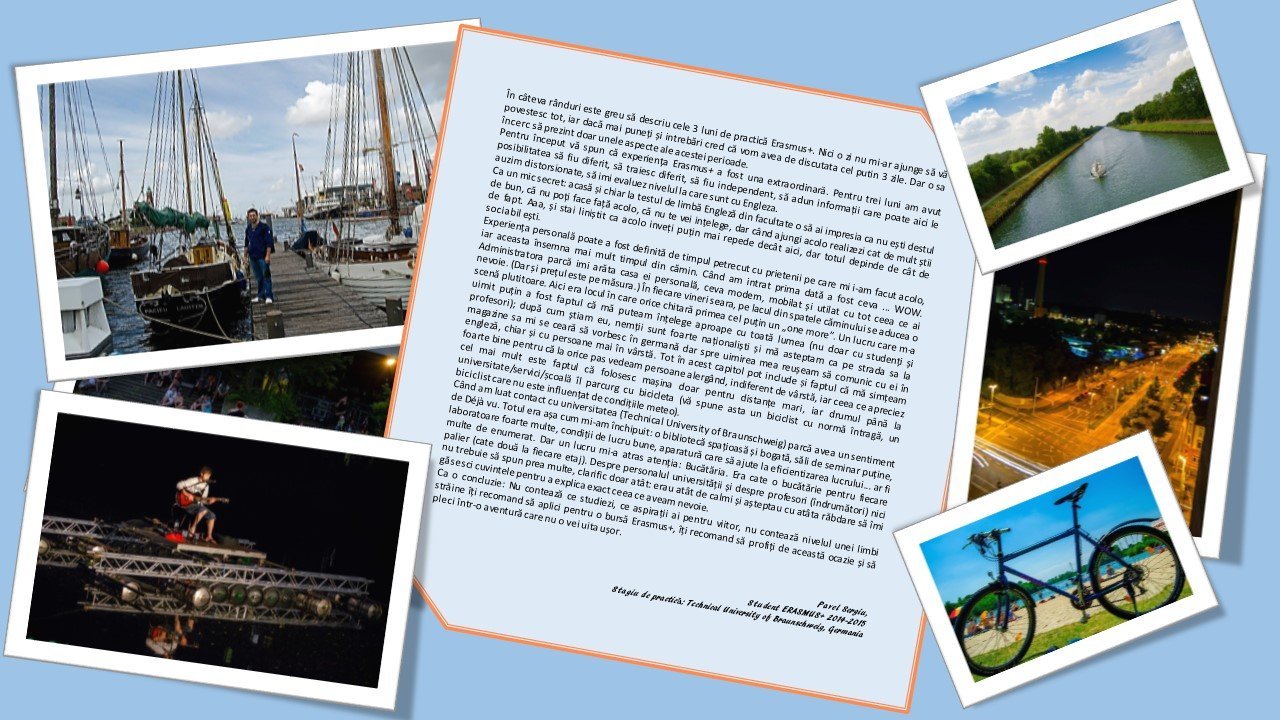
Pavel Sergiu, Traineeship mobility: Technical University of Braunschweig, Germany
Cristea Florentina, Traineeship mobility: NH Hesperia Sabinal Hotel, Spain
Busuioc Monica-Andreea , Traineeship mobility: Iberostar Creta Panorama Hotel, Greece
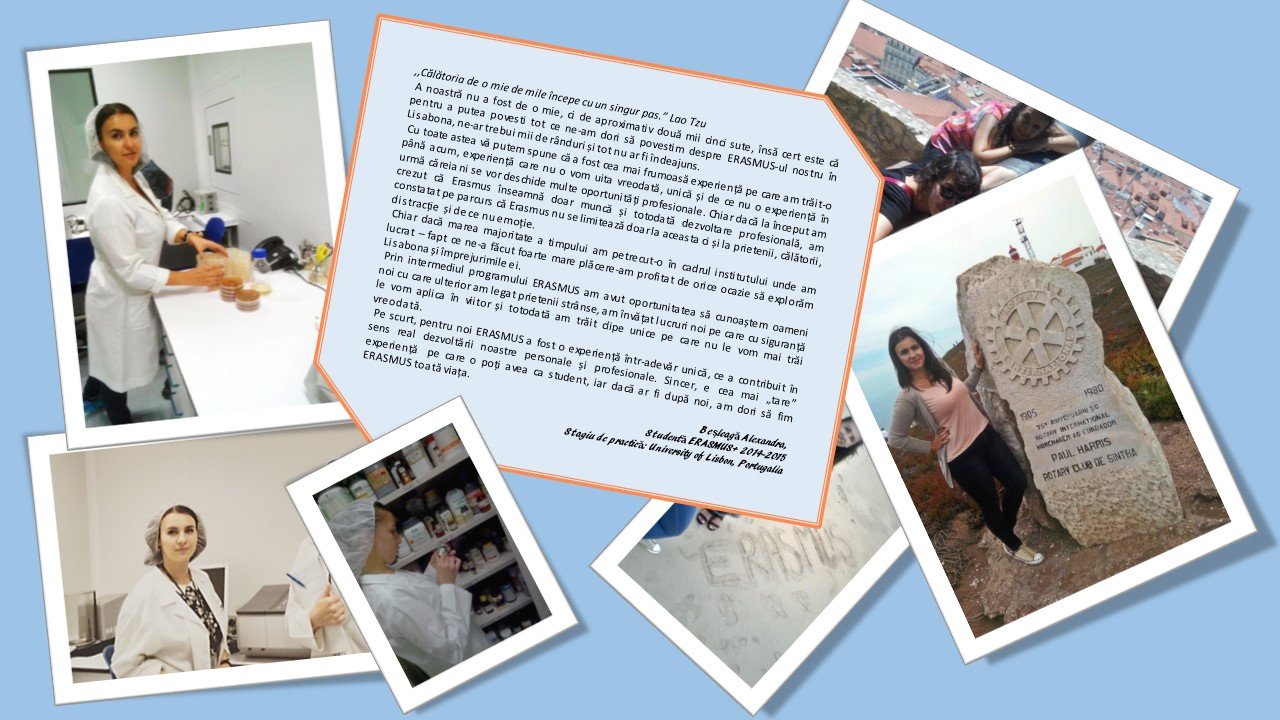
Beșleagă Alexandra, Traineeship mobility: University of Lisbon, Portugal
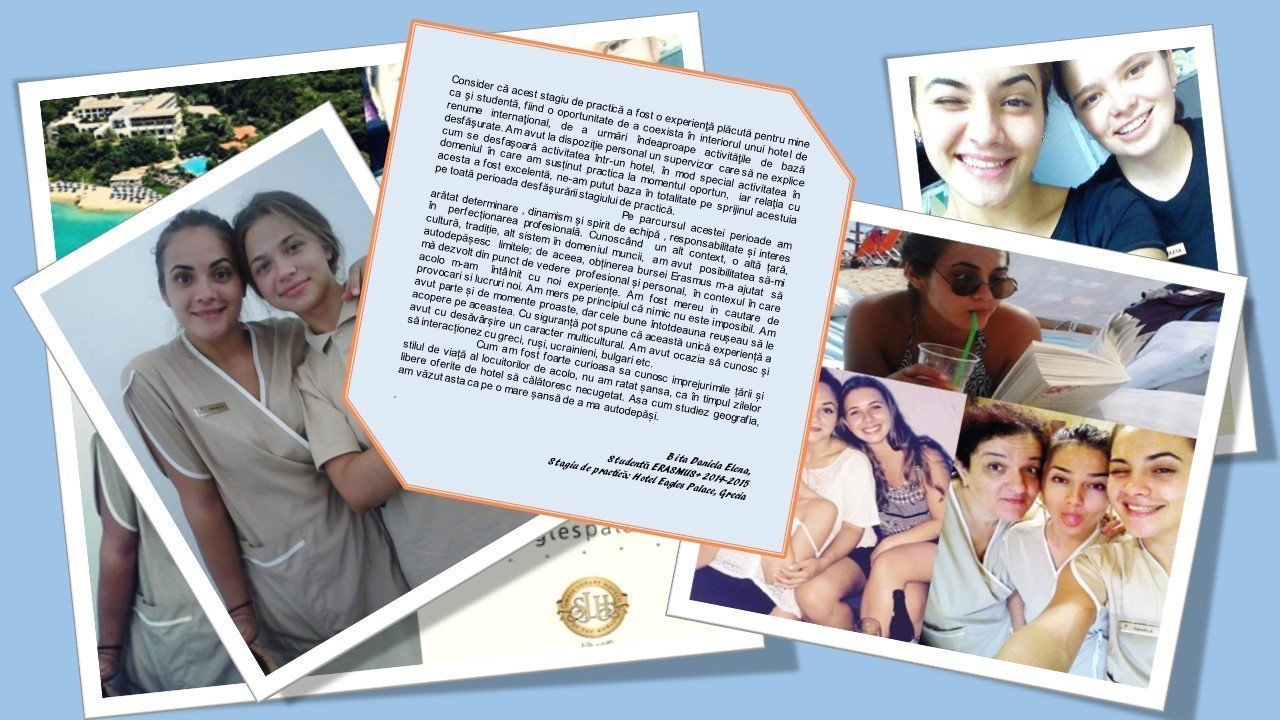
Bita Daniela Elena, Traineeship mobility: Eagles Palace Hotel, Greece
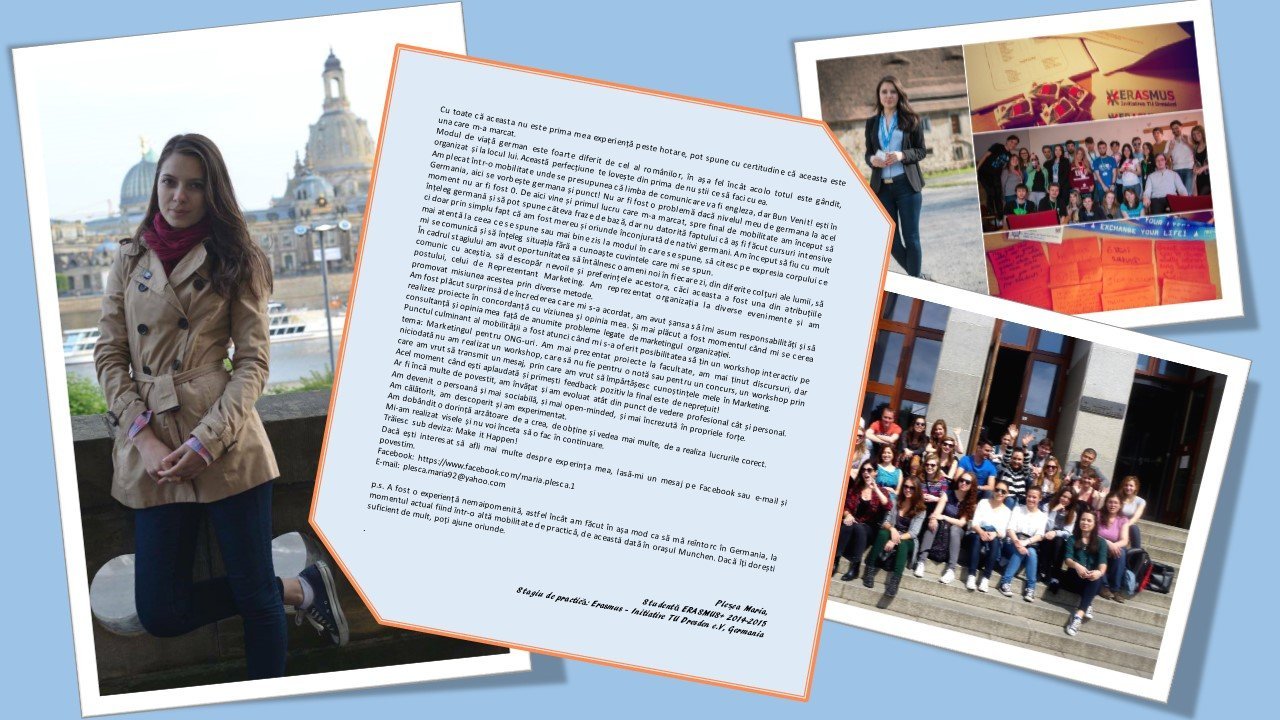
Pleșca Maria, Traineeship mobility: Erasmus – Initiative TU Dresden e.V, Germany
Lău Diana, Traineeship mobility: Iberostar Creta Panorama Hotel, Greece
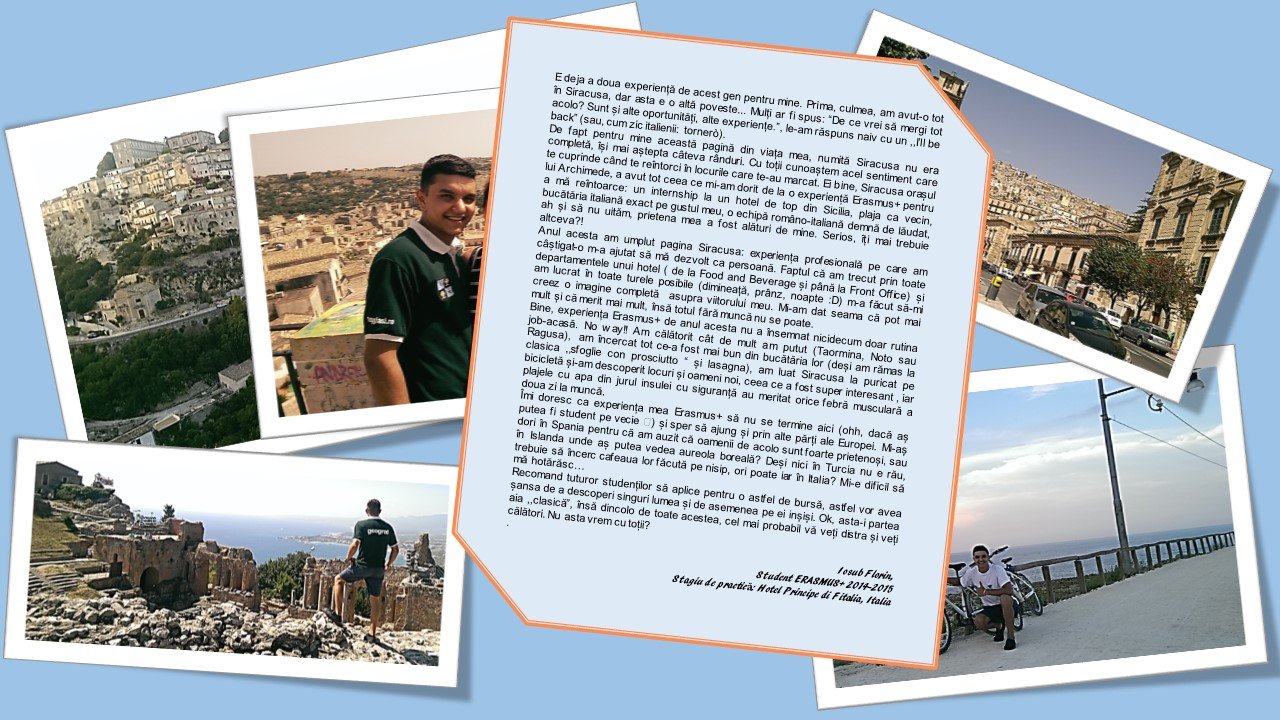
Iosub Florin, Traineeship mobility: Principe di Fitalia Hotel, Italy
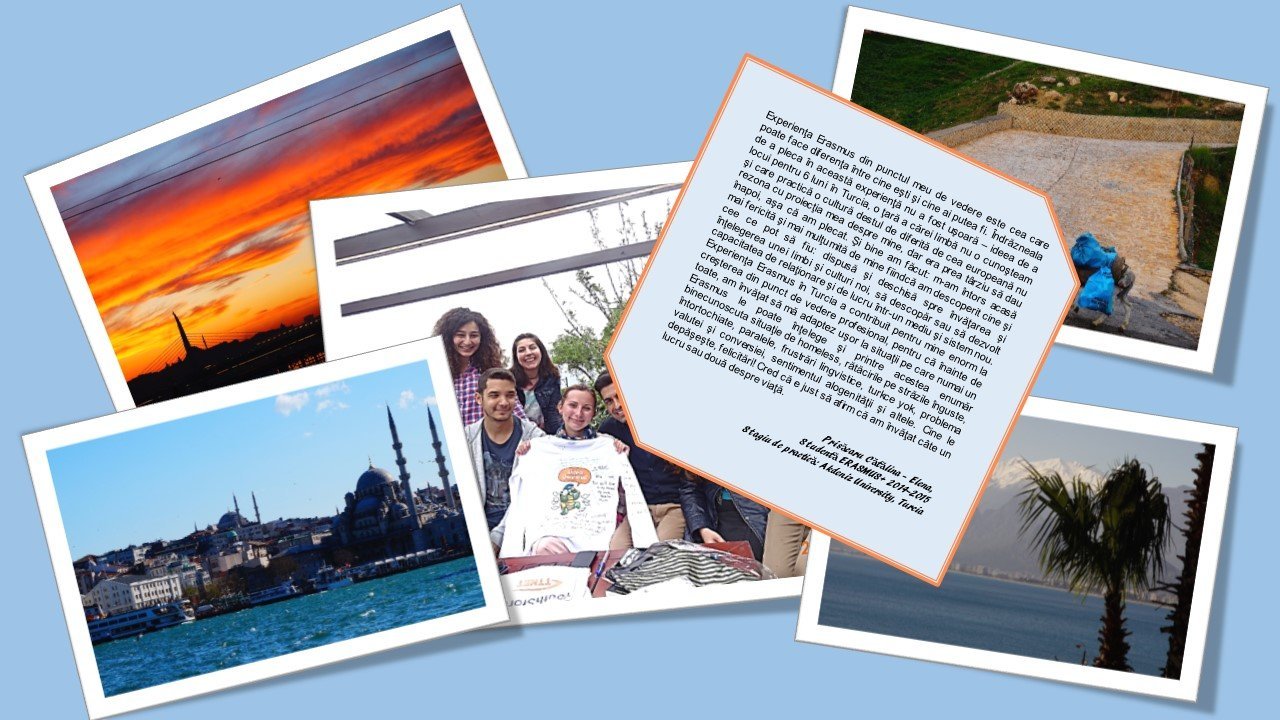
Prisăcaru Cătălina – Elena, Traineeship mobility: Akdeniz University, Turkey
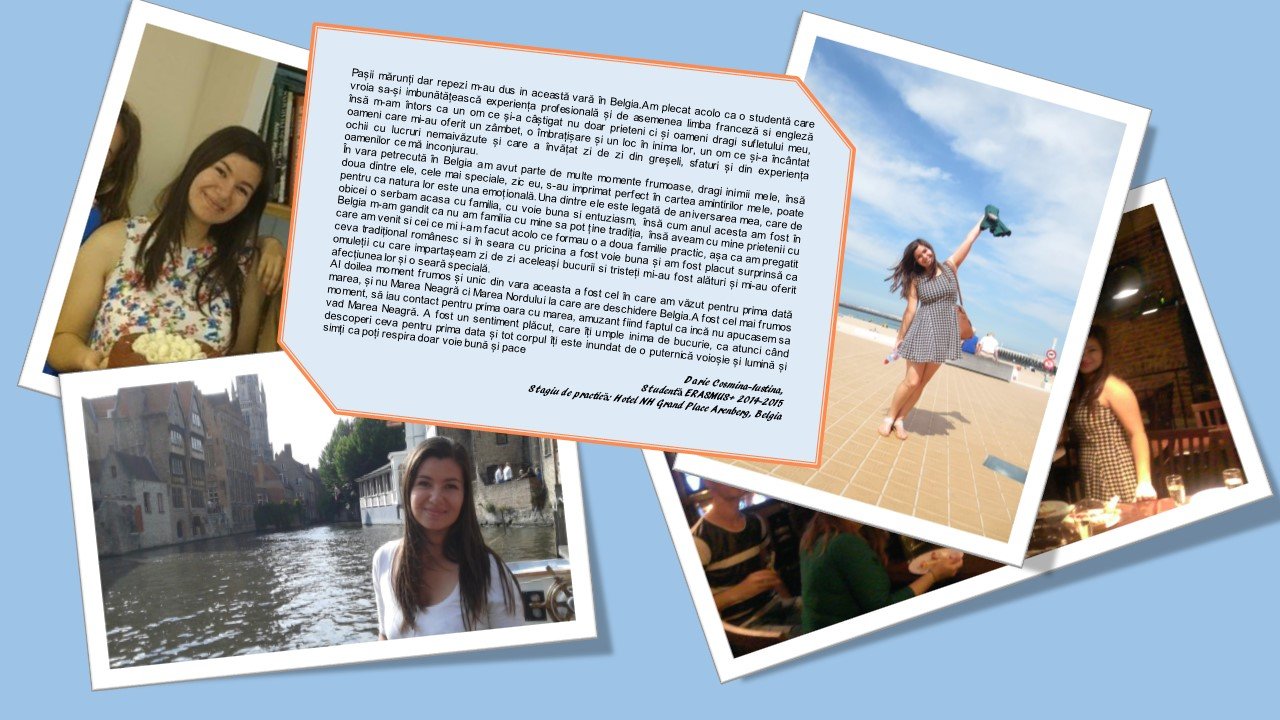
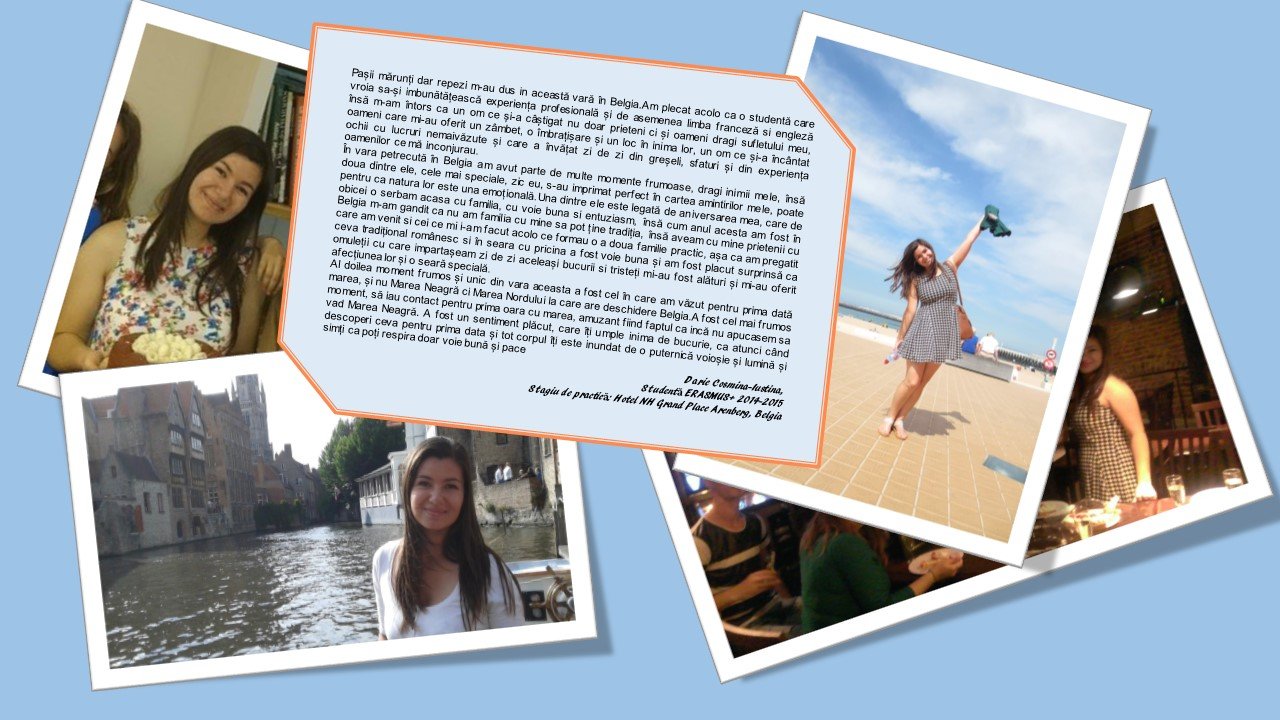
Darie Cosmina-Iustina, Traineeship mobility: NH Grand Place Arenberg Hotel, Belgium
Alexandra Oprea, Traineeship mobility: Principe di Fitalia Hotel, Italy
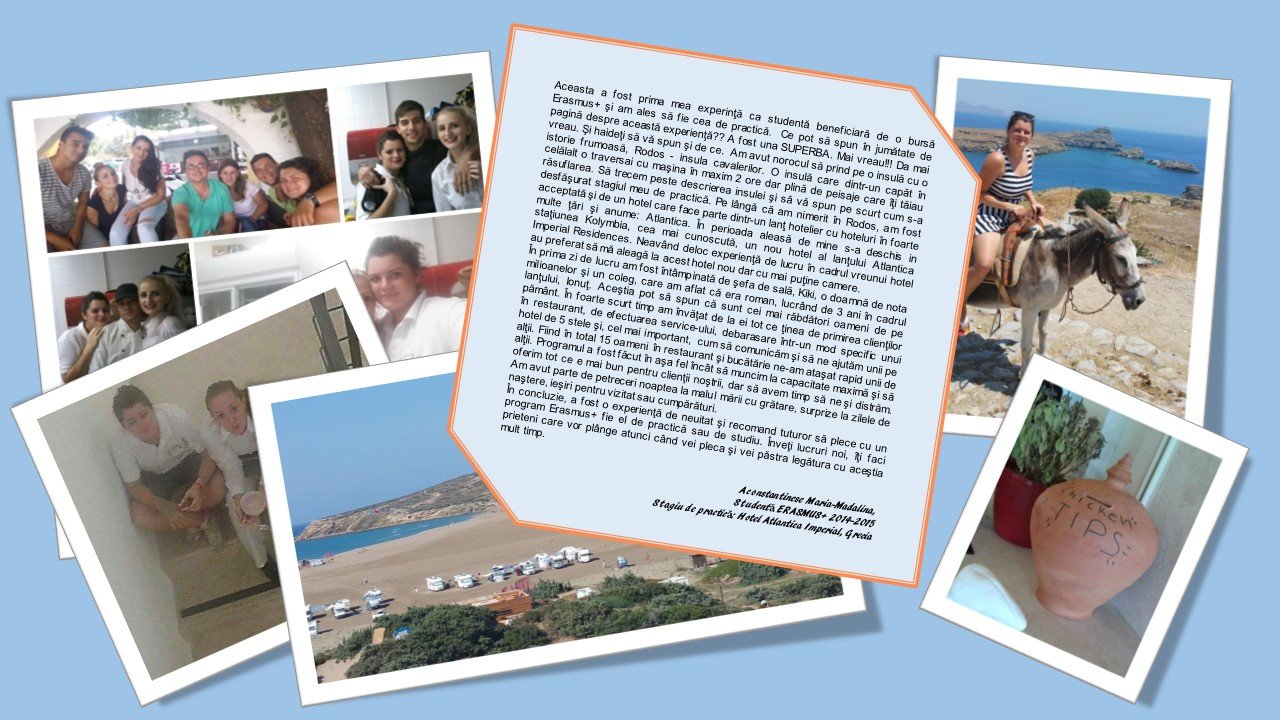
Aconstantinese Maria-Madalina, Traineeship mobility: Atlantica Imperial Hotel, Greece
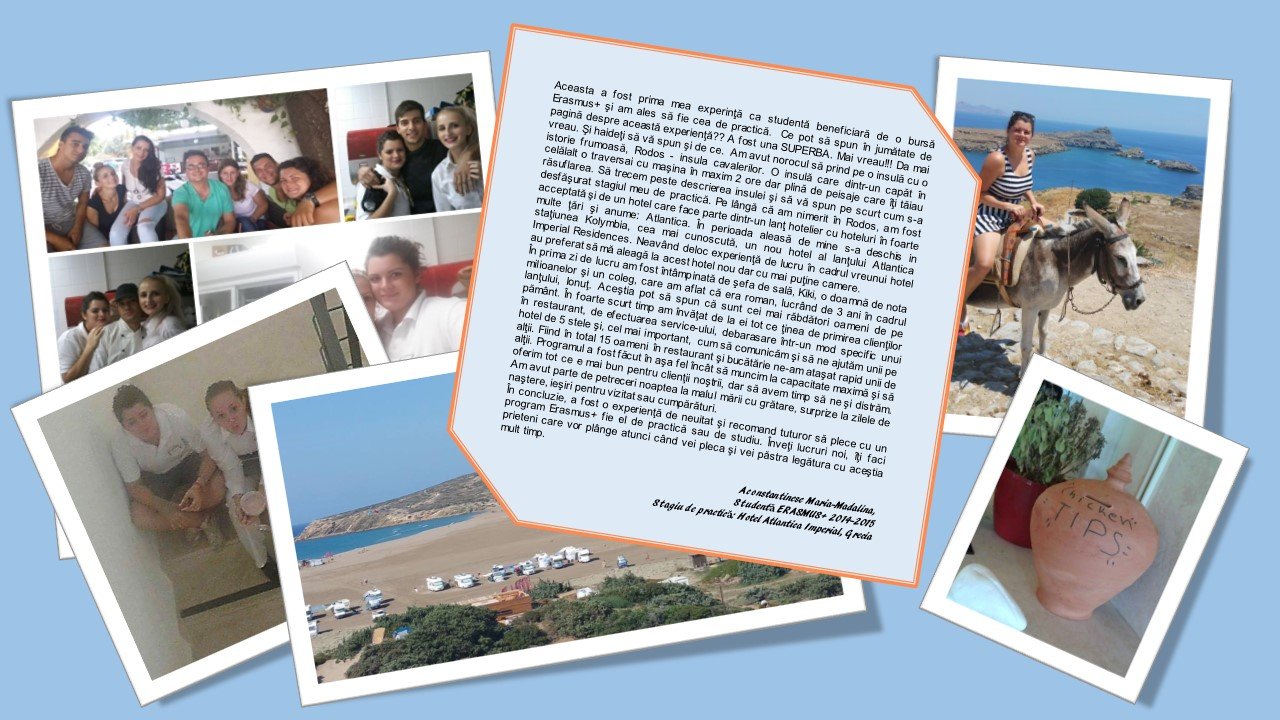
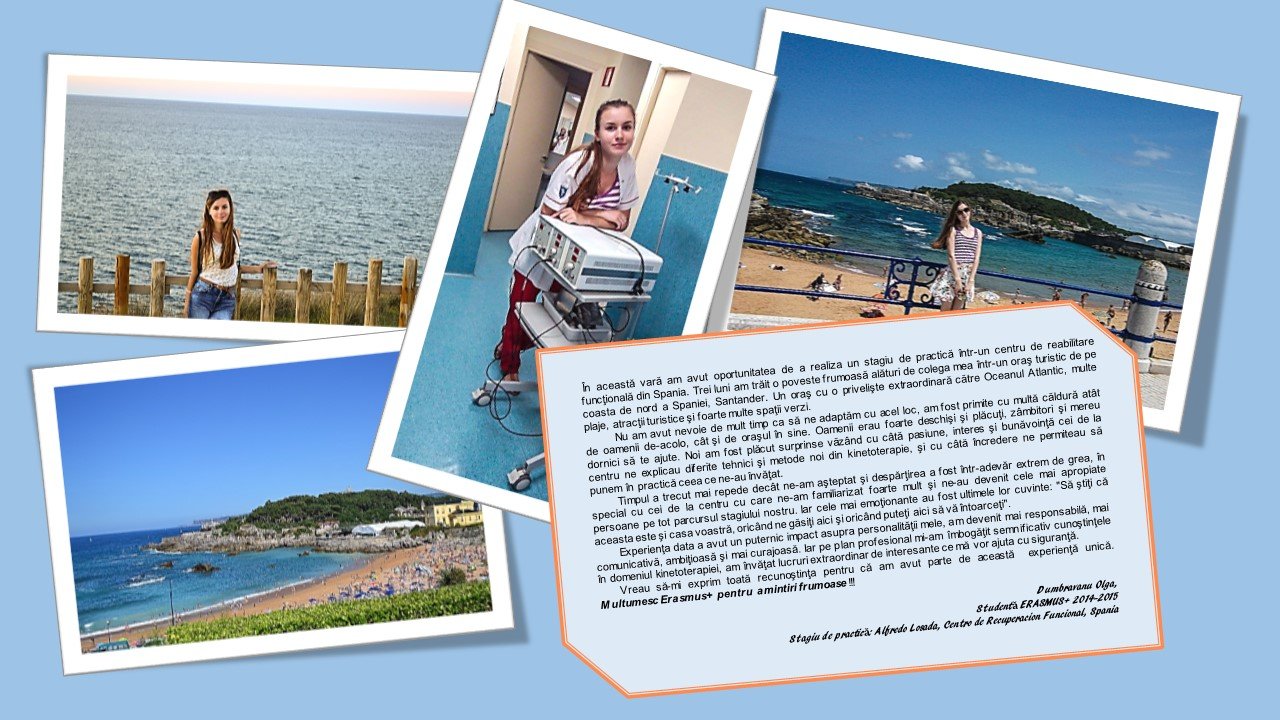
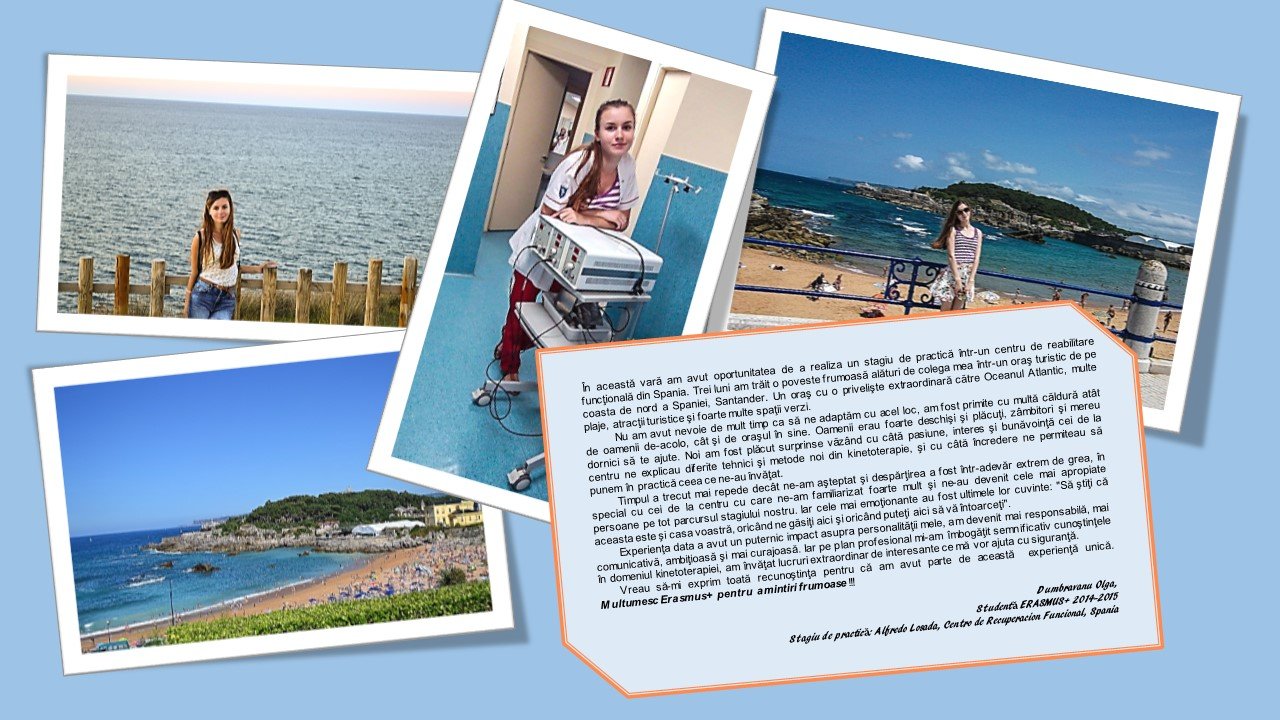
Dumbravanu Olga, Traineeship mobility: Alfredo Losada, Centro de Recuperacion Funcional, Spain
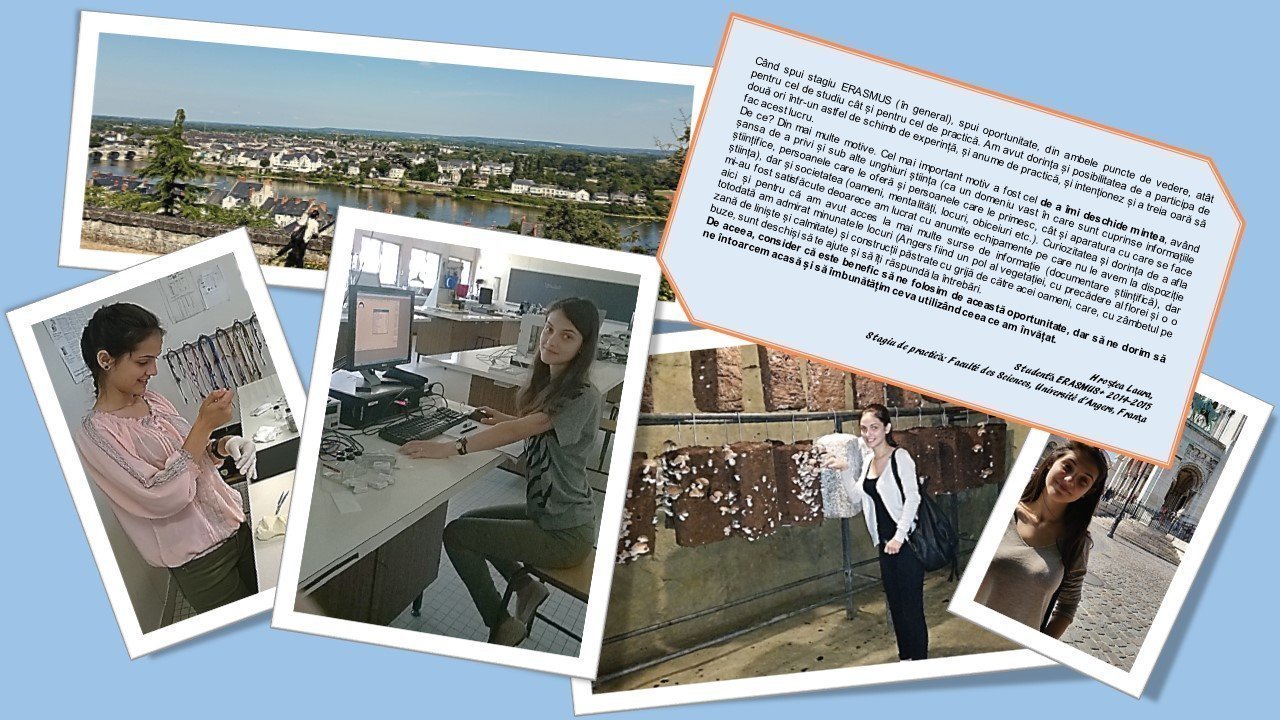
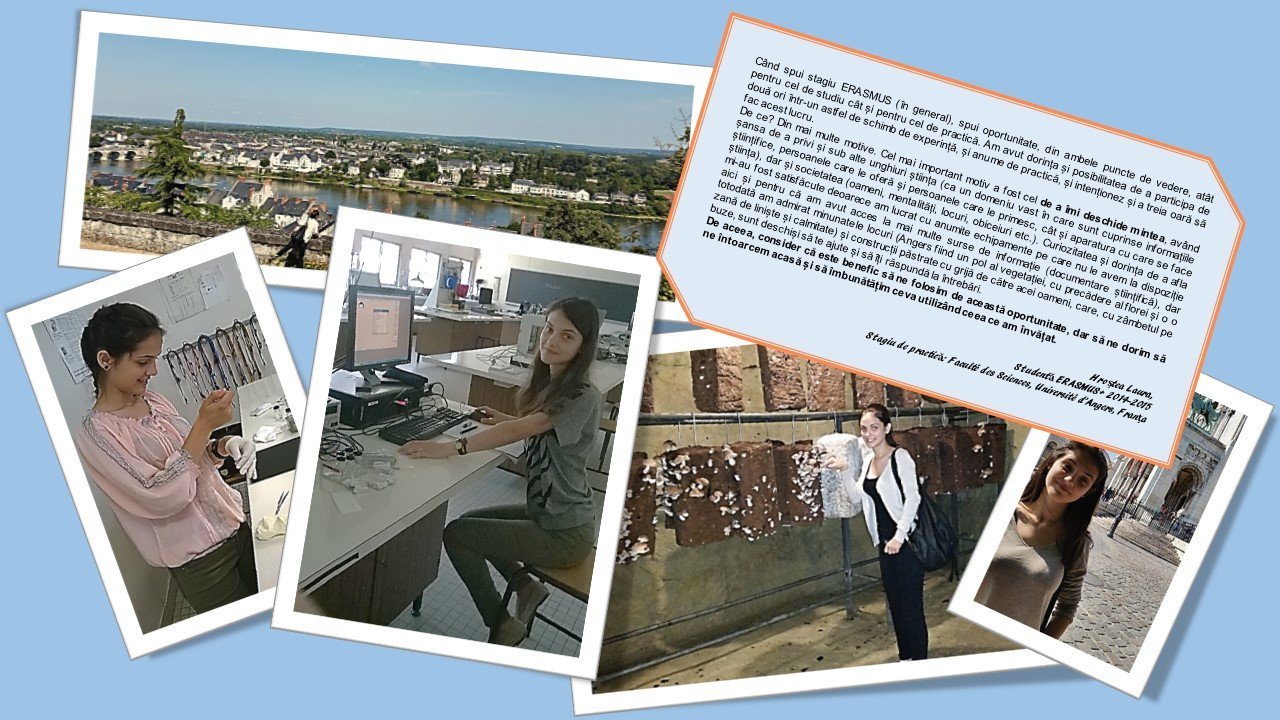
Hroștea Laura, Traineeship mobility: Faculté des Sciences, Université d’Angers, France
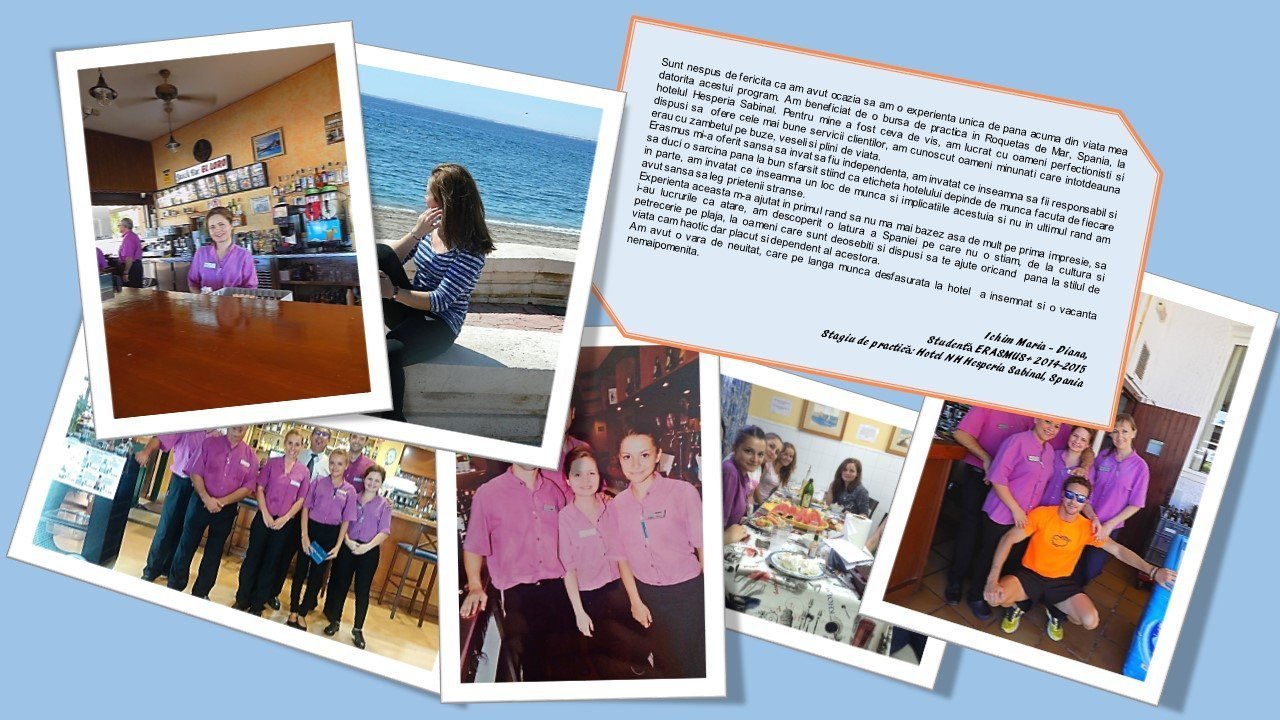
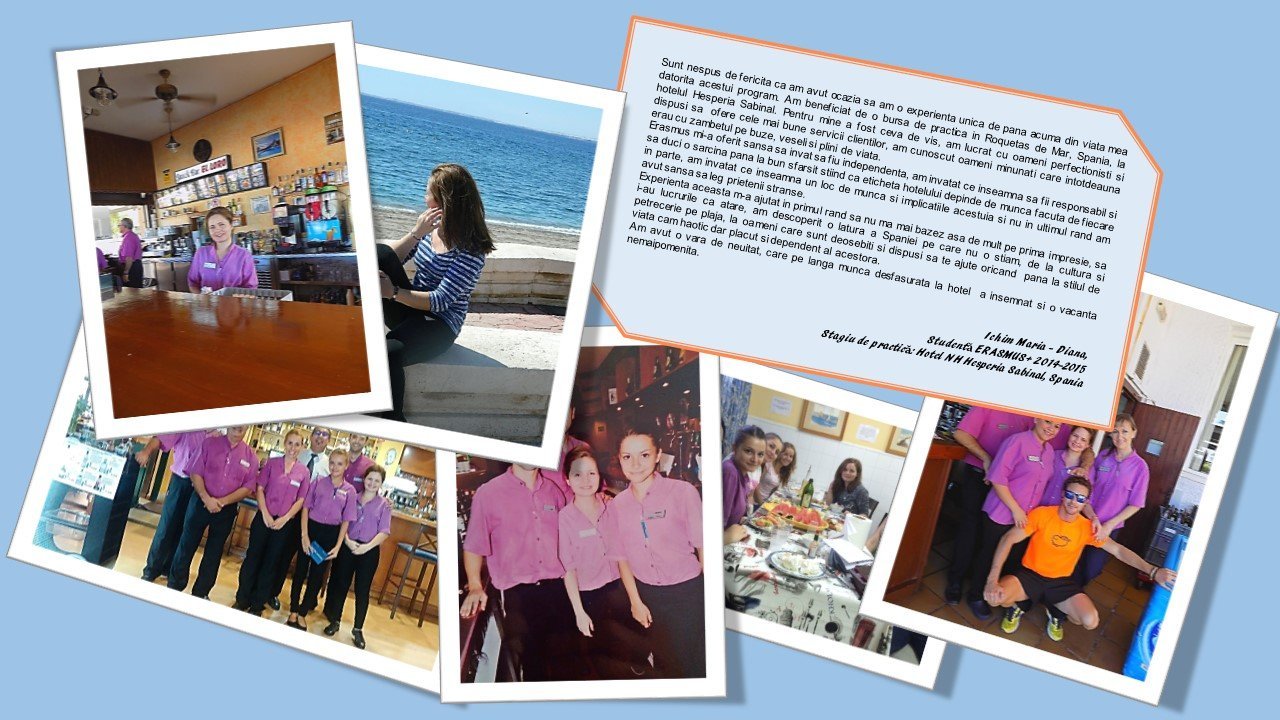
Ichim Maria – Diana, Traineeship mobility: NH Hesperia Sabinal Hotel, Spain
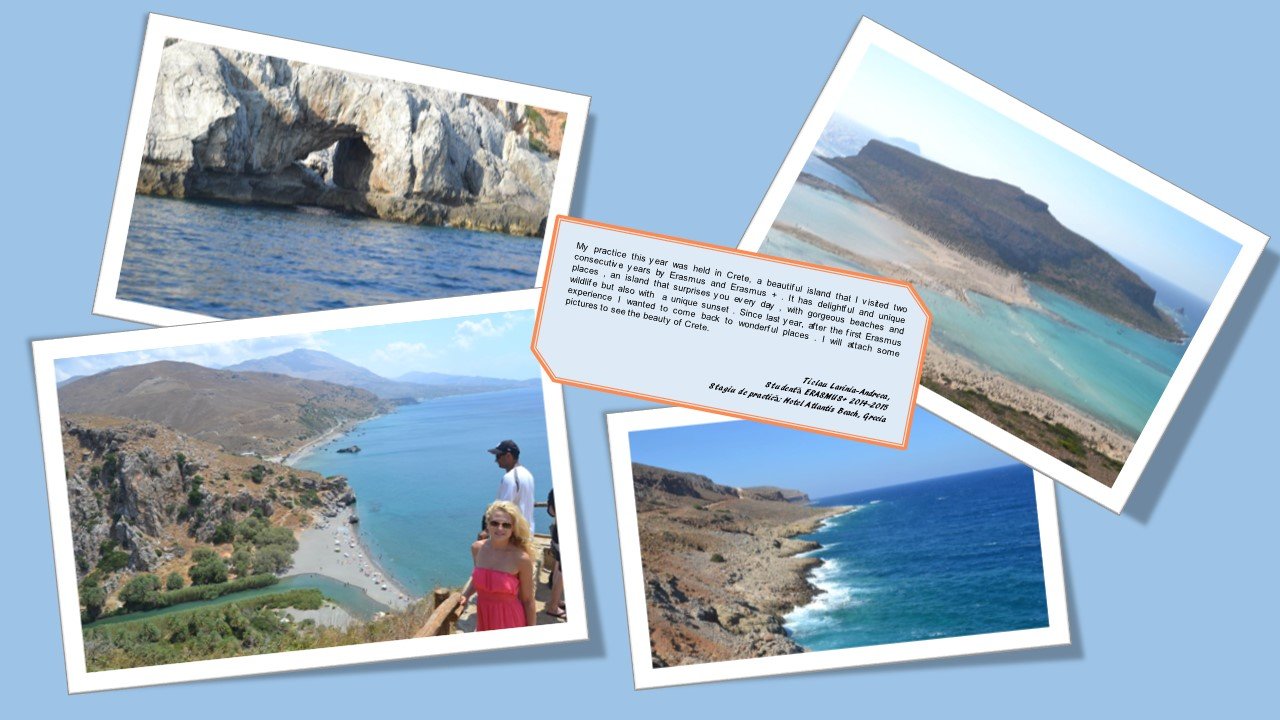
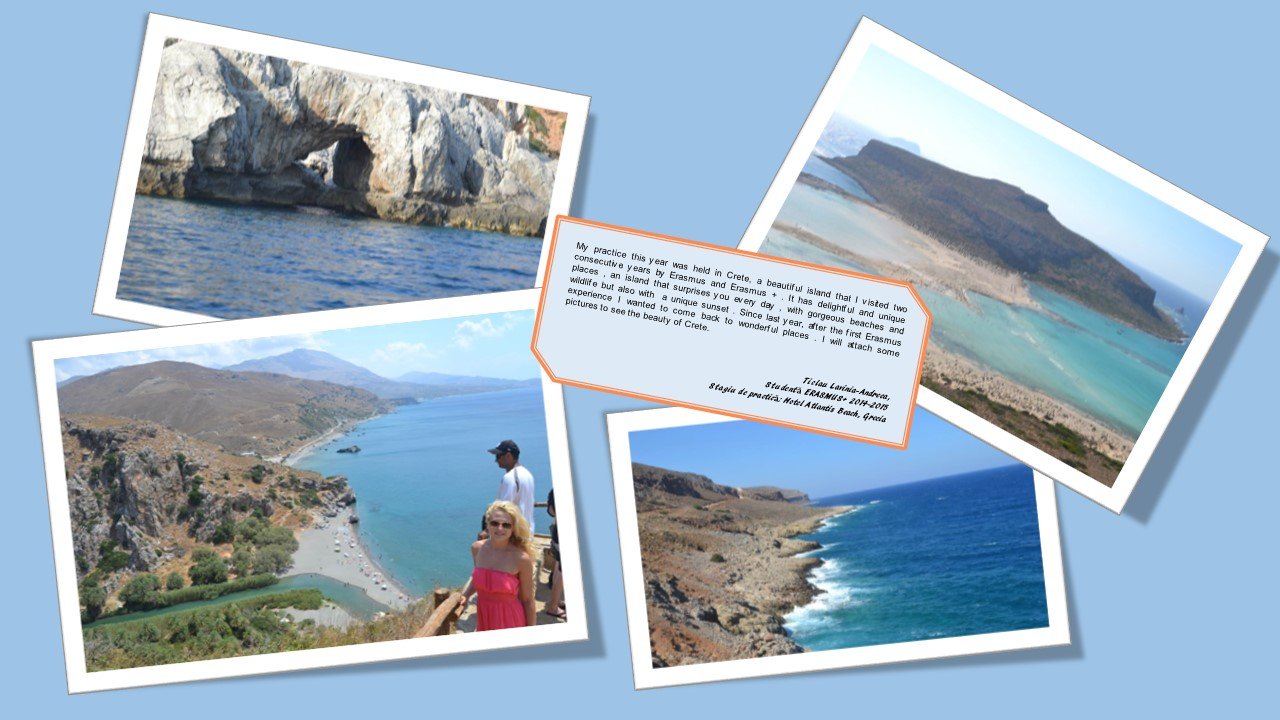
Ticlau Lavinia-Andreea, Traineeship mobility: Atlantis Beach Hotel, Greece
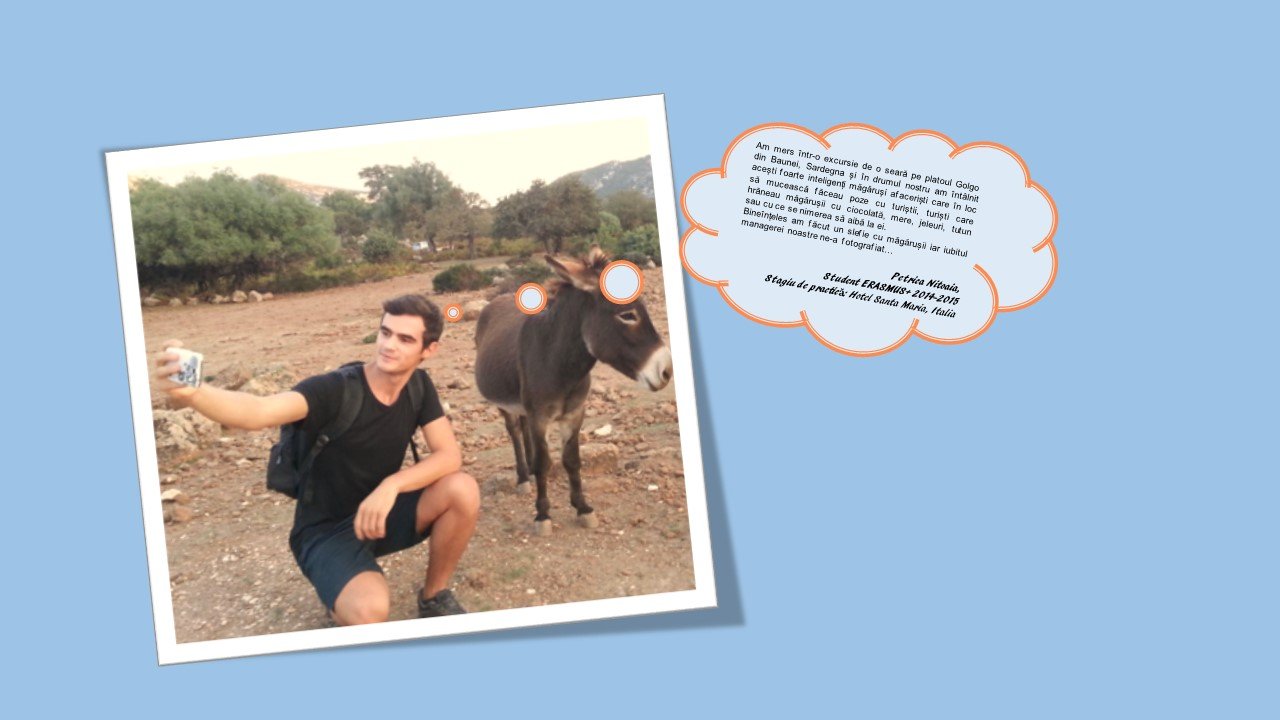
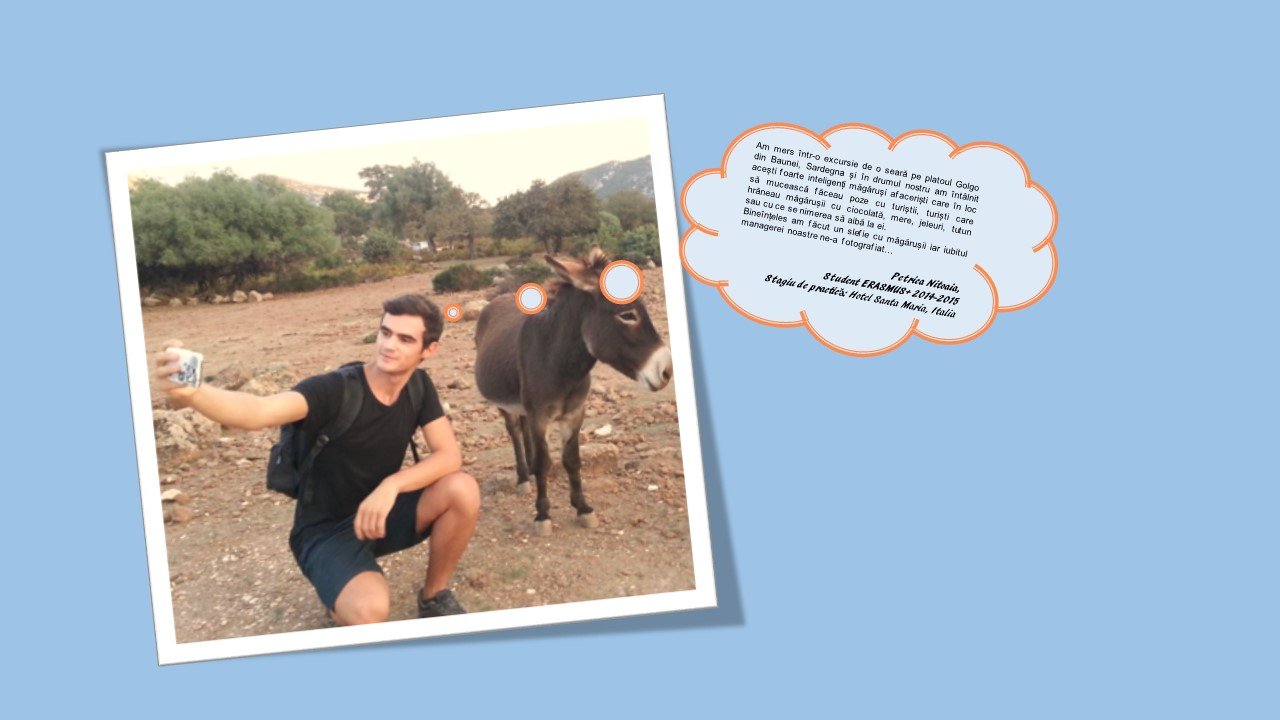
Petrică Nițoaia, Traineeship mobility: Santa Maria Hotel, Italy
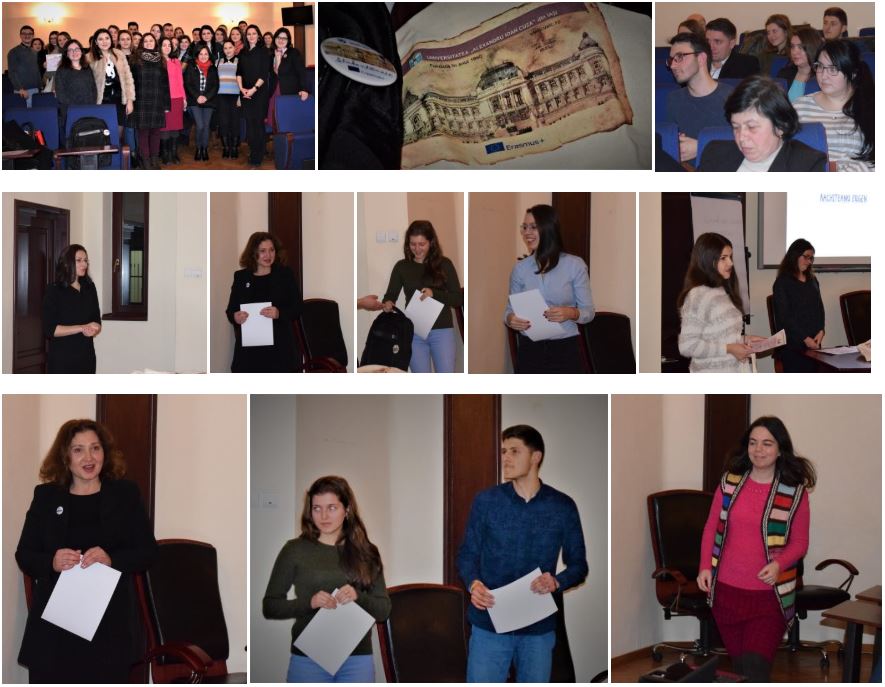
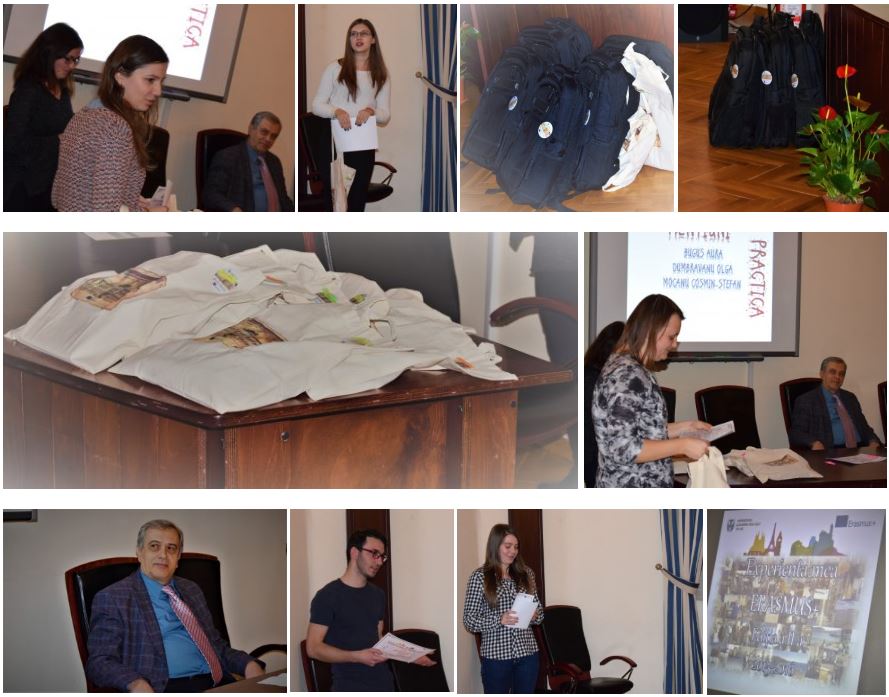
My Erasmus+ Experience Competition, 3rd Edition, 2016-2017
Announcement of the competition with prizes: My Erasmus Experience 2014 – 2015

Participants’ presentation video

List of winners

Award ceremony announcement
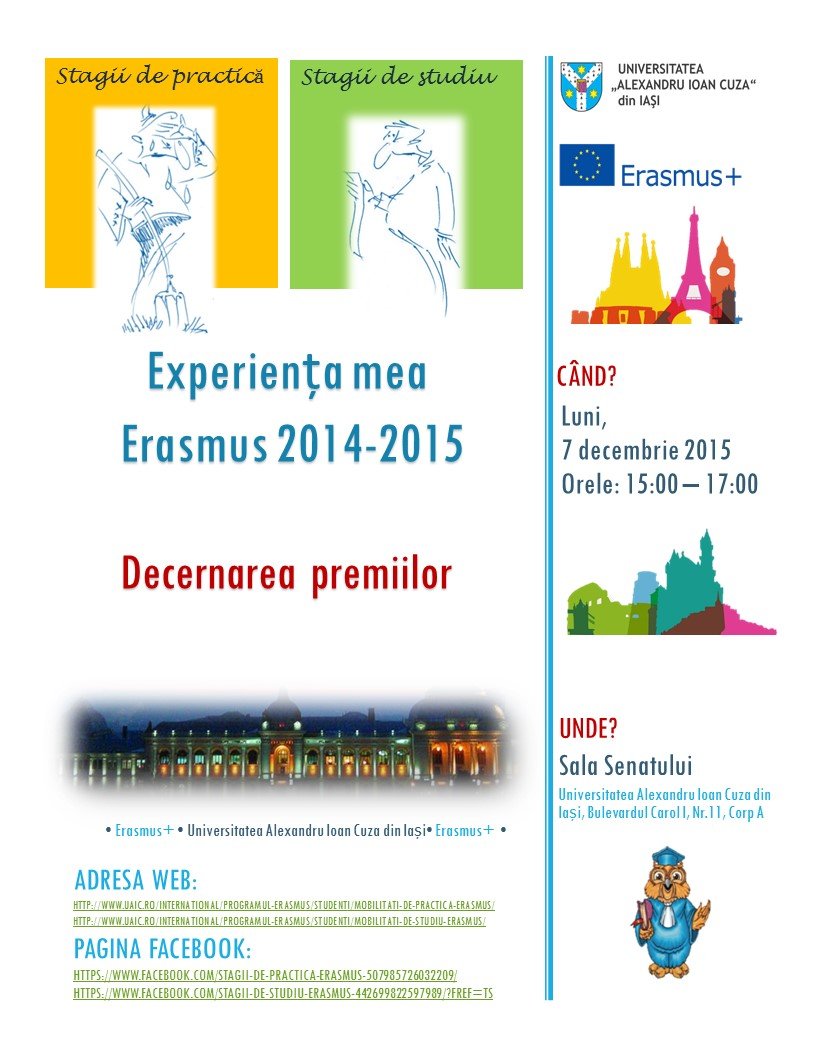
award ceremony announcementERASMUS students entered in the competition:

Ungureanu Andra,

Traineeship: Suleyman Demirel University, TurkeySlide35

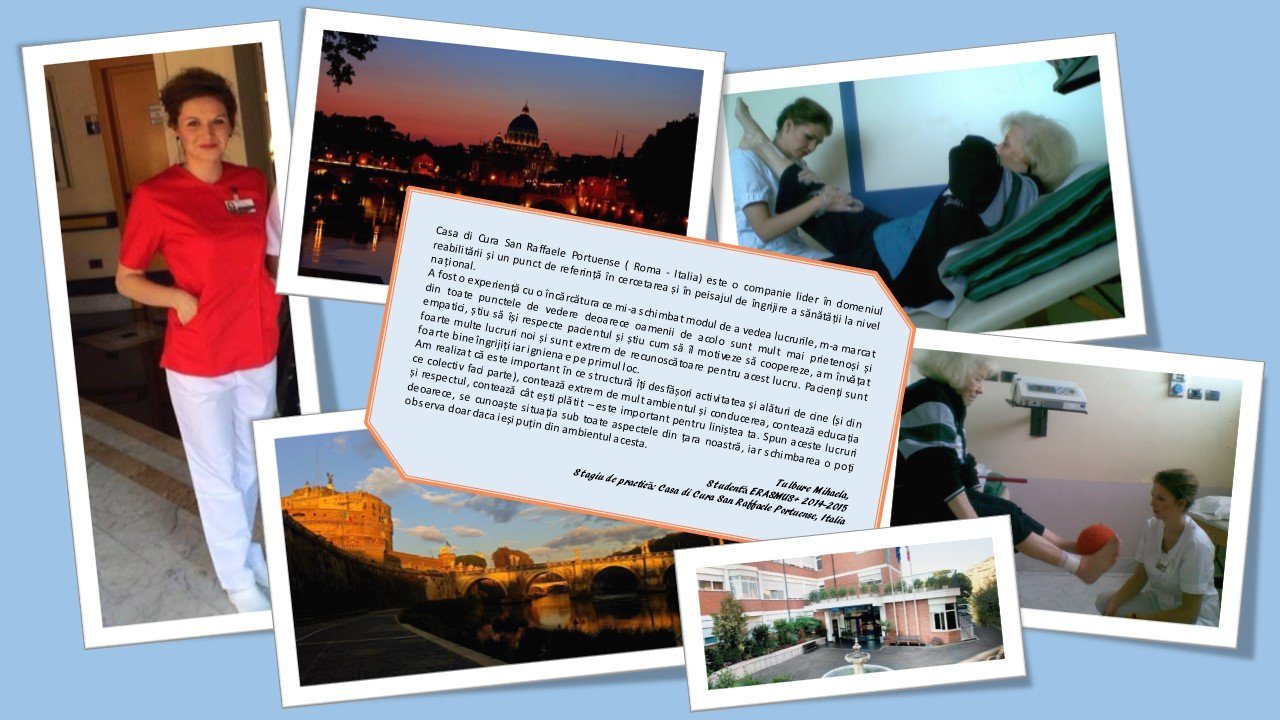
Tulbure Mihaela,

Traineeship: Casa di Cura San Raffaele Portuense, ItalySlide34
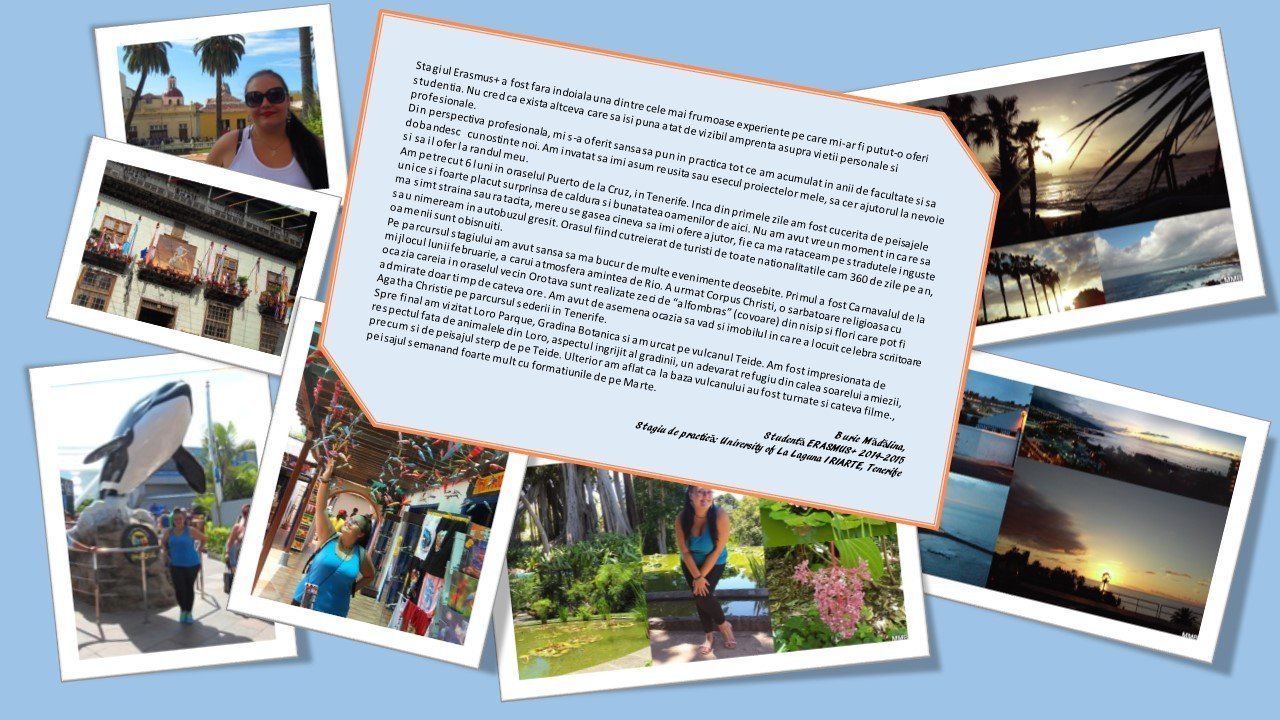
Buric Mădălina,

Traineeship: University of La Laguna IRIARTE, TenerifeSlide33
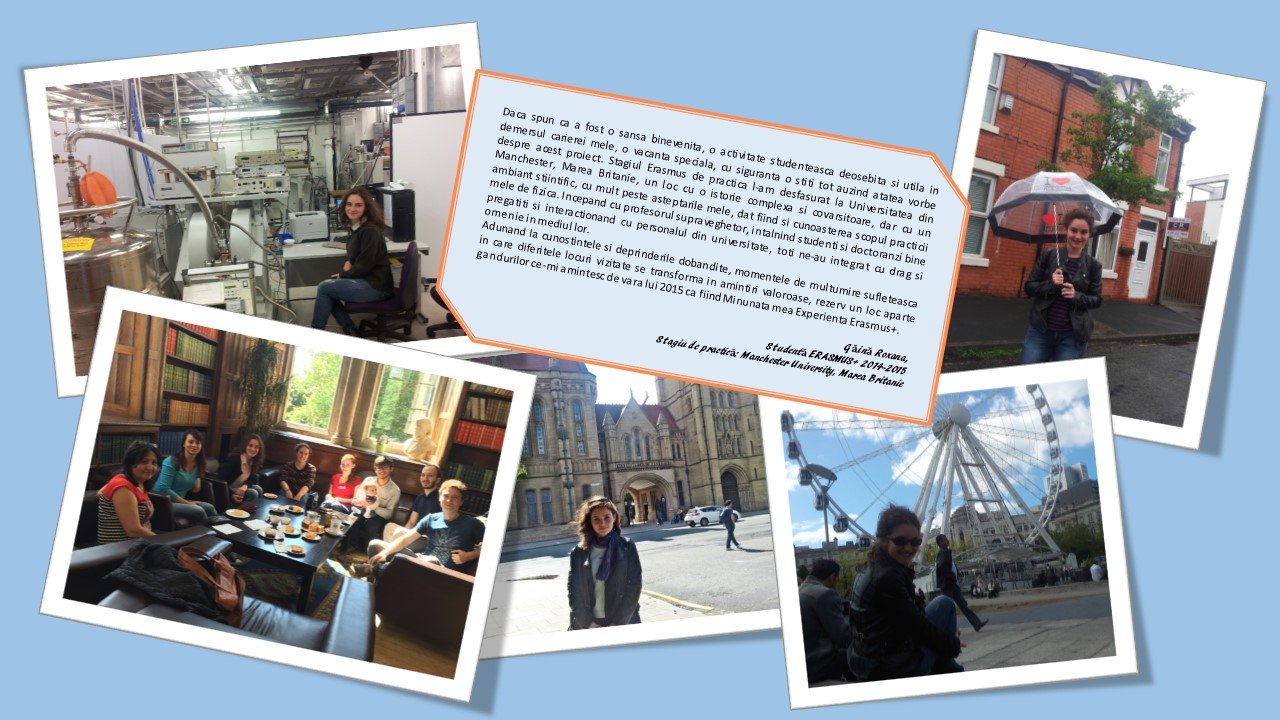
Găină Roxana,

Traineeship: Manchester University, United KingdomSlide32
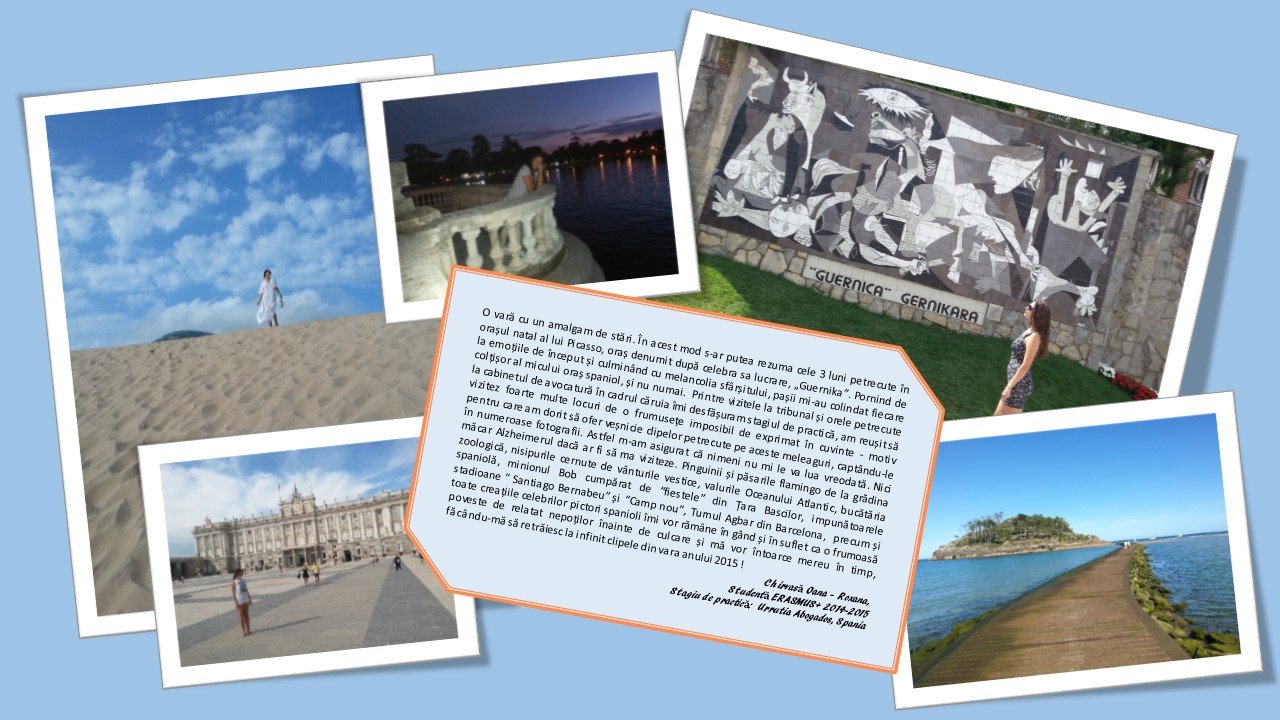
Chirvasă Oana – Roxana,

Traineeship: Urrutia Abogados, SpainSlide31
Dicu Ioana,

Traineeship: Fondazione Edmund Mach, ItalySlide30
Alistar Andreea – Larisa,

Traineeship: Hotel Caravel Zante, GreeceSlide29
Claichnet Andrian,

Traineeship: De Montfort University, United KingdomSlide28
Fotache Mihai,

Traineeship: University of Pannonia, HungarySlide27
Ioniță Diana – Iuliana,

Traineeship: Centre Hospitalier de Belfort-Montbéliard, FranceSlide26

Benchea Angelica,

Traineeship: The Congregation of the daughters of St. Mary of divine Providence, ItalySlide25
Cernea Maria,

Traineeship: Cabinetul de Avocatură Ruxandra RAȚĂ, BelgiumSlide24
Vițel Ionuț,

Traineeship: Urrutia Abogados, SpainSlide23
Strătilă Alexandra,

Traineeship: Rozalen Rehabilitation Clinic, SpainSlide22
Certan Andrei,

Traineeship: Hotel Aquila Porto Rethymno, GreeceSlide21
Andriuță Ana,

Traineeship: Universite d’Angers, FranceSlide20
Ștefanache Cătălina – Andreea,

Traineeship: Hotel Minos Mare, GreeceSlide19
Pavel Sergiu,

Traineeship: Technical University of Braunschweig, GermanySlide18
Cristea Florentina,

Traineeship: Hotel NH Hesperia Sabinal, SpainSlide17

Busuioc Monica-Andreea ,

Traineeship: Hotel Iberostar Creta Panorama, GreeceSlide16

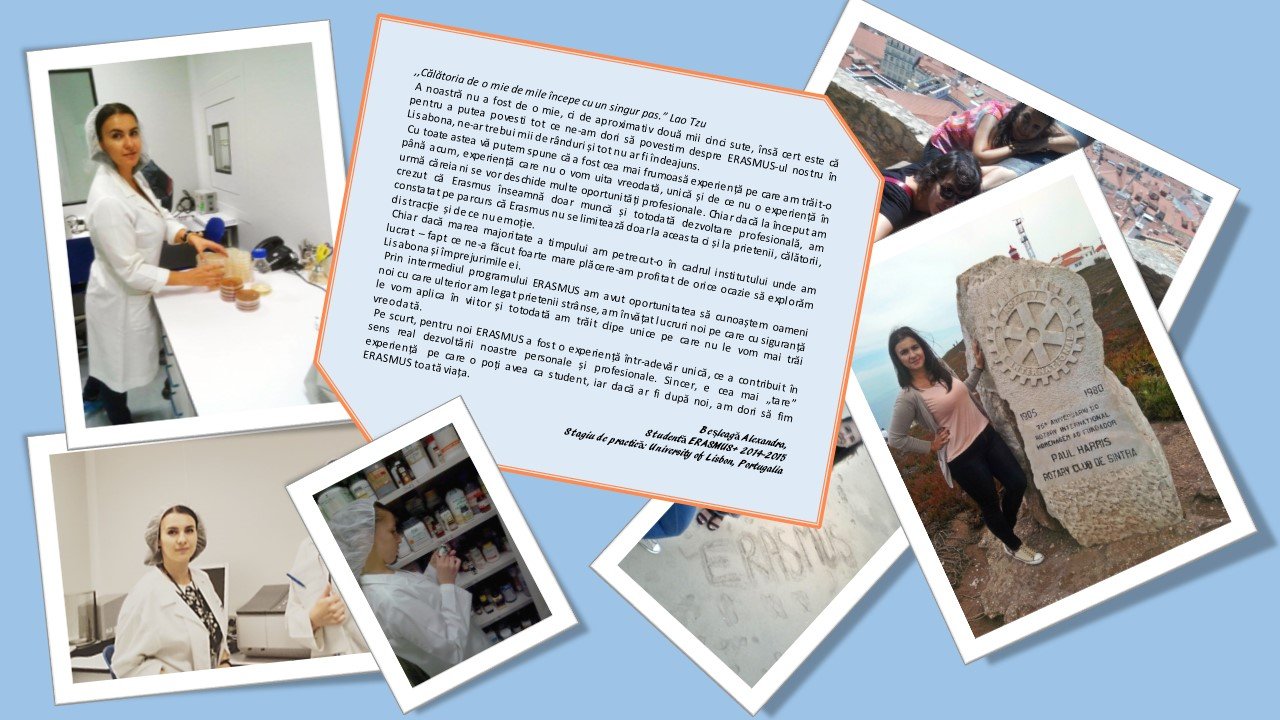
Beșleagă Alexandra,

Traineeship: University of Lisbon, PortugalSlide15
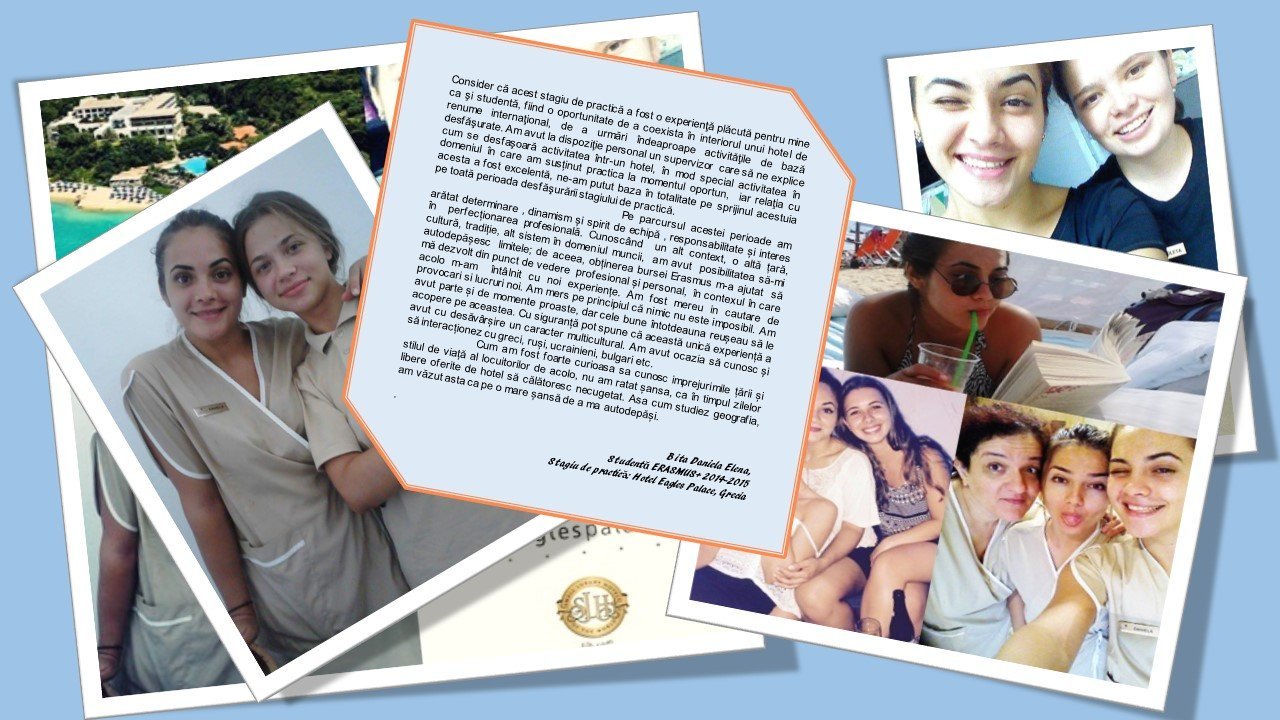
Bita Daniela Elena,

Traineeship: Hotel Eagles Palace, GreeceSlide14
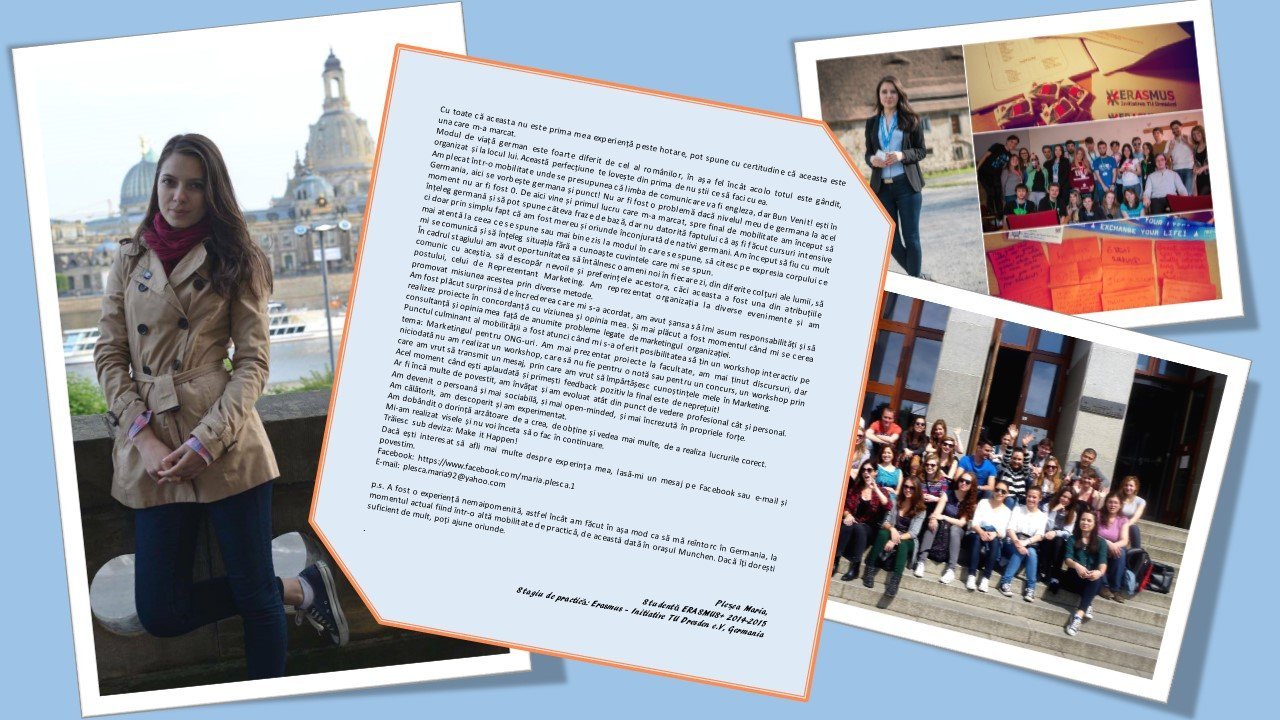
Pleșca Maria,

Traineeship: Erasmus – Initiative TU Dresden e.V, GermanySlide13
Lău Diana,

Traineeship: Hotel Iberostar Creta Panorama, GreeceSlide12

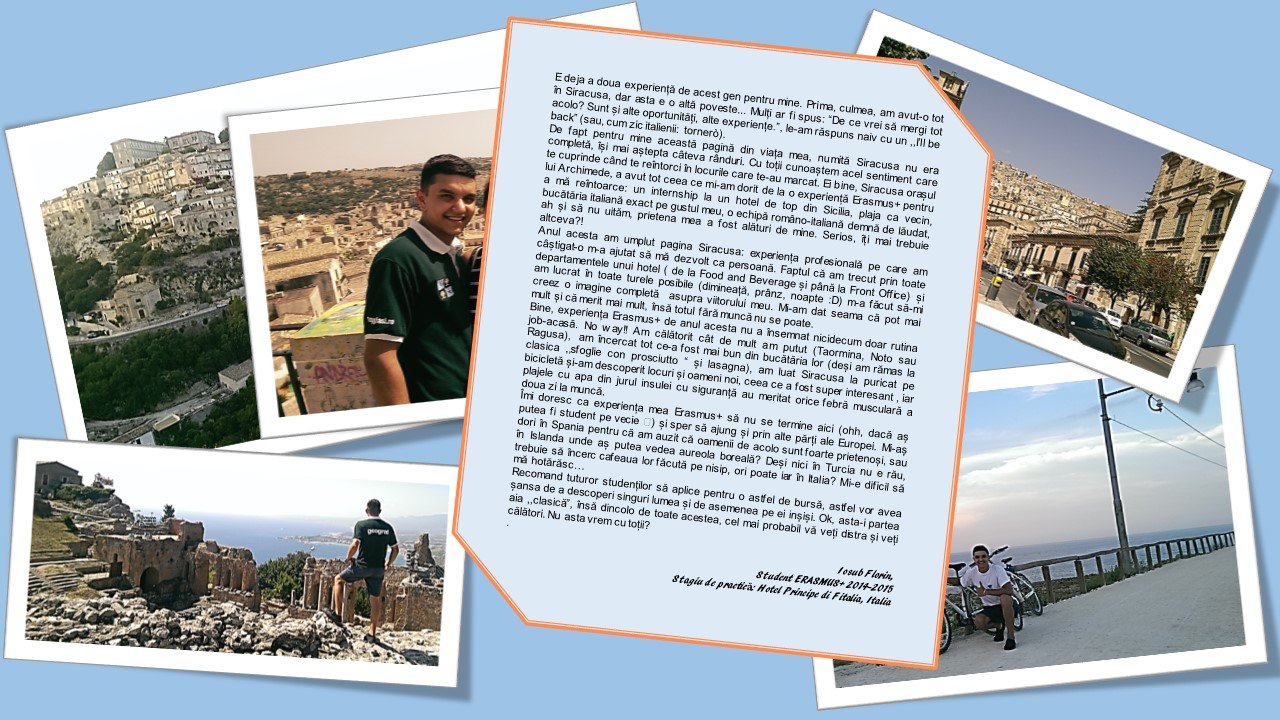
Iosub Florin,

Traineeship: Hotel Principe di Fitalia, ItalySlide11
Prisăcaru Cătălina – Elena,

Traineeship: Akdeniz University, TurkeySlide10

Darie Cosmina-Iustina,

Traineeship: Hotel NH Grand Place Arenberg, BelgiumSlide9
Alexandra Oprea,

Traineeship: Hotel Principe di Fitalia, ItalySlide8

Aconstantinese Maria-Madalina,

Traineeship: Hotel Atlantica Imperial, GreeceSlide7
Dumbravanu Olga,

Traineeship: Alfredo Losada, Centro de Recuperacion Funcional, SpainSlide6
Hroștea Laura,

Traineeship: Faculté des Sciences, Université d’Angers, FranceSlide5
Ichim Maria – Diana,

Traineeship: Hotel NH Hesperia Sabinal, SpainSlide4
Ticlau Lavinia-Andreea,

Traineeship: Hotel Atlantis Beach, GreeceSlide3
Petrică Nițoaia,

Traineeship: Hotel Santa Maria, ItalySlide2
Străuneanu Caterina,

Traineeship: Hotel NH Stephanie, BelgiumSlide1

ERASMUS+ and EEA Information Marathon (Erasmus Days, October 9 – 13, 2023)

Accessibility Toolbar