

Short-term Erasmus Mobilities
SMS and SMT Selection Call – short-term mobilities (applicable to selections organized starting May 1, 2025)
Presentation of short-term ERASMUS+ mobilities
UAIC Regulation on the selection and organization of mobilities within the ERASMUS+ KA131 – HED Programme
Short-term study mobility (SMS) – a study period carried out by students at a higher education institution abroad.
Students of “Alexandru Ioan Cuza” University (UAIC) whose field of study is included in the bilateral agreements concluded by UAIC with universities in the Erasmus+ KA131-HED Programme countries (EU Member States, EEA – Norway, Iceland and Liechtenstein, Turkey, North Macedonia, Serbia) may participate in the selection for short-term study mobilities.
The list of partner universities is available both on the UAIC webpage (https://www.uaic.ro/international/programul-erasmus/studenti/mobilitati-de-studiu-erasmus/), as well as on the UAIC faculty websites.
Short-term traineeship mobility (SMT) – a traineeship period abroad (in EU Member States, EEA – Norway, Iceland and Liechtenstein, Turkey, North Macedonia, Serbia) (practical training activities) carried out by UAIC students, doctoral candidates, and recent graduates at[1]: a) any public or private organization active in the labor market or in the fields of education, training, youth, research, and innovation. For example, such an organization can be:
c) a body providing career guidance, professional counseling, and information services;
d) a higher education institution from an EU Member State or third country associated to the programme holding an ECHE, or a higher education institution from a third country not associated to the programme recognized by competent authorities, which has signed inter-institutional agreements with its partners from an EU Member State or third country associated to the programme before the mobility takes place.
Erasmus+ traineeship mobilities also include:
Presentation of short-term ERASMUS+ mobilities
UAIC Regulation on the selection and organization of mobilities within the ERASMUS+ KA131 – HED Programme
Short-term study mobility (SMS) – a study period carried out by students at a higher education institution abroad.
Students of “Alexandru Ioan Cuza” University (UAIC) whose field of study is included in the bilateral agreements concluded by UAIC with universities in the Erasmus+ KA131-HED Programme countries (EU Member States, EEA – Norway, Iceland and Liechtenstein, Turkey, North Macedonia, Serbia) may participate in the selection for short-term study mobilities.
The list of partner universities is available both on the UAIC webpage (https://www.uaic.ro/international/programul-erasmus/studenti/mobilitati-de-studiu-erasmus/), as well as on the UAIC faculty websites.
Short-term traineeship mobility (SMT) – a traineeship period abroad (in EU Member States, EEA – Norway, Iceland and Liechtenstein, Turkey, North Macedonia, Serbia) (practical training activities) carried out by UAIC students, doctoral candidates, and recent graduates at[1]: a) any public or private organization active in the labor market or in the fields of education, training, youth, research, and innovation. For example, such an organization can be:
- a small, medium, or large enterprise, public or private (including social enterprises);
- a public body at local, regional, or national level;
- embassies or consular offices of Romania;
- a social partner or other representative of working life, including chambers of commerce, craft/professional associations, and trade unions;
- a research institute;
- a foundation;
- a school/institute/educational center (at any level, from pre-school to upper secondary education, including vocational training and adult education);
c) a body providing career guidance, professional counseling, and information services;
d) a higher education institution from an EU Member State or third country associated to the programme holding an ECHE, or a higher education institution from a third country not associated to the programme recognized by competent authorities, which has signed inter-institutional agreements with its partners from an EU Member State or third country associated to the programme before the mobility takes place.
Erasmus+ traineeship mobilities also include:
- Traineeship assistantships for future teachers;
- Research assistantships carried out in any relevant research institution;
- Digital Opportunity Traineeships[2] – carried out to acquire digital skills.
- UAIC Webpage: http://www.uaic.ro/international/programul-erasmus/studenti/mobilitati-de-practica-erasmus/oferte-stagii-practica-erasmus/ and the UAIC faculty websites;
- International Relations Office Facebook page: https://www.facebook.com/ServiciulRelatiiInternationaleUAIC
- Erasmus UAIC Facebook Group: https://www.facebook.com/groups/173152296132716/
- Erasmus+/SEE, UAIC Instagram page: https://www.instagram.com/erasmus_see_uaic/
- UAIC faculty Facebook pages;
- The notice board at faculty secretariats;
- The erasmusintern.org portal;
- Erasmus+ Coordinators for traineeship mobilities within the faculty;
- Webpages of eligible public or private institutions.
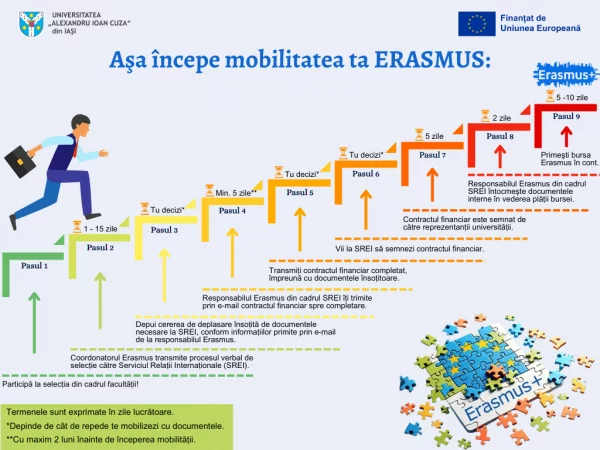
Click here for a better resolution!
Useful forms and documents for short-term Erasmus+ study mobilities:
- Erasmus+ Digital Learning Agreement
- Application Form
- Certificate of Stay
- Standard request for the Rector’s Travel Order for departures abroad (completion model here)
- Erasmus+ Declaration (before departure)
- Erasmus+ Declaration
- Declaration on own responsibility for avoiding double funding (upon return from mobility)
- Request for recognition and equivalence of the Erasmus+ study mobility
- Learning Agreement Student Mobility for Traineeships (completion guidelines, and completion model)
- Application Form
- Letter of Acceptance
- Standard request for the Rector’s Travel Order for departures abroad (completion model here)
- Erasmus+ Scholarship Holder Form
- Erasmus Declaration – Traineeship mobility
- Certificate of Stay
- Declaration on own responsibility for avoiding double funding (upon return from mobility)
- Learning Agreement – After the Mobility
- Request for equivalence of the Erasmus+ traineeship mobility
ELIGIBILITY CRITERIA:
The following students are eligible to apply:
– Students enrolled at “Alexandru Ioan Cuza” University of Iași, in any year and at any study level, including Romanian citizens or citizens of other states;
– Students who have previously benefited from mobilities under the Socrates / LLP-Erasmus / Erasmus+ Programmes may benefit from new mobilities only on the condition that the total duration of all mobilities does not exceed 12 months per study cycle;
– Only for traineeship mobilities: students and doctoral candidates in their final year can participate in selections until the end of the evaluation session of the second semester of their final year, or until the date of the public defense of their doctoral thesis, for mobilities taking place in the first year after graduation; they will have the status of “conditionally selected” and will become “full participants” once they can prove their graduate status by presenting a certificate issued by the faculty, or a certificate issued by the Secretariat of the Doctoral School where they were enrolled or by the Office for University Doctoral Studies. These mobilities must be carried out and completed within one year of graduation;
– A student can benefit from Erasmus+ study and traineeship mobilities at each study level (Bachelor, Master, Doctorate), totaling a maximum of 12 months of mobility (study + traineeship) per level; – Consecutive mobilities at the same host institution are not eligible.
Notes!
Students may participate in multiple selection sessions for Erasmus+ study/traineeship mobilities; however, it is recommended that there is a sufficient time interval between two mobilities to allow for the fulfillment of all obligations and responsibilities specific to finalizing the first Erasmus+ mobility, as well as for completing the administrative procedures necessary for the next mobility.
The following students are eligible to apply:
– Students enrolled at “Alexandru Ioan Cuza” University of Iași, in any year and at any study level, including Romanian citizens or citizens of other states;
– Students who have previously benefited from mobilities under the Socrates / LLP-Erasmus / Erasmus+ Programmes may benefit from new mobilities only on the condition that the total duration of all mobilities does not exceed 12 months per study cycle;
– Only for traineeship mobilities: students and doctoral candidates in their final year can participate in selections until the end of the evaluation session of the second semester of their final year, or until the date of the public defense of their doctoral thesis, for mobilities taking place in the first year after graduation; they will have the status of “conditionally selected” and will become “full participants” once they can prove their graduate status by presenting a certificate issued by the faculty, or a certificate issued by the Secretariat of the Doctoral School where they were enrolled or by the Office for University Doctoral Studies. These mobilities must be carried out and completed within one year of graduation;
– A student can benefit from Erasmus+ study and traineeship mobilities at each study level (Bachelor, Master, Doctorate), totaling a maximum of 12 months of mobility (study + traineeship) per level; – Consecutive mobilities at the same host institution are not eligible.
Notes!
Students may participate in multiple selection sessions for Erasmus+ study/traineeship mobilities; however, it is recommended that there is a sufficient time interval between two mobilities to allow for the fulfillment of all obligations and responsibilities specific to finalizing the first Erasmus+ mobility, as well as for completing the administrative procedures necessary for the next mobility.
DOCUMENTS REQUIRED FOR THE APPLICATION FILE:
- Application Form – which will include:
- Motivation (including concrete objectives pursued by the candidate and expected results)
- Proposed mobility period
- Declaration regarding the maximum number of Erasmus+ mobility months a student can benefit from during the study cycle in which they are enrolled at the time of application;
- Information note on the processing of personal data;
- Curriculum Vitae;
- Language certificate / high school transcript / language competency certificate obtained at the Baccalaureate exam / academic transcript for university studies regarding the foreign language studied or the study programme, for those studying in a foreign language, according to the candidate’s option and depending on the foreign languages studied (a copy will remain in the student’s selection file);
- Invitation letter from the host university / institution where the mobility will take place (a scanned copy sent by email is accepted).
- A copy of the residence permit in Romania; students enrolled at UAIC – Bălți/ Chișinău Extension are exempt from this requirement.
Short-term study mobility (SMS) – a study period carried out by students at a higher education institution abroad.
UAIC students whose field of study is included in the bilateral agreements concluded by UAIC with universities from the Erasmus+ KA131-HED Programme countries (EU Member States, EEA – Norway, Iceland and Liechtenstein, Turkey, North Macedonia, Serbia) may participate in the selection for short-term study mobilities within the Erasmus+ KA131-HED Programme[1].
The list of partner universities is available both on the UAIC webpage (https://www.uaic.ro/international/programul-erasmus/studenti/mobilitati-de-studiu-erasmus/) and on the faculty website (www. …………..).
Short-term traineeship mobility (SMT) – a traineeship period abroad (not courses followed at a university) carried out by students, doctoral candidates, and recent graduates at[2]:
[2] The following types of organizations are not eligible as host institutions for student mobility: EU institutions and other EU bodies, including specialized agencies (the exhaustive list is available on the website – https://europa.eu/european-union/abouteu/institutions-bodies_en); organizations managing EU programmes, such as Erasmus+ National Agencies (to avoid possible conflict of interest and/or double funding). [3] When the student or recent graduate carries out one or more of the following activities during the mobility: digital marketing; digital graphic, mechanical, or architectural design; development of applications, software, scripts, or websites; installation, maintenance, and management of IT systems and networks; cybersecurity; data analysis, mining, and visualization; programming and training of robots and artificial intelligence applications. Generic customer support, order fulfillment, data entry, or office tasks are not part of this category.
UAIC students whose field of study is included in the bilateral agreements concluded by UAIC with universities from the Erasmus+ KA131-HED Programme countries (EU Member States, EEA – Norway, Iceland and Liechtenstein, Turkey, North Macedonia, Serbia) may participate in the selection for short-term study mobilities within the Erasmus+ KA131-HED Programme[1].
The list of partner universities is available both on the UAIC webpage (https://www.uaic.ro/international/programul-erasmus/studenti/mobilitati-de-studiu-erasmus/) and on the faculty website (www. …………..).
Short-term traineeship mobility (SMT) – a traineeship period abroad (not courses followed at a university) carried out by students, doctoral candidates, and recent graduates at[2]:
- a public or private institution active in the labor market, or in the fields of education, training, youth, research, and innovation;
- a non-profit organization, association, or NGO;
- a body providing career guidance, professional counseling, and information services;
- a higher education institution from an EU Member State or a third country associated to the programme holding an ECHE, or a higher education institution from a third country not associated to the programme recognized by competent authorities, which has signed inter-institutional agreements with its partners from an EU Member State or a third country associated to the programme before the mobility takes place.
- Traineeship assistantships for future teachers;
- Research assistantships carried out in any relevant research institution;
- Digital Opportunity Traineeships[3] – carried out to acquire digital skills.
[2] The following types of organizations are not eligible as host institutions for student mobility: EU institutions and other EU bodies, including specialized agencies (the exhaustive list is available on the website – https://europa.eu/european-union/abouteu/institutions-bodies_en); organizations managing EU programmes, such as Erasmus+ National Agencies (to avoid possible conflict of interest and/or double funding). [3] When the student or recent graduate carries out one or more of the following activities during the mobility: digital marketing; digital graphic, mechanical, or architectural design; development of applications, software, scripts, or websites; installation, maintenance, and management of IT systems and networks; cybersecurity; data analysis, mining, and visualization; programming and training of robots and artificial intelligence applications. Generic customer support, order fulfillment, data entry, or office tasks are not part of this category.
DURATION OF SHORT-TERM MOBILITIES (SMS/SMT): between 5 and 30 days of physical activity, to which a virtual component is added (mandatory for Bachelor and Master cycles and optional for the Doctoral study cycle).
SELECTION OF CANDIDATES FOR SHORT-TERM MOBILITIES
Students may participate in selections for short-term mobilities throughout the academic year, provided they receive an acceptance from a partner university with which there is a valid Erasmus+ agreement in the respective field of study (for study mobilities) / for traineeships offered by the faculty where the student is enrolled (for traineeship mobilities), as follows:
• the selection can be made at least 30 days before the start date of the mobility, whether physical or virtual (mobility dates are specified in the selection report); • application files are to be submitted to the faculty secretariat / sent via email to the faculty Erasmus+ coordinator; • the Erasmus+ coordinator confirms receipt of the application by email and, following the evaluation of the files, publishes the results on the faculty’s webpage; • any appeals may be sent within 24 hours of the publication of the results to the Erasmus+ coordinator via email; these are analyzed and resolved within 48 hours by the Faculty Appeals Committee, and the Erasmus+ coordinator publishes the final results; • the Erasmus+ coordinator submits the selection report to the International Relations Office immediately after the selection is finalized and informs the selected students about the need to contact the Erasmus+ mobility officer within the International Relations Office.
Students may participate in selections for short-term mobilities throughout the academic year, provided they receive an acceptance from a partner university with which there is a valid Erasmus+ agreement in the respective field of study (for study mobilities) / for traineeships offered by the faculty where the student is enrolled (for traineeship mobilities), as follows:
• the selection can be made at least 30 days before the start date of the mobility, whether physical or virtual (mobility dates are specified in the selection report); • application files are to be submitted to the faculty secretariat / sent via email to the faculty Erasmus+ coordinator; • the Erasmus+ coordinator confirms receipt of the application by email and, following the evaluation of the files, publishes the results on the faculty’s webpage; • any appeals may be sent within 24 hours of the publication of the results to the Erasmus+ coordinator via email; these are analyzed and resolved within 48 hours by the Faculty Appeals Committee, and the Erasmus+ coordinator publishes the final results; • the Erasmus+ coordinator submits the selection report to the International Relations Office immediately after the selection is finalized and informs the selected students about the need to contact the Erasmus+ mobility officer within the International Relations Office.
ERASMUS GRANT
The Erasmus+ grant may be awarded only on the condition that:
- The Selection Report is submitted to the International Relations Office immediately after the selection process is finalized;
- The Travel Request endorsed by the faculty is submitted to the university registry at least 10 working days before the start of the mobility;
- The completed and signed financial contract, along with the supporting documents, is submitted to the Erasmus+ financial officer at the International Relations Office at least 5 working days before the start of the mobility.
- Individual support
- 79 Euro/day: up to the 14th day of activity
- 56 Euro/day: between the 15th and the 30th day of activity
- Additional individual support (maximum 2 days) for travel (one travel day before the activity and one travel day after the activity): 2 days x 79 Euro/day OR 2 days x 56 Euro/day, depending on the mobility duration;
- Travel Grant, calculated according to the European Commission’s distance calculator (accessible at this link). The “travel distance” represents the distance between the place of origin and the venue of the activity, while the “amount” represents the grant for the travel to the venue and back:
| Travel distance | “Green travel” category – Amount per participant in Euro | “Non-green travel” category – Amount per participant in Euro |
| 10 – 99 KM | 56 | 28 |
| 100 – 499 KM | 285 | 211 |
| 500 – 1 999 KM | 417 | 309 |
| 2 000 – 2 999 KM | 535 | 395 |
| 3 000 – 3 999 KM | 785 | 580 |
| 4 000 – 7 999 KM | 1 188 | 1 188 |
| 8 000 KM or more | 1 735 | 1 735 |
Erasmus grant top-ups:
c) a student coming from a single-parent family (due to death, disappearance, incarceration of the other parent, or non-recognition on the birth certificate);
d) a student in the “first-generation student” category (meaning they do not already hold a bachelor’s degree and their parents have not obtained a university degree, although they may have siblings who are already university students / have already graduated);
e) a person with a disability (including physical, mental, intellectual, or sensory impairments) or health problems (including serious illnesses, chronic diseases, or any other situation related to physical or mental health that hinders participation in the programme);
f) a person whose family did not achieve an average monthly net income per family member higher than the national minimum net basic salary in the 12 months prior to submitting the supporting documents;
g) a person of Roma ethnicity;
h) a person with refugee status.
!!! The Erasmus+ grant top-up also applies to students of nationalities other than Romanian, students enrolled in tuition-paying positions, and students attending part-time/distance learning forms of education, who are selected for mobility and fall into one of the previously described categories.
!!! Files submitted in the 2024-2025 academic year under criteria b, c, d, e, g, and h of this document and considered eligible are valid for the entire duration of the study cycle in which the student is enrolled and do not need to be resubmitted during that cycle. Files submitted based on financial criteria (point f) must be submitted annually, in the academic year in which the Erasmus+ mobility takes place.
[2] The file must be submitted for only one category. A student can only benefit from one Erasmus+ grant top-up per mobility. The file must be submitted physically to the Scholarships and Social Issues Office (Address: 7 Gheorghe Asachi St., Codrescu Campus, Dormitory C12, room 4, Public hours: 8:00 – 16:00, lunch break: 12:30 – 13:00), ideally before bringing the documents to the Erasmus+ Office. !!!! Incomplete files are not valid and will not be taken into consideration. !!!!! List of required documents for each category of students with fewer opportunities and the corresponding annexes: All documents must be presented in Romanian (documents in other languages must be accompanied by an official translation).
- For students with fewer opportunities, the Erasmus+ grant is supplemented by 250 Euro/month; in accordance with the Programme Guide and the 2024 National Call, a participant with fewer opportunities is one who falls into one or more of the following categories:
c) a student coming from a single-parent family (due to death, disappearance, incarceration of the other parent, or non-recognition on the birth certificate);
d) a student in the “first-generation student” category (meaning they do not already hold a bachelor’s degree and their parents have not obtained a university degree, although they may have siblings who are already university students / have already graduated);
e) a person with a disability (including physical, mental, intellectual, or sensory impairments) or health problems (including serious illnesses, chronic diseases, or any other situation related to physical or mental health that hinders participation in the programme);
f) a person whose family did not achieve an average monthly net income per family member higher than the national minimum net basic salary in the 12 months prior to submitting the supporting documents;
g) a person of Roma ethnicity;
h) a person with refugee status.
!!! The Erasmus+ grant top-up also applies to students of nationalities other than Romanian, students enrolled in tuition-paying positions, and students attending part-time/distance learning forms of education, who are selected for mobility and fall into one of the previously described categories.
!!! Files submitted in the 2024-2025 academic year under criteria b, c, d, e, g, and h of this document and considered eligible are valid for the entire duration of the study cycle in which the student is enrolled and do not need to be resubmitted during that cycle. Files submitted based on financial criteria (point f) must be submitted annually, in the academic year in which the Erasmus+ mobility takes place.
- For students using sustainable means of transport – „green travel” (bicycle, bus, car-pooling, or train), if these were used for the majority of the round-trip journey (more than 50% of the distance calculated according to the European Commission’s distance calculator), the Erasmus+ grant is supplemented as follows:
- the travel grant corresponding to the „green travel” category is awarded (according to the table above)
- the amount corresponding to a maximum of 4 additional days (outside the mobility period) is awarded, if applicable, for the round-trip journey.
- For participants with special needs, whose physical, mental, or health condition is such that participation in the mobility is not possible without additional support, who require a preparatory visit to participate in the mobility, or who require an accompanying person during the mobility, the Erasmus grant is supplemented with amounts granted based on the principle of real costs, according to needs.
[2] The file must be submitted for only one category. A student can only benefit from one Erasmus+ grant top-up per mobility. The file must be submitted physically to the Scholarships and Social Issues Office (Address: 7 Gheorghe Asachi St., Codrescu Campus, Dormitory C12, room 4, Public hours: 8:00 – 16:00, lunch break: 12:30 – 13:00), ideally before bringing the documents to the Erasmus+ Office. !!!! Incomplete files are not valid and will not be taken into consideration. !!!!! List of required documents for each category of students with fewer opportunities and the corresponding annexes: All documents must be presented in Romanian (documents in other languages must be accompanied by an official translation).
The Erasmus+ Programme encourages the participation of students and university staff with special needs. If one of the selected participants has a physical, mental disability, or other health-related issues that prevent them from taking part in the mobility without additional financial support, the university may request a special needs grant top-up from the National Agency to cover the necessary additional costs. Participants wishing to apply for additional financial support for special needs must discuss these aspects with the Erasmus+ Office representatives while preparing their mobility documents.
The documents required to request a special needs top-up are:
– a request addressed to the home institution specifying the mobility details and the request to supplement the grant with the total amount needed, explaining the nature of the needs, the types of planned expenses, and the corresponding amounts;
– a copy of the participant’s disability certificate, valid for the duration of the mobility and issued by an authorized institution;
– copies of other documents supporting the participant’s request may also be attached (for example: if the request concerns covering treatment costs, a referral or a medical letter from a doctor indicating the need for treatment during the mobility should be included);
The university will draft an official letter to the National Agency including details about the project for which the special needs top-up is requested, details about the participant’s mobility, and the request to supplement the grant with the total necessary amount.
Photocopies of the documents submitted by the participant and the official letter are sent by the university in electronic format, via email, to the project expert within the National Agency. Upon receipt, the National Agency will analyze the case and send an official response to the university. If the request is approved, the National Agency will issue an amendment to increase the funds for the project in question.
The additional funds are allocated to the participant based on the financial agreement signed between the university and the participant. Upon completion of the mobility, the participant must present proof of the expenses incurred in the form of receipts, invoices, tickets, etc.
The documents required to request a special needs top-up are:
– a request addressed to the home institution specifying the mobility details and the request to supplement the grant with the total amount needed, explaining the nature of the needs, the types of planned expenses, and the corresponding amounts;
– a copy of the participant’s disability certificate, valid for the duration of the mobility and issued by an authorized institution;
– copies of other documents supporting the participant’s request may also be attached (for example: if the request concerns covering treatment costs, a referral or a medical letter from a doctor indicating the need for treatment during the mobility should be included);
The university will draft an official letter to the National Agency including details about the project for which the special needs top-up is requested, details about the participant’s mobility, and the request to supplement the grant with the total necessary amount.
Photocopies of the documents submitted by the participant and the official letter are sent by the university in electronic format, via email, to the project expert within the National Agency. Upon receipt, the National Agency will analyze the case and send an official response to the university. If the request is approved, the National Agency will issue an amendment to increase the funds for the project in question.
The additional funds are allocated to the participant based on the financial agreement signed between the university and the participant. Upon completion of the mobility, the participant must present proof of the expenses incurred in the form of receipts, invoices, tickets, etc.
UAIC students whose field of study is included in the bilateral agreements concluded by UAIC with universities from the Erasmus+ KA131-HED Programme countries (EU Member States, EEA – Norway, Iceland and Liechtenstein, Turkey, North Macedonia, Serbia) may participate in the selection for short-term study mobilities within the Erasmus+ KA131-HED Programme[1].
The list of partner universities is available both on the UAIC webpage (https://www.uaic.ro/international/programul-erasmus/studenti/mobilitati-de-studiu-erasmus/) and on the faculty website.
[1] Mobilities to countries not associated with the Erasmus+ KA131-HED Programme may also be funded, within the limit of available funds and provided that a bilateral Erasmus agreement has been signed beforehand.
For traineeship mobility offers, you may consult:
- UAIC Webpage: http://www.uaic.ro/international/programul-erasmus/studenti/mobilitati-de-practica-erasmus/oferte-stagii-practica-erasmus/ and the faculty’s webpage: ………………………………………….
- The Facebook page of the UAIC International Relations Office: (9) UAIC International Relations Office | Facebook
- The Erasmus UAIC Facebook group: https://www.facebook.com/groups/173152296132716/
- The Erasmus+/SEE, UAIC Instagram page: https://www.instagram.com/erasmus_see_uaic/
- The faculty’s Facebook page: ………………………………………………………
- The notice board at the faculty secretariat
- The erasmusintern.org portal
- The faculty Erasmus+ Coordinator for traineeship mobilities
- Webpages of eligible public or private institutions.
RECOGNITION AND EQUIVALENCE OF ERASMUS+ STUDY/TRAINEESHIP MOBILITIES
From an academic perspective, all Erasmus+ mobilities are carried out based on the study/traineeship contract (Learning Agreement Student Mobility), which is signed by the student, the Erasmus+ coordinator of the faculty where the student is enrolled, and the supervisor/mentor at the host institution/partner university.
Upon return from the mobility, the activities carried out or courses followed at the host institution/partner university will be automatically recognized, according to the Learning Agreement signed before the start of the mobility. The certification of result recognition and the equivalence of the grades obtained will be performed by the committee designated at the faculty level and approved by the Executive Board of the University’s Board of Administration. The Equivalence and Recognition Committee consists of 1 to 3 members, depending on the number of departments within the faculty, and must include the faculty Erasmus+ coordinator and the ECTS departmental coordinator who signs the Erasmus study/traineeship contracts (if this is a different person from the Erasmus coordinator).
The equivalence of grades will be carried out according to the following principles:
Students who, as a result of an Erasmus+ study/traineeship mobility, cannot participate in the examination session at UAIC, and whose Learning Agreement does not provide for the equivalence of all subjects for that semester, may request the course instructors or the Dean of the faculty for an early examination session (before departure), an examination session upon completion of the mobility, or during the special examination and final graduation exam session in September for students who benefited from Erasmus+ mobilities during that academic year (the special session is organized with the approval of the Executive Board of the Board of Administration and the UAIC Senate).
Regulation on the recognition and equivalence of studies and traineeships carried out within the Erasmus+ program
From an academic perspective, all Erasmus+ mobilities are carried out based on the study/traineeship contract (Learning Agreement Student Mobility), which is signed by the student, the Erasmus+ coordinator of the faculty where the student is enrolled, and the supervisor/mentor at the host institution/partner university.
Upon return from the mobility, the activities carried out or courses followed at the host institution/partner university will be automatically recognized, according to the Learning Agreement signed before the start of the mobility. The certification of result recognition and the equivalence of the grades obtained will be performed by the committee designated at the faculty level and approved by the Executive Board of the University’s Board of Administration. The Equivalence and Recognition Committee consists of 1 to 3 members, depending on the number of departments within the faculty, and must include the faculty Erasmus+ coordinator and the ECTS departmental coordinator who signs the Erasmus study/traineeship contracts (if this is a different person from the Erasmus coordinator).
The equivalence of grades will be carried out according to the following principles:
- All subjects included in the Learning Agreement signed before the start of the mobility at the host institution/university will be recognized upon return;
- Equivalence will be performed based on an equivalence request completed and signed by the beneficiary student (study mobility equivalence form / traineeship mobility equivalence form), which will subsequently be subject to approval by the faculty-level recognition and equivalence committee;
- The grade recognition principle is that for a UAIC course, the grade corresponding to the mark obtained at the host university is awarded, which can range from 1 to 5, where: 1 = poor/unsatisfactory, 2 = satisfactory, 3 = good, 4 = very good, 5 = excellent.
- Grades are established by the faculty recognition committee and not by each individual course instructor.
Students who, as a result of an Erasmus+ study/traineeship mobility, cannot participate in the examination session at UAIC, and whose Learning Agreement does not provide for the equivalence of all subjects for that semester, may request the course instructors or the Dean of the faculty for an early examination session (before departure), an examination session upon completion of the mobility, or during the special examination and final graduation exam session in September for students who benefited from Erasmus+ mobilities during that academic year (the special session is organized with the approval of the Executive Board of the Board of Administration and the UAIC Senate).
Regulation on the recognition and equivalence of studies and traineeships carried out within the Erasmus+ program
Erasmus Coordinators by faculty (click here)
To assist Erasmus students in finding accommodation during their mobility, we recommend accessing the Erasmus Play platform.
Erasmus Play started as a response from a former Erasmus+ group of students who encountered difficulties in finding accommodation in different host cities. It allows you to compare all available housing options with ease. Moreover, you will be able to book in total safety since all accommodations are provided by verified platforms. Book your student accommodation in 3 steps:
– Choose your host University, campus or city and your required dates. – Easily compare accommodation from multiple sites. – Click on view and book it on the website of our trustworthy partners.
Erasmus Play started as a response from a former Erasmus+ group of students who encountered difficulties in finding accommodation in different host cities. It allows you to compare all available housing options with ease. Moreover, you will be able to book in total safety since all accommodations are provided by verified platforms. Book your student accommodation in 3 steps:
– Choose your host University, campus or city and your required dates. – Easily compare accommodation from multiple sites. – Click on view and book it on the website of our trustworthy partners.
Erasmus Survival Guide 2026-2027
If you are about to submit your file to the Erasmus+ Office to obtain your Erasmus grant, or if you have completed your mobility and need to bring the supporting documents, please make an appointment in advance. This way, you will not have to wait in line.
You can choose the day and time here.
We look forward to seeing you at the Erasmus+ Office!
You can choose the day and time here.
We look forward to seeing you at the Erasmus+ Office!
The Erasmus+ App is a real importance and utility online tool that allows Erasmus students to efficiently and securely manage all administrative stages of their mobility period (before, during, and after their stay abroad).
Through this application (connected with the OLS online language support platform), students have the opportunity to improve their language skills, access informative details about the host and home universities, and research various aspects necessary for organizing their mobility (e.g., tips from other Erasmus beneficiaries, information about local events and ESN activities, OLA status, etc.).
We invite you to download the application from this link: https://erasmusapp.eu/ and enjoy its features!
Through this application (connected with the OLS online language support platform), students have the opportunity to improve their language skills, access informative details about the host and home universities, and research various aspects necessary for organizing their mobility (e.g., tips from other Erasmus beneficiaries, information about local events and ESN activities, OLA status, etc.).
We invite you to download the application from this link: https://erasmusapp.eu/ and enjoy its features!
The new Online Language Support (OLS) is waiting for you!
It offers a range of interactive and engaging language learning activities to help you learn a new language or master one you have already studied. The best part is that it is specifically designed to meet the needs of each individual learner.
This means you will enjoy a unique language learning experience at your own pace.
So, what are you waiting for? Whether it’s learning the basics of French or mastering German at a native level, click here to get started.
It only takes a few seconds to set up your profile and begin your language learning journey today! Our introductory module quickly guides you through the account creation process, which you can use to access OLS and many other short courses on EU Academy. See you in the new OLS!
It offers a range of interactive and engaging language learning activities to help you learn a new language or master one you have already studied. The best part is that it is specifically designed to meet the needs of each individual learner.
This means you will enjoy a unique language learning experience at your own pace.
So, what are you waiting for? Whether it’s learning the basics of French or mastering German at a native level, click here to get started.
It only takes a few seconds to set up your profile and begin your language learning journey today! Our introductory module quickly guides you through the account creation process, which you can use to access OLS and many other short courses on EU Academy. See you in the new OLS!
The Erasmus+ Programme aims to support the educational, professional, and personal development of participating students and graduates.
It also seeks to promote, across all its actions, equal opportunities and access, inclusion, diversity, and equity. Furthermore, the programme contributes to achieving EU objectives related to digital transformation, sustainable development, and active citizenship.
The Erasmus Student Charter reflects the values and priorities mentioned above, serving to properly inform participants of their rights and obligations and to ensure the successful implementation of their mobility. It can be consulted by accessing this link: https://erasmus-plus.ec.europa.eu/resources-and-tools/erasmus-student-charter-0
It also seeks to promote, across all its actions, equal opportunities and access, inclusion, diversity, and equity. Furthermore, the programme contributes to achieving EU objectives related to digital transformation, sustainable development, and active citizenship.
The Erasmus Student Charter reflects the values and priorities mentioned above, serving to properly inform participants of their rights and obligations and to ensure the successful implementation of their mobility. It can be consulted by accessing this link: https://erasmus-plus.ec.europa.eu/resources-and-tools/erasmus-student-charter-0
Contact Persons:
Andreea-Alina PURCARU (study mobilities)
E-mail: andreea.purcaru@uaic.ro Phone: 0232 20 1113
Grigoriţa Elena COCEANU (traineeship mobilities)
E-mail: grigorita.coceanu@uaic.ro Phone: 0232 20 1812

Erasmus+ Office
International Relations Office
Alexandru Ioan Cuza University of Iași
11 Carol I Boulevard
700506 IASI, ROMANIA


 Serviciul Relaţii Internaţionale, Universitatea Alexandru Ioan Cuza din Iași, Bulevardul Carol I, Nr. 11, Corp A, Iaşi, România, Telefon: 0040. 232. 20 1111, Fax: 0232. 20 1802, Email: relint@uaic.ro
