

Erasmus+ Program with participating countries – study mobilities
"The world is a book, and those who do not travel read only a page." (St. Augustine)
Archive - Selection announcements and regulations (2015 - 2024)
SMS Selection Announcement – long-term (valid for the 2023-2024 academic year)
Erasmus+ KA131 SMS Selection Regulation (valid starting with the 2022-2023 academic year)
SMS Selection Announcement – long-term (valid for the 2022-2023 academic year)
2021-2022 Erasmus+ SMS Selection Regulation
2020-2021 Erasmus+ SMS Selection Regulation2019-2020 Erasmus+ SMS Selection Regulation
2018-2019 Erasmus+ Selection Regulation
2017-2018 Erasmus+ Study Mobility Selection Regulation
2016-2017 Erasmus+ Study Mobility Selection Regulation
2015-16 Erasmus+ SMS Selection Regulation
Amendment to the regulation
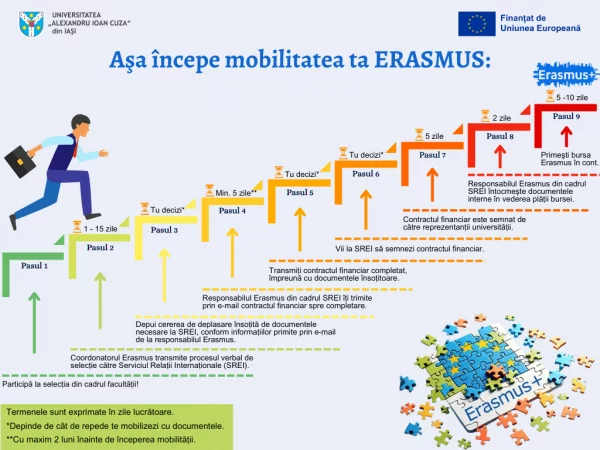
Click here for a better resolution!
ELIGIBILITY CRITERIA:
A. General Criteria: The following may apply for selection:
A. General Criteria: The following may apply for selection:
- students enrolled in full-time/ distance learning/ part-time education at the “Alexandru Ioan Cuza” University of Iași, Romanian citizens, citizens of other countries participating in the Erasmus+ Program, or citizens of countries not participating in the Erasmus+ Program;
- students in the 1st, 2nd, or 3rd year of Bachelor’s studies (at faculties where Bachelor’s studies last 4 years) and 1st year Master’s students;
- PhD students in the 1st, 2nd, 3rd year, including those in the extension period for mobilities carried out until the date of the public defense of the doctoral thesis;
- students and PhD students in terminal years – only for selection for study mobilities that take place in the same academic year in which the selection occurs;
- former beneficiaries of a study or traineeship mobility in previous generations of Socrates, LLP-Erasmus and/or Erasmus+ programs, only if they meet the above-mentioned criteria and provided that the total duration of the mobilities (Socrates/LLP-Erasmus and Erasmus+) does not exceed 12 months per study cycle.
- Students who wish to apply and have previously benefited from a study mobility for which the exam grades have not been sent by the date of selection, will present the academic results from before departing for the Erasmus mobility.
- A student can benefit from Erasmus+ study and traineeship mobilities at each level of studies (Bachelor, Master, PhD), totaling a maximum of 12 months of mobility (study + traineeship) per level.
- have an ECTS score at the time of selection of at least 70% of the maximum score, with the exception of 1st year students, 1st semester (for whom the admission average will be considered – minimum 8 – for the study cycle in which they are enrolled) and students enrolled in integrated study programs (for whom the admission average for the respective study program will be considered, the minimum average being the same as the minimum admission average established within the partnership organizing the program);
- obtain at least grade 7 in the interview held during the selection process at the faculty;
- attest knowledge of the language of study at the university for which they are applying through one of the following documents:
- language certificate[1];
- high school transcript (for candidates who studied a foreign language during high school);
- language proficiency certificate obtained at the Baccalaureate exam;
- transcript of records for university studies, in the case of students who have the language of study from the partner university as a specialization/ as the language of instruction within their university studies;
- academic record for university studies, according to the candidate’s option and depending on the foreign language studied, in exceptional cases and only with the approval of the selection committee.
- French Cultural Institute Iași, 26 Carol I Blvd. (French);
- German Cultural Center Iași, 38 Lascăr Catargi St. (German);
- Foreign Language Center of the Faculty of Letters;
- EuroEd Iași, 1C Florilor St. (English, French, Italian, Spanish).
Documents required for the application file:
To evaluate compliance with the conditions above, the application file must include:
To evaluate compliance with the conditions above, the application file must include:
- Application Form – which will include:
- Motivation (the candidate’s mobility options, the list of courses, the reasons for participating in the selection for a study mobility at a specific university – concrete objectives pursued by the candidate and expected results);
- The proposed semester for the mobility;
- Declaration regarding the maximum number of Erasmus+ mobility months a student can benefit from during the study cycle in which they are enrolled at the time of application;
- Information note regarding the processing of personal data.
- Curriculum Vitae (will remain in the student’s selection file);
- Language certificate / high school transcript / language proficiency certificate obtained at the Baccalaureate exam / academic record for university studies for the foreign language studied or for the study program for those studying in a foreign language (a copy will remain in the student’s selection file);
- Transcript of records extract for the study cycle in which the candidate is enrolled at the time of selection. This document will not be requested by the candidates; instead, it will be issued by the faculty secretariat (bearing the faculty’s signature only) and attached to the file by the Erasmus coordinator;
- A copy of the residence permit – students of Moldovan citizenship enrolled at UAIC – Bălți and Chișinău Extensions are exempt from this requirement.
- a) academic results – 50% of the score;
- b) language proficiency – 30% of the score;
- c) interview – 20% of the score.
UAIC students whose field of study is included in the bilateral agreements concluded by UAIC with universities from the Erasmus+ KA131-HED Programme countries (EU member states, EEA – Norway, Iceland and Liechtenstein, Turkey, North Macedonia, Serbia) can participate in the selection for long-term study mobilities within the Erasmus+ KA131-HED Programme.
The list of partner universities is available both on the UAIC website (https://www.uaic.ro/international/programul-erasmus/38892-2/) and on the web pages of the UAIC faculties.
Note!
Mobilities to countries not associated with the Erasmus+ KA131-HED Programme (non-EU countries) may also be funded, within the limit of available funds and in accordance with the eligibility and selection conditions available at the following link: Erasmus+ Programme with Partner Countries (non-EU) – “Alexandru Ioan Cuza” University of Iași (uaic.ro)
The list of partner universities is available both on the UAIC website (https://www.uaic.ro/international/programul-erasmus/38892-2/) and on the web pages of the UAIC faculties.
Note!
Mobilities to countries not associated with the Erasmus+ KA131-HED Programme (non-EU countries) may also be funded, within the limit of available funds and in accordance with the eligibility and selection conditions available at the following link: Erasmus+ Programme with Partner Countries (non-EU) – “Alexandru Ioan Cuza” University of Iași (uaic.ro)
The duration of a long-term study mobility can be a minimum of 2 months (in the case of doctoral mobilities) / one academic semester/term – including the first exam session – at the host university (for Bachelor’s and Master’s students) and a maximum of one academic year / 12 months[1] of physical activity.
[1] The mobility period is calculated according to the Erasmus+ Program rules established by the European Commission, which state that an Erasmus+ mobility month has 30 days, regardless of the number of calendar days (28, 29, 30, or 31 days) of the respective month.
!!! You can benefit from study and traineeship mobilities at each study level (Bachelor, Master, PhD), totaling a maximum of 12 months of mobilities (study + traineeship) per level.
ERASMUS+ GRANT
The Erasmus+ grant can be awarded only on the condition that:
The Erasmus grant payment will be made as follows:
– An advance of 90% of the Erasmus financial support before departure, only after the Travel Order has been issued and the Financial Contract has been signed by UAIC representatives.
– The remaining balance of 10% will be received after returning from the mobility and fulfilling all obligations specified in the financial contract.
- The Selection Minutes are submitted to the Department of International Relations immediately after the conclusion of the selection;
- The Travel Request endorsed by the faculty is submitted to the registry at least 10 working days before the start of the mobility;
- The completed and signed financial contract, along with the supporting documents, is sent to the Erasmus+ financial officer at the Department of International Relations at least 5 working days before the start of the mobility.
- 674 Euro/ month: Austria, Belgium, Cyprus, Czech Republic, Denmark, Estonia, Finland, France, Germany, Greece, Iceland, Ireland, Italy, Latvia, Liechtenstein, Luxembourg, Malta, Netherlands, Norway, Portugal, Slovakia, Slovenia, Spain, Sweden.
- 606 Euro/ month: Bulgaria, Croatia, Hungary, Lithuania, North Macedonia, Poland, Serbia, Turkey.
- A maximum of 2 days of additional individual support (depending on the destination country) for the round-trip journey (one day of travel before the activity and one day of travel after the activity);
- Travel grant, calculated according to the European Commission’s distance calculator (accessible at this link). The “Travel distance” represents the distance between the place of origin and the place where the activity takes place, while the “amount” represents the grant for travel both to and from the activity location:
| Travel distance | “Green travel” category – Amount per participant in EUR | “Non-green travel” category – Amount per participant in EUR |
| 10 – 99 KM | 56 | 28 |
| 100 – 499 KM | 285 | 211 |
| 500 – 1 999 KM | 417 | 309 |
| 2 000 – 2 999 KM | 535 | 395 |
| 3 000 – 3 999 KM | 785 | 580 |
| 4 000 – 7 999 KM | 1 188 | 1 188 |
| 8 000 KM or more | 1 735 | 1 735 |
Erasmus+ grant top-ups:
- For students with fewer opportunities, the Erasmus+ grant is supplemented by 250 Euro/month; in accordance with the Programme Guide and the 2024 National Call, a participant with fewer opportunities is one who falls into one or more of the following categories:
- For students using sustainable means of transport – „green travel” (bicycle, bus, car-pooling, or train), if these were used for the majority of the round-trip journey (more than 50% of the distance calculated according to the European Commission’s distance calculator), the Erasmus+ grant is supplemented as follows:
- The travel grant corresponding to the „green travel” category is awarded (according to the table above);
- The amount for a maximum of 4 additional days (outside the mobility period) is awarded, if applicable, for the round-trip journey.
- For participants with special needs, whose physical, mental, or health condition is such that participation in the mobility is not possible without additional support, requiring a preparatory visit for participation, or requiring a companion during the mobility, the Erasmus grant is supplemented with amounts based on the real costs principle, depending on the needs.
The grant amount will be calculated by the administrative officer at the Erasmus+ Office when the student presents the travel documents. Normally, the procedure is as follows:
STEP 1: The grant is selected based on the destination country.
STEP 1: The grant is selected based on the destination country.
- 674 Euro/ month: Austria, Belgium, Cyprus, Czech Republic, Denmark, Estonia, Finland, France, Germany, Greece, Iceland, Ireland, Italy, Latvia, Liechtenstein, Luxembourg, Malta, Netherlands, Norway, Portugal, Slovakia, Slovenia, Spain, Sweden.
- 606 Euro/ month: Bulgaria, Croatia, Hungary, Lithuania, North Macedonia, Poland, Serbia, Turkey.
1. Participate in the pre-selection information meeting organized by your faculty (check the faculty notice board, website, and corresponding Facebook page).
2. Consult the list of universities with which your faculty has concluded partnerships and choose a possible destination. We recommend consulting the academic curriculum of the respective university/universities by accessing the Incoming students section on their website(s).
3. Prepare the application file. It must obligatorily include the following documents:
- Application Form – which will include:
- Motivation (the candidate’s mobility options, the list of courses, the reasons for participating in the selection for a study mobility at a specific university – concrete objectives pursued by the candidate and expected results);
- The proposed semester for the mobility;
- Declaration regarding the maximum number of Erasmus+ mobility months a student can benefit from during the study cycle in which they are enrolled at the time of application;
- Information note regarding the processing of personal data.
- Curriculum Vitae (will remain in the student’s selection file);
- Recommendation from the PhD supervisor, in the case of doctoral students;
- Language certificate / high school transcript / language proficiency certificate obtained at the Baccalaureate exam / academic record for university studies for the foreign language studied or for the study program for those studying in a foreign language (a copy will remain in the student’s selection file);
- Transcript of records extract for the study cycle in which the candidate is enrolled at the time of selection. This document will not be requested by the candidates; instead, it will be issued by the faculty secretariat (bearing the faculty’s signature only) and attached to the file by the Erasmus coordinator;
- academic results – 50% of the score;
- language proficiency – 30% of the score;
- the interview – 20% of the score.
Presentation – ERASMUS+ Post-selection Information Session
Steps to follow after faculty selection
- Participation in post-selection information sessions – consult your faculty website/Facebook pages (International Relations Office, UAIC) and Instagram (erasmus_see_uaic) of the International Relations Office.
- Online registration at the host university – consult the host university’s website to inform yourself about the documents to be completed and the submission deadlines (registration takes place after your nomination by the Erasmus+ coordinator at your faculty).
- Completion of a standard travel request for abroad following the respective template. Before obtaining the first 3 signatures from the faculty, in order to calculate the total grant in Euro, you must present yourself at the Erasmus+ Office (Ms. Andreea PURCARU, andreea.purcaru@uaic.ro) with the following documents completed and signed:
- Invitation / acceptance / confirmation / email: original or copy. In the case of an email, a printscreen will be submitted;
- Learning Agreement for studies signed by the student, the UAIC Erasmus+ coordinator, and the host university Erasmus+ coordinator: copy;
- Academic calendar (consult the host university’s website): printscreen;
- Declaration regarding the number of previous Erasmus+ mobility months (maximum 12 cumulative months per study cycle) and self-declaration for avoiding double funding: original;
- ERASMUS+ Grant Holder Form: original.
- Completion of the financial contract: it is received by email only after the approval of the standard travel request and the documents mentioned in step 2, and it must be returned completed also via email.
- Completion of the first online language assessment (OLS) after receiving the invitation email.
Erasmus Coordinators by faculty (click here)
Students from faculties that have concluded bilateral Erasmus agreements with universities in countries participating in the Erasmus+ Programme **are eligible to participate** in the selection for **Erasmus+ student study mobilities**.
Selections are held at the faculty level and take place in:
Selections are held at the faculty level and take place in:
- February–March for study mobilities carried out in the following academic year, for both the 1st and 2nd semesters.
- if funds are still available, a new selection round is organized in October-November, only for mobilities carried out in the 2nd semester.
If you are about to bring your application file to the Erasmus+ Office to obtain the Erasmus grant, or if you have completed your mobility and need to submit the supporting documents, please make an appointment in advance. This way, you will not have to wait in line.
You can choose the day and time here.
We look forward to seeing you at the Erasmus+ Office!
You can choose the day and time here.
We look forward to seeing you at the Erasmus+ Office!
The Erasmus+ Programme encourages the participation of students and university staff with special needs. If a selected participant has a physical, mental, or health-related condition that prevents them from participating in the mobility without additional financial support, the university can request a special needs grant top-up from the National Agency to cover the necessary additional costs. Participants who wish to request additional financial support for special needs must discuss these aspects with the Erasmus+ Office representatives when preparing their mobility documents.
The documents required to request a special needs top-up are:
– a request addressed to the home institution specifying the mobility details and the request for a grant top-up with the total amount needed, explaining the nature of the needs, the types of planned expenses, and the corresponding amounts;
– a copy of the disability certificate of the participant, valid for the duration of the mobility and issued by an authorized institution; – copies of other documents supporting the participant’s request may also be attached (for example: if the request covers treatment costs, a medical referral or letter from a doctor indicating the need for treatment during the mobility should be included);
The university will draft an official letter to the National Agency including details about the project for which the special needs top-up is requested, details about the participant’s mobility, and the request to supplement the grant with the total necessary amount.
Photocopies of the documents submitted by the participant and the official letter are sent by the university electronically, via email, to the project expert at the National Agency. Upon receipt, the National Agency will analyze the case and send an official response to the university. If the request is approved, the National Agency will issue an amendment to supplement the funds for the project in question.
The additional funds are allocated to the participant based on the financial agreement signed by the university and the participant. At the end of the mobility, the participant will provide proof of expenses incurred in the form of receipts, invoices, tickets, etc.
The documents required to request a special needs top-up are:
– a request addressed to the home institution specifying the mobility details and the request for a grant top-up with the total amount needed, explaining the nature of the needs, the types of planned expenses, and the corresponding amounts;
– a copy of the disability certificate of the participant, valid for the duration of the mobility and issued by an authorized institution; – copies of other documents supporting the participant’s request may also be attached (for example: if the request covers treatment costs, a medical referral or letter from a doctor indicating the need for treatment during the mobility should be included);
The university will draft an official letter to the National Agency including details about the project for which the special needs top-up is requested, details about the participant’s mobility, and the request to supplement the grant with the total necessary amount.
Photocopies of the documents submitted by the participant and the official letter are sent by the university electronically, via email, to the project expert at the National Agency. Upon receipt, the National Agency will analyze the case and send an official response to the university. If the request is approved, the National Agency will issue an amendment to supplement the funds for the project in question.
The additional funds are allocated to the participant based on the financial agreement signed by the university and the participant. At the end of the mobility, the participant will provide proof of expenses incurred in the form of receipts, invoices, tickets, etc.
Online Learning Agreement for studies (starting with the 2022-2023 academic year, it must be completed exclusively ONLINE on the OLA platform – https://learning-agreement.eu)
Guidelines-learning-studies_en (OLA completion guide in English)
Online-learning-agreement-feb-2021_completion model (OLA completion model in Romanian)
Guidelines-learning-studies_en (OLA completion guide in English)
Online-learning-agreement-feb-2021_completion model (OLA completion model in Romanian)
ERASMUS regulation for recognition and equivalence of study and traineeship mobilities
Annex 2 – Application for academic recognition and equivalence (to be submitted to the faculty together with the TOR)
Annex 4 – Certificate of ERASMUS study recognition and equivalence
Annexes:
Annex 1 – Grade conversion scaleAnnex 2 – Application for academic recognition and equivalence (to be submitted to the faculty together with the TOR)
Annex 4 – Certificate of ERASMUS study recognition and equivalence
The Erasmus+ App is a highly important and useful online tool that allows Erasmus students to efficiently and securely manage all administrative stages related to their mobility period (before, during, and after their stay abroad).
Through this application (which is connected to the OLS online linguistic support platform), students have the opportunity to improve their language skills, access informative details about the host and home universities, and find documentation regarding various aspects necessary for organizing their mobility (e.g., tips from other Erasmus beneficiaries, information about local events and ESN activities, OLA status, etc.).
We invite you to download the application from this link: https://erasmusapp.eu/ and enjoy its features!
Through this application (which is connected to the OLS online linguistic support platform), students have the opportunity to improve their language skills, access informative details about the host and home universities, and find documentation regarding various aspects necessary for organizing their mobility (e.g., tips from other Erasmus beneficiaries, information about local events and ESN activities, OLA status, etc.).
We invite you to download the application from this link: https://erasmusapp.eu/ and enjoy its features!
The new Online Language Support (OLS) is waiting for you!
It offers a range of interactive and engaging language learning activities to help you learn a new language or master one you have already studied. The best part is that it is specifically designed to meet the needs of each learner.
This means you will enjoy a unique language learning experience at your own pace.
So, what are you waiting for? Whether it’s learning the basics of French or mastering German at a native level, click here to get started.
It only takes a few seconds to set up your profile and begin your language learning journey today! Our introductory module quickly guides you through the account creation process, which you can use to access OLS and many other short courses on the EU Academy. See you in the new OLS!
It offers a range of interactive and engaging language learning activities to help you learn a new language or master one you have already studied. The best part is that it is specifically designed to meet the needs of each learner.
This means you will enjoy a unique language learning experience at your own pace.
So, what are you waiting for? Whether it’s learning the basics of French or mastering German at a native level, click here to get started.
It only takes a few seconds to set up your profile and begin your language learning journey today! Our introductory module quickly guides you through the account creation process, which you can use to access OLS and many other short courses on the EU Academy. See you in the new OLS!
The Erasmus+ Programme aims to support the educational, professional, and personal development of participating students and graduates.
It also seeks to promote, in all its actions, equal opportunities and access, inclusion, diversity, and equity. Furthermore, the programme contributes to achieving EU objectives related to digital transformation, sustainable development, and active citizenship.
The Erasmus Student Charter reflects the values and priorities mentioned above, aiming to adequately inform participants of their rights and obligations and to ensure the successful implementation of their mobility; it can be consulted by accessing this link: https://erasmus-plus.ec.europa.eu/ro/resources-and-tools/erasmus-student-charter-0
It also seeks to promote, in all its actions, equal opportunities and access, inclusion, diversity, and equity. Furthermore, the programme contributes to achieving EU objectives related to digital transformation, sustainable development, and active citizenship.
The Erasmus Student Charter reflects the values and priorities mentioned above, aiming to adequately inform participants of their rights and obligations and to ensure the successful implementation of their mobility; it can be consulted by accessing this link: https://erasmus-plus.ec.europa.eu/ro/resources-and-tools/erasmus-student-charter-0
Contact person: Andreea-Alina PURCARU
E-mail: andreea.purcaru@uaic.ro Phone: 0232 20 1113

Erasmus+ Office
Department of International Relations
“Alexandru Ioan Cuza” University of Iași
11 Carol I Boulevard
700506 IASI, ROMANIA
Office hours for the public: Monday – Thursday, 09:30 AM – 12:00 PM
Most partner universities offer Erasmus students the possibility to stay in their student dormitories; however, there may be exceptions. We recommend that you inform yourself about this aspect well in advance!
To assist Erasmus students looking for accommodation during their mobility period, we suggest accessing the Erasmus Play platform.
Erasmus Play started as a response from a former Erasmus+ group of students who encountered difficulties in finding accommodation in different host cities. It allows you to compare all available housing options with ease. Moreover, you will be able to book in total safety since all accommodations are provided by verified platforms. Book your student accommodation in 3 steps:
– Choose your host University, campus or city and your required dates. – Easily compare accommodation from multiple sites. – Click on view and book it on the website of our trustworthy partners.
To assist Erasmus students looking for accommodation during their mobility period, we suggest accessing the Erasmus Play platform.
Erasmus Play started as a response from a former Erasmus+ group of students who encountered difficulties in finding accommodation in different host cities. It allows you to compare all available housing options with ease. Moreover, you will be able to book in total safety since all accommodations are provided by verified platforms. Book your student accommodation in 3 steps:
– Choose your host University, campus or city and your required dates. – Easily compare accommodation from multiple sites. – Click on view and book it on the website of our trustworthy partners.
Erasmus Survival Guide 2026-2027
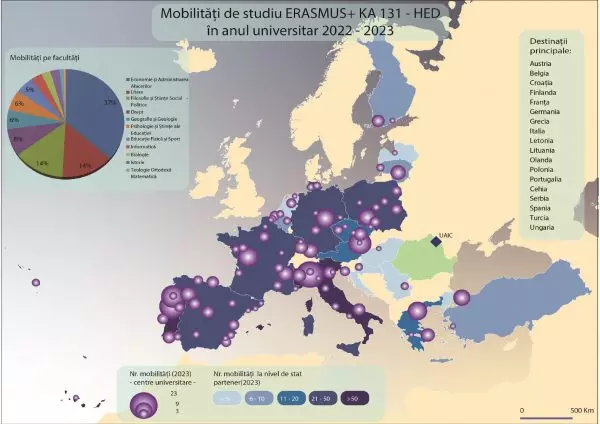
Destinations by country for students who carried out ERASMUS+ study mobilities in the 2022 – 2023 academic year
Pre-selection presentations:
- 2022 Erasmus+ STUDY Mobilities
- 2020 Erasmus Study and Traineeship Presentation
- 2017-2019 Erasmus+ Traineeship and Study
- 2016-2018 Erasmus+ Traineeship and Study
- Erasmus+ Information Presentation, May 2015
- 2015-2016 Erasmus+ Selection Presentation, March 25, 2014
- Presentation on travel formalities – November 10, 2022
- Presentation on travel formalities – November 12, 2021
- Presentation on travel formalities – November 6, 2020
- Presentation on travel formalities – November 14, 2019
- Presentation on travel formalities – November 21, 2018
- Presentation on travel formalities – November 16, 2017
- Presentation on travel formalities – November 8, 2016
- Presentation on travel formalities – April 26, 2016
- Presentation on travel formalities – November 11, 2015
- Presentation on travel formalities – April 23, 2015
CONTACT
Department of International Relations“Alexandru Ioan Cuza” University of Iași
11 Carol I Boulevard 700506 – IASI / ROMANIA
Fax: 0232 20 1802
Email: relint(at)uaic.ro

The content of this material is the sole responsibility of the authors, and the National Agency and the European Commission are not responsible for any use which may be made of the information contained therein.


 Serviciul Relaţii Internaţionale, Universitatea Alexandru Ioan Cuza din Iași, Bulevardul Carol I, Nr. 11, Corp A, Iaşi, România, Telefon: 0040. 232. 20 1111, Fax: 0232. 20 1802, Email: relint@uaic.ro
